What Had Austrian Priest Joseph Tieffenthaler Documented About Ram Janmbhoomi 250 Years Ago?
When Austrian Priest Joseph Tieffenthaler arrived in Ayodhya, walking through its narrow lanes, he could see remnants of temples and ancient markings scattered everywhere.

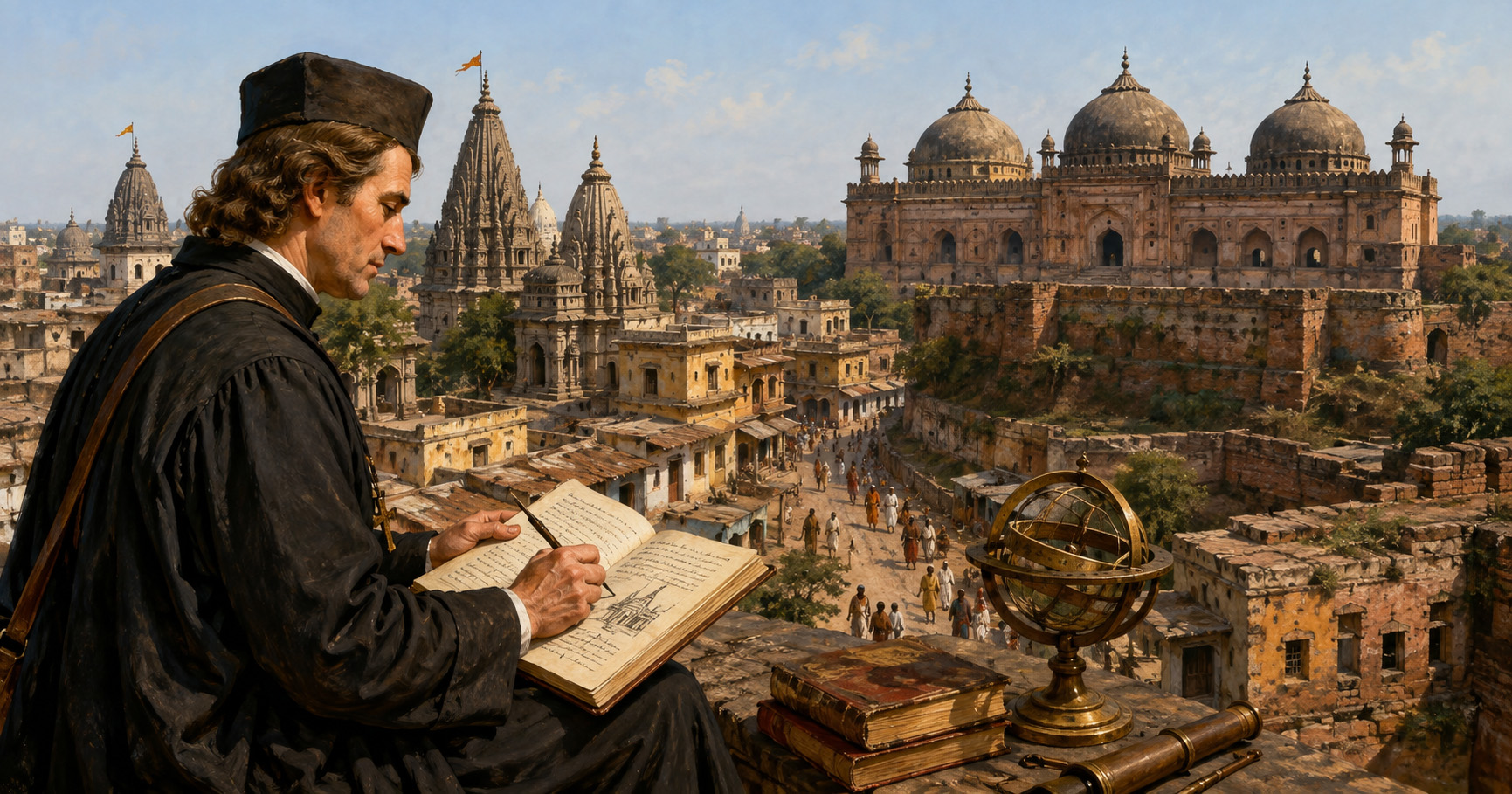
Austrian Jesuit priest Joseph Tieffenthaler | This image is AI-generated
About two hundred and fifty years ago, an Austrian Jesuit priest set foot on Indian soil: Joseph Tieffenthaler. He was not merely a religious missionary, but also an accomplished mathematician, astronomer, and extraordinary geographer. Possessing mastery over several languages, including Latin, French, Persian, and Sanskrit, Tieffenthaler studied the history and geography of India with meticulous detail. He spent nearly four decades in India, from 1743 to 1785. It was during this time, between 1766 and 1771, that he toured the province of Awadh (Ayodhya) and recorded some historically immortal and significant references in his diary.
When Tieffenthaler arrived in Ayodhya, walking through its narrow lanes, he could see remnants of temples and ancient markings scattered everywhere. As he walked further, his steps led him toward a vast area that the locals referred to as 'Ramkot'—an ancient and magnificent fort. However, the old fort was no longer there. The Mughal ruler Aurangzeb (and according to some, Babur) had demolished that historical fort and erected a Muslim structure with triple domes in its place. He documented all of this with utmost care.
Upon closer observation, he noticed that even though a mosque had been erected in place of the demolished temple, its pillars had still not hidden their history. Inside the structure, fourteen ancient pillars of black stone, standing five spans high, still stood in all their grandeur; twelve of these pillars supported the inner arches of the mosque. These pillars stood as a silent testimony to the existence of the ancient temple.


The above images are sets of historic architectural sketches and site layouts of Ayodhya created by the Austrian Jesuit missionary, Joseph Tiefenthaler, during his travels to India between 1766 and 1771.
While observing this entire complex, one specific spot caught Tieffenthaler's attention. Inside the mosque, on the left side, there was a square platform raised 5 inches above the ground, bordered with lime. This area was roughly 5 spans long and 4 spans wide. The local Hindu residents revered this place with immense devotion as the 'Bedi' (the cradle). It was the firm belief of the Hindus that Lord Rama had manifested in human form at this very spot, and that his ancestral home once stood there.
Although the Mughal rulers had demolished the original house to destroy the faith of the Hindus and to prevent them from worshipping there, the devotion of the Hindus was so profound that they never abandoned their tradition, even under such hostile conditions. Tieffenthaler himself witnessed that even during those times, Hindu devotees would visit the site, perform three circumambulations (pradakshinas) around that sacred spot, and prostrate themselves on the ground in deep reverence. To protect this sacred space, a low wall had been built around it, with a small semicircular doorway providing entry.
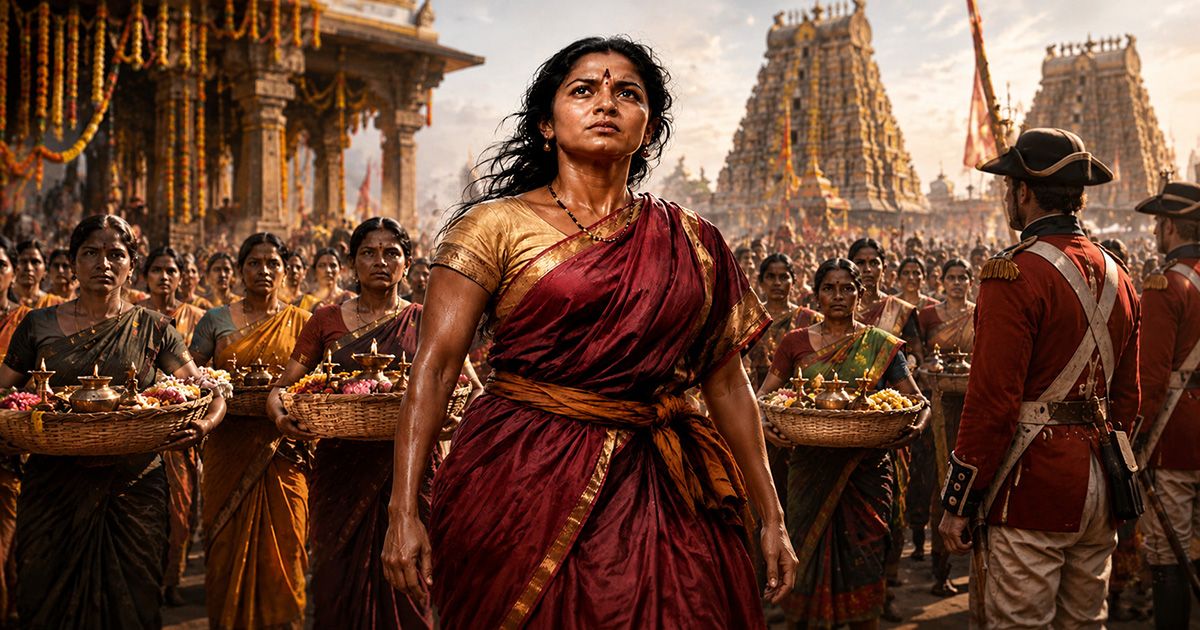
Tieffenthaler witnessed the most magnificent manifestation of this unwavering Hindu tradition on the day of 'Ram Navami'. He recorded that on the 24th day of the month of 'Chaitra', which is Ram Navami, an immense gathering of Hindu devotees from all over India would assemble at this site to celebrate the birth anniversary of Lord Rama. Remarkably, while Tieffenthaler observed the Hindus worshipping and celebrating with absolute devotion, he made no mention anywhere in his records of Muslims offering Namaz at that place.
Joseph Tieffenthaler honestly documented this eyewitness truth in his monumental work, Descriptio Indiae. Great scholars of Europe highly acclaimed his work. In later times, certain leftist historians attempted to downplay his significance by dismissing him as an "obscure traveler"; nevertheless, the true account recorded by Tieffenthaler, along with the maps he prepared and the evidence he provided, remains today the most authentic, impartial, and solid proof of the struggle for the Ram Mandir in Ayodhya and the unbroken faith of the Hindus.