The First Battle Against Triple Talaq: When Hamid Dalwai Took to the Streets of Mumbai with Seven Women and Shook the Orthodox Establishment
A single word, "talaq", could destroy a marriage, leaving women homeless and helpless. There was almost no legal support available for them.

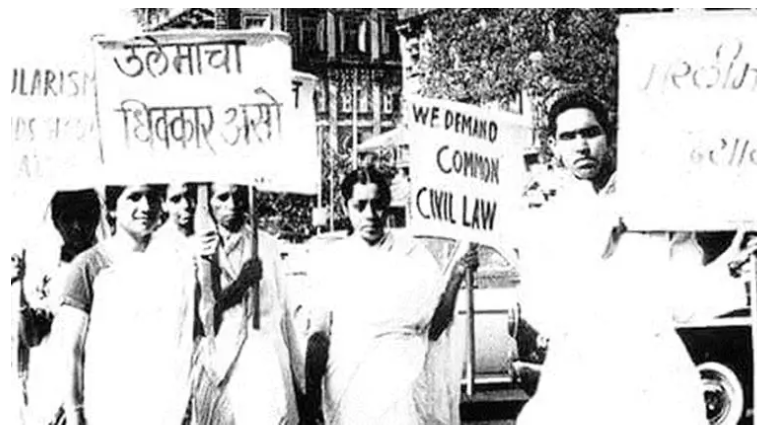
Hamid Dalwai leading a march in Mumbai with women against triple talaq | Image Source: The Indian Express
Religious orthodoxy within Islam has long been seen as a challenge to social reform, and one of its most controversial practices was triple talaq. But during the 1960s, a powerful voice rose from within the Muslim community itself against this practice — a voice that disturbed influential clerics and orthodox leaders alike. That voice belonged to Hamid Dalwai.
In the 1960s, India was moving toward democratic values and a modern Constitution after independence, yet Muslim women continued to suffer because of the deeply unequal practice of instant triple talaq. A single word, "talaq", could destroy a marriage, leaving women homeless and helpless. There was almost no legal support available for them. Large sections of Muslim society defended the practice as a religious tradition.
In such an atmosphere, Hamid Dalwai realized that unless someone challenged this injustice, future generations of women would continue to live in the same darkness. Dalwai did not believe that writing articles or giving speeches alone was enough. He chose direct action. In 1965, he founded an organization called Sada-e-Niswan and began reaching out to women affected by triple talaq. Then, on 18 April 1966, Mumbai witnessed a historic moment when Hamid Dalwai led seven Muslim women in the first public protest march against triple talaq.
The number of women may have been small, but their courage was immense. At that time, for a Muslim woman to publicly oppose triple talaq was considered nothing less than rebellion. These women submitted a memorandum to Maharashtra’s then-Chief Minister Vasantrao Naik demanding a ban on triple talaq, polygamy, and halala. It became the first organized movement in India for Muslim women’s rights.
Hamid Dalwai stood almost alone behind this movement. Orthodox groups branded him an “enemy of religion.” Thousands of Muslim women were mobilized in rallies against him by conservative leaders. In 1971, orthodox elements even formed the All India Muslim Personal Law Protection Committee. But Dalwai refused to back down. He openly stated that issues like marriage and triple talaq were not merely religious matters, but questions related to human dignity and constitutional rights. He clearly told the orthodox leadership that Muslim society could never progress unless women were granted equal rights.
Hamid Dalwai’s greatest strength was his rational and constitutional approach. He understood that emotional speeches alone could not bring real change. He organized meetings of divorced women, brought their stories before society, and explained how triple talaq was not just a religious practice, but a serious injustice against women. Dalwai also argued that abolishing triple talaq alone would not be enough — practices like polygamy and halala also needed reform.
To carry this mission forward, he established the Muslim Satyashodhak Mandal in 1970. The organization aimed to spread awareness about social reform and women’s rights within Muslim society. Dalwai traveled from village to village and city to city, educating women and promoting modern education, scientific thinking, and constitutional values. But this struggle came at a high personal cost. Orthodox groups continuously targeted him. Even his wife, Mehrunnisa Dalwai, faced social boycott. Attempts were made to stop him from speaking at public gatherings. The hostility did not end even after his death.
On 3 May 1977, Hamid Dalwai passed away at the age of just 44. Even then, some orthodox elements behaved disrespectfully toward him because he had expressed his wish to have his last rites performed according to Hindu customs.
Today, when India passed the law against triple talaq on 30 July 2019, it was, in many ways, the result of the struggle that Hamid Dalwai had started decades earlier. He raised his voice at a time when doing so was seen as standing against his own community. He proved that true reform means standing by truth even under difficult circumstances. Hamid Dalwai’s movement was not only against triple talaq — it was a larger fight for women’s dignity, equality, and justice.
The footsteps of those seven women who marched through the streets of Mumbai became the first sign of a change that would eventually lead to the end of triple talaq across the country forever.