Simla Agreement 1972: How a Midnight Conversation Resulted in the Signing of the Agreement, but Later Turned Into Pakistan’s Biggest Unkept Promises
The meeting for negotiations between the two leaders began on June 28, 1972, and continued till June 30, without any consensus. The next day, on July 1, 1972, the two leaders reached a deadlock, which was later described as the most uncertain and fragile phase of the negotiations.

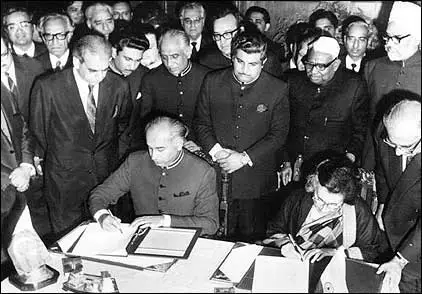
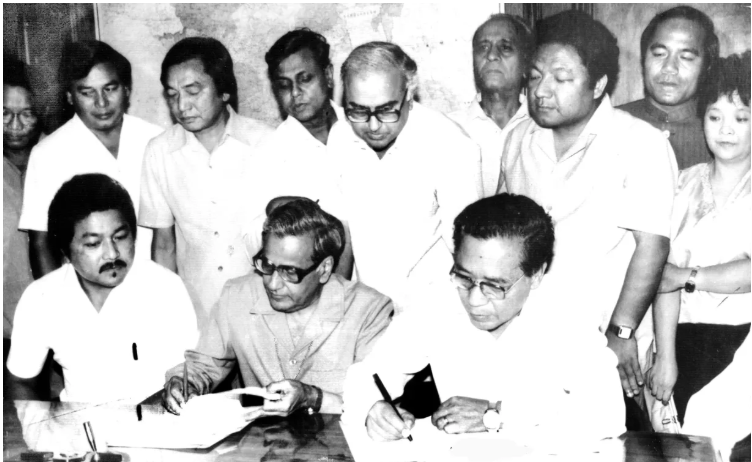
The Signing of the Simla Agreement in 1972 | Image Source: Asia Times
In December 1971, a monumental war had just ended. India had achieved a historic, decisive victory on the battlefield—a victory that changed the map of the subcontinent and left New Delhi holding all the leverage: vast territories of captured land and over 93,000 Pakistani prisoners of war. It was this massive loss for Pakistan that brought its President, Zulfikar Ali Bhutto, to the hills of Shimla, India, in July 1972 to strike a deal favouring the defeated nation—famously known as the Simla Agreement of July 3, 1972. The venue was Barnes Court, presently the Himachal Raj Bhavan. However, only a few are aware of what led to this breakthrough. It was not the diplomatic negotiations held at the table, but off-camera casual talks after the dinner that led to the major turning point for an otherwise almost-failed discussion. What happened during these private talks is exactly what we will be telling you today.
When Diplomacy Almost Failed
The meeting for negotiations between the two leaders began on June 28, 1972, and continued till June 30, without any consensus. The next day, on July 1, 1972, the two leaders reached a deadlock, which was later described as the most uncertain and fragile phase of the negotiations. On the Indian side were Foreign Minister Swaran Singh and Foreign Secretary Triloki Nath Kaul, while Pakistan was represented by Aziz Ahmad and Aftab Ahmad. However, despite hours of engagement, the two sides were unable to identify a workable framework. The point of contention between both sides included the repatriation of 93,000 Pakistani Prisoners of War (POWs) and the conversion of the 1949 ceasefire line into a permanent boundary, or the Line of Control (LoC). The inability to agree on even a preliminary framework pushed the talks, yet again, to the next day.
On July 2nd, the negotiations began again. Since it was the last day that the leaders were here, both teams worked hard to draft a declaration denoting the outcome. Yet, nothing fruitful came. Officials struggled to even draft a joint declaration. Yet, keeping the momentum, the two sides sat for a formal dinner. It was then that the turning point came.
The After-Dinner Pivot
The ministers on both sides were utterly exhausted. A stubborn, unyielding deadlock had been reached. Defeated and weary, the diplomats retired to their rooms, assuming that the next morning would bring a public confession of total failure. But true breakthroughs rarely happen at loud, crowded tables. They happen in the quiet, unseen spaces where human beings face each other without their armor.
On the night of July 2nd, a little after the formal dinner at the Barnes Court, both leaders had a casual discussion later that night, a moment the Pakistani publication, Dawn, has described as when “the impasse suddenly broke.” However, as it was a private, one-on-one conversation between the two leaders without any diplomats around, it found no mention in the official records. What is known about that night comes from the aides and bureaucrats close to the two leaders. On this night, a breakthrough would indeed be achieved—born from an act of profound grace, but destined to become one of history’s greatest unkept promises.
Pakistan President Zulfikar Ali Bhutto (left) and Indian Prime Minister Indira Gandhi (right) | Image Source: India Today 
Then-bureaucrat M.K. Kaw—who was tasked to look after a young Benazir Bhutto, Zulfikar Ali Bhutto’s daughter, who had come with him to India—has vivid memories of that moment. He recalled that after the talks collapsed and everyone went back to their rooms, Bhutto arrived at Indira Gandhi’s room, “fell at her feet”, and told her that he could not go back home unless India released Pakistan’s POWs. "He told Gandhi that he would be lynched if he went without an honourable pact and pleaded with her to show the way,” Kaw stated.
At the time, Gandhi told Bhutto that she wanted the LoC converted into an international border. The Indian PM outrightly told the Pakistani President that if she got this in writing, she would accept all of his demands. It was at this moment that everything changed. As P.N. Dhar, the then secretary to Indira Gandhi, reveals, the Indian PM asked Bhutto if this was the understanding on which to proceed. To this, Bhutto had replied, "Absolutely! Aap mujh par bharosa keejiye (trust me)." Kaw stated that Gandhi fell for Bhutto’s persuasive talks.
Immediately after this, the two leaders, Indira Gandhi and Zulfikar Ali Bhutto, went to the main hall and summoned their respective officials, P. N. Dhar and Aziz Ahmad. They sat over the vaguely drafted text and gave a final touch to it. Finally, both sides agreed, and the document was set for the signatories. At this point, the rest of the diplomats were called in, and the accord was formally signed 40 minutes past midnight, i.e., at 12.40 AM of July 3, 1972.
India released the ninety-three thousand prisoners of war and returned the captured lands, operating from a place of immense grace, hoping this grand gesture would lay the foundation for a permanent, lasting friendship between the two nations.
The Unkept Promise
Nonetheless, Kaw was right—Gandhi did fall for Bhutto’s persuasive talks, as he never kept his word. Since then, Pakistan has been breaching the Simla Agreement by arming and infiltrating militants across the LoC into India, even sending its soldiers to alter the status quo on the ground during the 1999 Kargil conflict, and by repeatedly raising the Kashmir issue at the United Nations and OIC meetings to internationalize a bilateral conflict. In fact, following the 2025 Pahalgam attack, where Pakistani terrorists killed 26 innocent lives in broad daylight, the country announced the “suspension” of the Simla Agreement. However, it is a stark irony because a country that has been regularly breaching the agreement has no right to “suspend” the same.
More than 50 years later, the midnight meeting at Shimla stands as a timeless reminder that while a war can be won with strength, enduring peace can only be sustained when a promise is fiercely protected by both sides.