Two Sisters Who Hunted Down 21 British Soldiers: The Santhal Rebellion Led by Phulo-Jhano
The agony behind this struggle was no ordinary one. The British had occupied the lands of the Santhal janjaatis, who had lived freely for generations in Jharkhand.

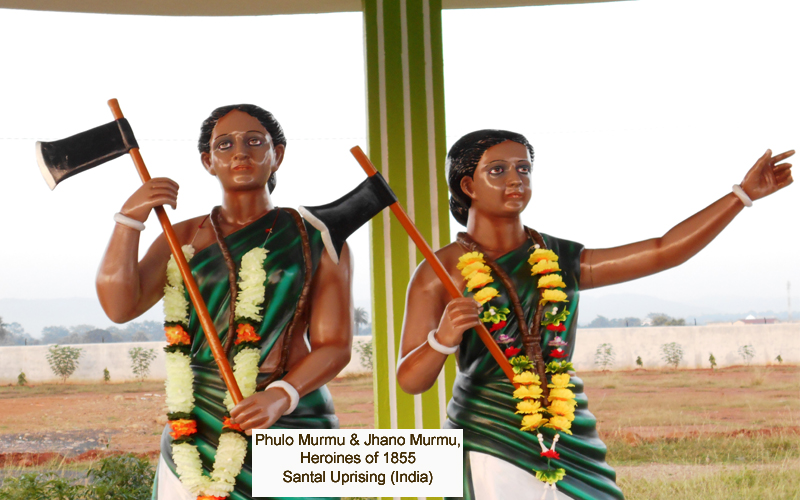
Santhal Tribal Heroines, Phulo Murmu and Jhano Murmu | Image Source: Tribal Darshan
Empires always take pride in their military might, but this is a roar that proves how insignificant that pride is in the face of self-respect. In 1855, the forests of Jharkhand, two young bolts of lightning charged toward a British military camp that was gloating in its perceived invincibility with modern Enfield rifles. They were heroines who moved as if the Forest Mother herself had taken a fierce form, sharp axes in their hands, volcanoes in their eyes. By dawn, the heads of 21 British soldiers were severed from their bodies. This 'carnage,' unheard of in the history of world warfare, was created by none other than the sisters of Sidhu-Kanhu—Phulo Murmu and Jhano Murmu.
The Agony Behind the Revolution
The agony behind this struggle was no ordinary one. The British had occupied the lands of the Santhal janjaatis, who had lived freely for generations in the Rajmahal Hills of Jharkhand. As zamindars and moneylenders (Dikus) conspired to loot the labor and dignity of the janjaatis, the Forest Mother wailed. When their hamlets were set ablaze before their eyes, and the British snatched food from the mouths of infants, the revenge born from that gut-wrenching pain erupted as the 'Hul' rebellion on June 30, 1855. At the call of four brothers—Sidhu, Kanhu Murmu, Chand, and Bhairav—more than 10,000 Santhals declared war against British rule.
However, those who left a mark as strong as, or even stronger than, the men in this war were Phulo and Jhano Murmu. Disliking the idea of being mere assistants to their brothers in the Hul war, Phulo-Jhano Murmu personally stepped onto the battlefield. Nature had taught them from birth which turn lay behind which tree in the forest and how to hunt the enemy in the darkness. They decided to use that very knowledge for the liberation of their community.
The Night of the Axe: A Guerrilla Masterclass
In the first week of July 1855, the rebellion had begun, and the entire forest was simmering. The British army had set up massive camps, equipped with sophisticated weapons. Exactly at that time, Phulo and Jhano moved like snakes through the dense bushes of the forest. They had more faith in the axes in their hands than in the aim of the enemy’s gun. Those two heroines executed a guerrilla war tactic that night, which is possible only for a very few.
Severed Heads and Shaken Empires
They lunged like lightning into the silent camp. Before the enemy could open their eyes and aim their guns, the strokes of their axes had slashed their throats. In that single night, the two sisters together beheaded a staggering 21 soldiers. This was not just an act of killing; it was a great struggle for the identity of a race. Seeing those children of the forest standing at dawn with blood-stained axes and fierce forms, the British army trembled with fear for the first time. They proved that a woman is not just the love of nature, but also the Goddess Kali, who moves at the command of Lord Shiva during the time of apocalypse.
Martyrdom and the Seeds of Independence
Statues of Sidho And Kanho at Birsa Memorial Museum and Park in Ranchi | Image Source: The Indian Tribal
The British rulers were suddenly jolted by this incident. They summoned thousands of troops and heavy artillery to blockade the forest. They fired indiscriminately at the Santhal heroes. In that fierce struggle, Phulo and Jhano, along with Sidhu and Kanhu, did not surrender. Showing their chests to the enemy's bullets, they attained martyrdom in the lap of their motherland. The blood they shed in late 1855 did not go to waste; it provided a strong foundation and inspiration for the nationwide freedom revolution that was to take place in 1857.