How Guru Hargobind Sahib Raised a Sikh Army and Challenged the Mughals Directly
With this conviction, Guru Hargobind introduced the philosophy of “Miri–Piri”—a balance between spiritual power (Piri) and worldly, temporal authority (Miri).

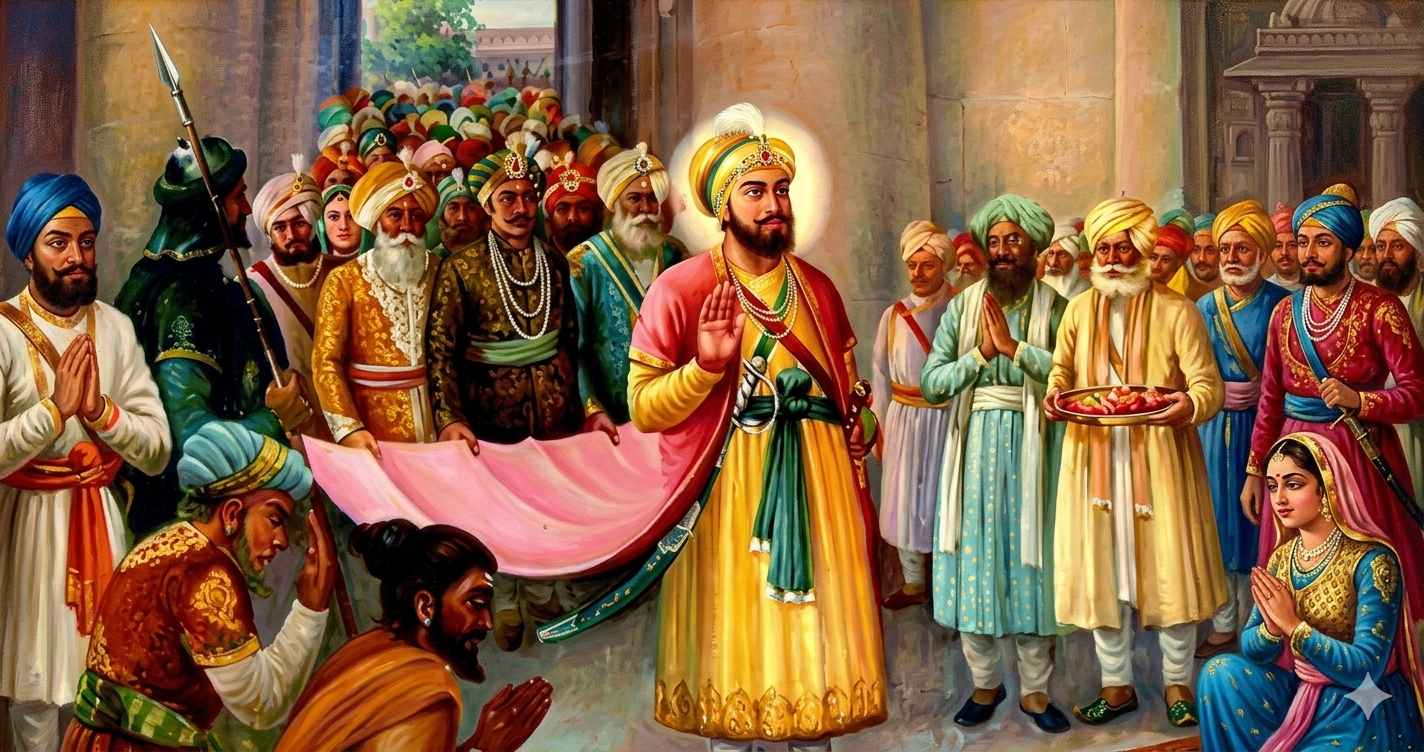
“Bandi Chhorh”—the Liberator of Prisoners | Image Source: Sikhnet
Can an eleven‑year‑old boy change the very soul of a community? Can a tradition of devotion suddenly rise, raise the sword, and stand fearlessly against injustice? In Sikh history, such a decisive turning point came when the tradition of the “saint turned soldier” was born. This was not a sudden revolution of the sword, but one shaped by pain, sacrifice, and a deep, far‑seeing vision. And it all began with how Guru Hargobind Sahib transformed the Sikhs from mere devotees into courageous warriors.
Guru Hargobind Sahib was born on 19 June 1595 in the village of Guru Ki Wadali, near Amritsar. He was the son of Guru Arjan Dev Ji, the fifth Sikh Guru. Even in childhood, his life seemed to blend spirituality and courage: he was deeply devoted, yet trained in the arts of war. Under the guidance of Baba Buddha Ji, he learnt the art of the sword, and from Bhai Gurdas Ji he absorbed the deep wisdom of the Gurbani.
For years, life flowed peacefully. But in 1606, a catastrophe shook everything. On the orders of the Mughal Emperor Jahangir, Guru Arjan Dev Ji was martyred. This was far more than the killing of a Guru; it was a blow to the very self‑respect of the entire Sikh community.
Guru Hargobind Sahib was just eleven years old that year, yet he grasped the cruel reality of the moment. He realized that in the face of such tyranny, devotion alone would not be enough; the protection of faith now demanded strength and power as well.
The Concept of “Miri–Piri”
With this conviction, Guru Hargobind introduced the philosophy of “Miri–Piri”—a balance between spiritual power (Piri) and worldly, temporal authority (Miri). He wore two swords at his side: one symbolizing Miri, the political and military power to defend the righteous, and the other symbolizing Piri, the spiritual authority that guided the soul.
Miri-Piri System | Image Source: Sikh Wisdom
He also laid the foundation of the Akal Takht in Amritsar—a seat of justice and political authority for the Sikh community. The Akal Takht became both the center of military strength and a platform from which the unjust orders of oppressors could be challenged.
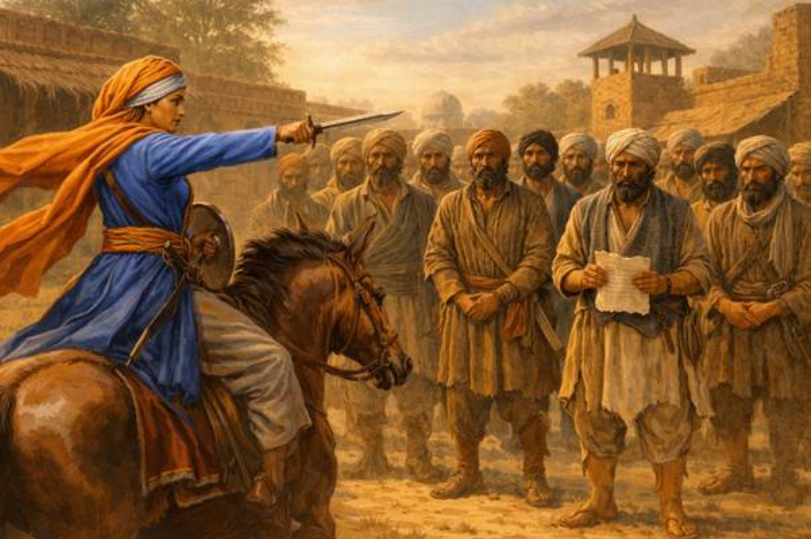
After this, Guru Hargobind Sahib began training the Sikhs in martial arts, horsemanship, and warfare. He gathered farmers, saints, and young men and turned them into a disciplined force called the Akal Sena, a small army, perhaps, but one unmatched in discipline, bravery, and loyalty.
Historians note that the Guru had around 700 horses, with about 300 mounted soldiers and 60 musketeers guarding his person. He had fortifications built around Amritsar and erected the strong fortress of Lohgarh. The very sight of this growing strength unsettled the Mughal court. The message was now clear: The Sikhs were no longer just a peaceful religious order; they were becoming an organized, armed power.
Aware of the rising Sikh power, jealous voices filled Emperor Jahangir’s ears. False reports claimed that Guru Hargobind was raising an army for rebellion. The Emperor, already wary of Sikhs after the execution of Guru Arjan, summoned the Guru to Delhi.
In January 1613, the Guru arrived in the Mughal capital. He explained his principles of justice, service, and righteous resistance, but Jahangir, driven by suspicion, ordered his imprisonment in Gwalior Fort. The Guru was locked in the fortress on charges of plotting revolt.
For nearly six years, he remained a political prisoner in Gwalior, alongside 52 Hindu kings unjustly held there. Yet even in chains, his spirit never broke. When Jahangir finally agreed to release him, the Guru refused to leave alone. He declared that he would walk out only with the 52 captive kings.
Jahangir, perhaps amused by the Guru’s audacity, laid down a condition: only as many kings as could hold on to the folds of the Guru’s robe while he exited the gates would be freed. The Guru had a cloak specially made with 52 tassels. As he walked out, each king held one of the tassels, and all 52 princes were liberated. That is why he came to be known as “Bandi Chhorh”—the Liberator of Prisoners.
After his return from Gwalior, Guru Hargobind saw clearly that resistance to injustice had become a sacred duty. He further strengthened his army and led the Sikhs into several battles: the War of Rohilla, the Battle of Kartarpur, and the Battle of Gurudwara—each a victory against the Mughals, each a step in the Sikh assertion of dignity and justice.
“Bandi Chhorh”—the Liberator of Prisoners | Image Source: Sikhnet
Under his guidance, the Sikhs embraced the identity of the “Saint‑Soldier” (Sant‑Sipahi)—men who could meditate in the morning and yet march into battle in the evening, ready to defend the weak and the truth. This same spirit would later become the bedrock of the Khalsa under Guru Gobind Singh Ji.
The Message for Today
The story of Guru Hargobind Sahib teaches a timeless truth: when injustice crosses all limits, the act of resistance becomes a sacred duty. His life is not just a historical narrative; it is a message for our time as well—that self‑respect, courage, and the will to stand up for justice are the very essence of true humanity.
From the sword of Miri and the rosary of Piri, he showed the world that a devotee can also be a warrior, and that a true spiritual path is incomplete without the courage to defend the truth.
.jpg)