The Silent Architect of Peace: The Untold Story Behind the Mizoram Peace Accord of 1986
A landmark peace deal was signed on 30 June 1986, ending one of the longest insurgencies in independent India.

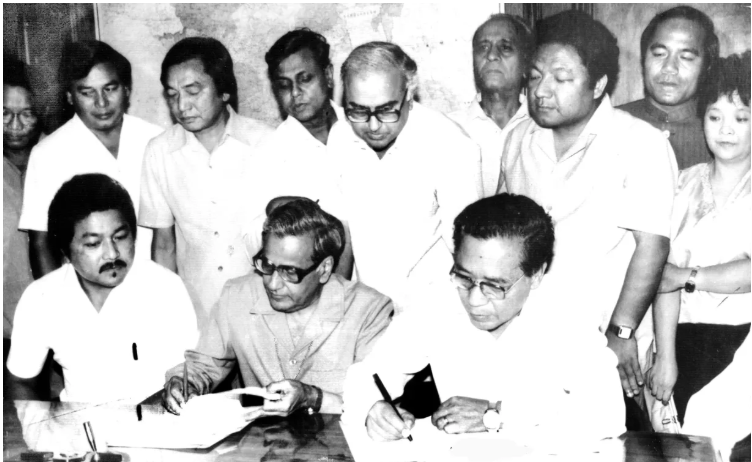
Then-Home Secretary R.D. Pradhan and MNF chief Laldenga signing the Mizoram Peace Accord | Image source: The Better India
A landmark peace deal was signed on 30 June 1986, ending one of the longest insurgencies in independent India. Today, the Mizoram Peace Accord is widely celebrated as India’s most successful reconciliation with an armed rebel group, but hidden behind its bold signatures is a far more human story—the quiet, tireless work of one Indian bureaucrat the world rarely names.
That man was R.D. Pradhan, who, as Union Home Secretary, wove together patience, empathy, and political wisdom to bring two decades of bloodshed in Mizoram to an end. The Mizoram Accord was not just an administrative triumph; it was the fruit of fragile trust, intimate dialogue, and deep emotional sensitivity.
The story begins long before the signing. The Mizo insurgency erupted violently on 28 February 1966, when around a thousand fighters of the Mizo National Front (MNF) stormed Aizawl’s BSF and Assam Rifles camp at 10:30 p.m. Under MNF leader Laldenga, they cut telephone lines, seized the treasury and other key government buildings, and declared their demand: Full independence for Mizoram.
The Indian Air Force responded with force to crush the rebellion. Laldenga fled to East Pakistan (later Bangladesh), from where he continued to direct the insurgency. The MNF switched to guerrilla warfare, striking security forces and blending seamlessly into local communities, making operations extremely difficult for Indian troops.
Between 4 January and 15 February 1967 alone, 75 security personnel were martyred, and over 100 rebels died in encounters. For the next two decades, the hills of Mizoram echoed with gunfire, blasts, and fear.
In January 1985, after the assassination of Indira Gandhi and the rise of Rajiv Gandhi as Prime Minister, a new approach was sought. The Government of India appointed R.D. Pradhan as Union Home Secretary—the top internal security official of the country. His task was to find a way to end the two‑decade‑long Mizo conflict without further bloodshed.
Pradhan did not treat the challenge as a mere “law‑and‑order” problem. Instead of sitting in a Delhi office drafting orders, he visited Mizoram, walked the land, and met local leaders and people. He studied the region through aerial surveys, spoke to villagers, and listened to stories of loss, dignity, and identity. Through these conversations, he understood that the conflict was not merely political or territorial; it was about a people’s desire for recognition, self‑esteem, and cultural pride.
Armed with this insight, Pradhan began crafting a sensitive surrender and integration process for the insurgents—ensuring that those who had carried weapons for years would not be humiliated, but welcomed back into the mainstream.
Pradhan reached out directly to Laldenga and his close associates, initiating quiet talks with a human‑centred approach. The Government made it clear that their arms would be accepted, and in return, they would be granted amnesty, rehabilitation, and political space.
As these talks progressed, the winds of change began to blow in Laldenga’s camp. By February 1986, even Laldenga—who had been living in exile—was eager to return to India and see if a peaceful resolution was possible.
June 1986 marked the decisive turn. R.D. Pradhan was on the verge of retirement, yet he refused to hand over the peace process halfway. He pushed ahead, telling Laldenga that the coming accord was not just a “paper agreement,” but the key to Mizoram’s future—economic development, stable governance, and a dignified life for the Mizo people.
Pradhan also convinced Prime Minister Rajiv Gandhi that the time had come to press for a final agreement with the rebel leader. On 25 June, Rajiv Gandhi summoned Lal Thanhawla, then Chief Minister of Mizoram, along with his entire cabinet, to Delhi. In that same meeting, at Pradhan’s suggestion, Laldenga was invited for direct talks with the Prime Minister, a meeting that, though incomplete, sowed the seeds for the final breakthrough.
Though the first high‑level talks did not yield an immediate agreement, Pradhan did not lose hope. He shifted to Plan B, continuing his quiet diplomacy. On 26 June, his persistence paid off: Laldenga arrived in Delhi himself to meet him. The two spent hours speaking about the hopes and fears of the Mizo people. Laldenga asked for genuine political guarantees, and Pradhan moved swiftly, taking him to Home Minister Buta Singh and securing firm assurances on the resolution of pending issues.
On 27 June, on Pradhan’s birthday, he invited Laldenga to his home for tea. Over that quiet, intimate conversation, Laldenga finally agreed to the peace terms—though he insisted on consulting his legal advisor Swaraj Kaushal, and other colleagues before the formal signing.
Even as the date approached, Pradhan engaged in parallel talks with Laldenga’s inner circle, ensuring that the entire leadership was on the same page. As a result, on June 30 1986, the accord was ultimately signed, 750 MNF fighters simultaneously surrendered their weapons and chose to rejoin mainstream life.
By 30 June 1986, R.D. Pradhan was technically retired, having completed his term that morning. But Prime Minister Rajiv Gandhi held a special Cabinet meeting to extend his tenure just long enough to sign the historic accord. At 9:30 p.m., before cameras and witnesses, the document was signed by Laldenga for the MNF, R.D. Pradhan for the Government of India, and Mizoram Chief Secretary Lalkhama for the state government. The Mizoram Peace Accord, 1986, was born.
However, the initiative for this peace had been underway for decades. While the Indian government had, on one side, assigned administrative officials the responsibility of finding a solution to suppress the insurgency through diplomatic means, it had also, behind the scenes, deployed intelligence agencies to work quietly from within—and that responsibility lay in the hands of Ajit Doval. During the period 1972–1974, while stationed in Mizoram, he had persuaded six of the principal associates of Laldenga, the leader of the rebellion, to agree to a peace settlement.
For the Mizoram peace accord, whereas R. D. Pradhan led the negotiations on the diplomatic front, Ajit Doval, operating as an intelligence officer, played a crucial role in breaking up the rebel ranks, sowing divisions among the insurgents, and thereby helping bring the insurgency to an end.