The Shared Legacy of Bamiyan Buddhas and Somnath: An Icon that Outlived Invaders Till 2001

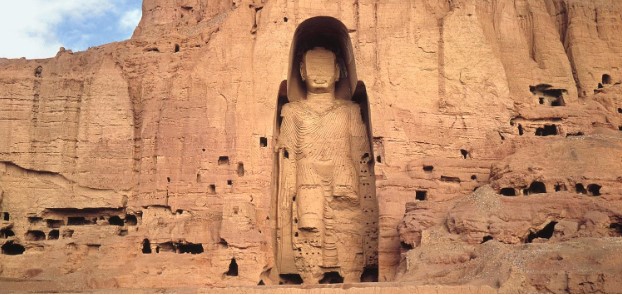
The larger of the two giant statues prior to their destruction by the Taliban | Image Source: Harvard University
Long before the Taliban destroyed the Bamiyan Buddhas in 2001, every invader who came to India tried to smash these giant statues. Each attacker, from Mahmud of Ghazni to others crossing the Khyber Pass, saw the huge rock Buddhas in Afghanistan as idols that had to be broken.
Mahmud started it between 1001 and 1006 AD while fighting in Afghanistan. He damaged Bamiyan's big Buddhas to show power and earn the name "idol-breaker." Nearly 20 years later, in 1025 AD, he attacked India's Somnath Temple, broke its holy center, and stole its gold and jewels. The same ideological compulsion that leveled Somnath had its first rehearsal in the caves of Afghanistan. This act of destruction was not an isolated crime; it was the opening chapter of a long, systematic campaign rooted in history.
The Ghaznavid Mindset:
The Genesis of Intolerance Mahmud of Ghazni’s unrelenting hostility toward other faiths made the Bamiyan Buddhas an early target. Standing at a staggering 55 meters, the physical destruction of these stone giants was beyond his 11th-century technical capability. Frustrated by their scale, he satisfied his 'But-shikan' impulse by looting the surrounding Buddhist monasteries and stealing priceless artifacts. Ghazni established a pattern that subsequent invaders would follow: The urge to erase any visible reminders of civilizations that did not conform to their theology.
This pattern did not end with Ghazni. From Babur to Aurangzeb, every wave of conquest carried a familiar impulse to desecrate symbols of the divine. While Babur justified temple destruction in the Baburnama, it was Aurangzeb in the 17th century who brought this fanaticism back to Bamiyan with brutal force. Using the same cruelty with which he demolished thousands of Indian temples like Kashi Vishwanath and Mathura, he deployed heavy artillery against the Bamiyan Buddhas. He ordered his cannons to fire upon the statues, specifically targeting their faces and legs to ensure they were permanently disfigured.
Relentless Assaults by Persian and Afghan Invaders
In the 18th century, the Persian invader Nadir Shah reportedly shelled the statues with cannons during his march to loot Delhi. This was followed in the 19th century by the Afghan ruler Amir Abdur Rahman Khan, who used fire-guns to further mutilate the Buddhas' faces. For a thousand years, these icons were subjected to continuous assaults. While their massive stone structures survived as scarred remnants, the intent of every invader remained the same—unrelenting hostility toward the representation of faiths other than their own.
The 2001 Taliban Culmination:
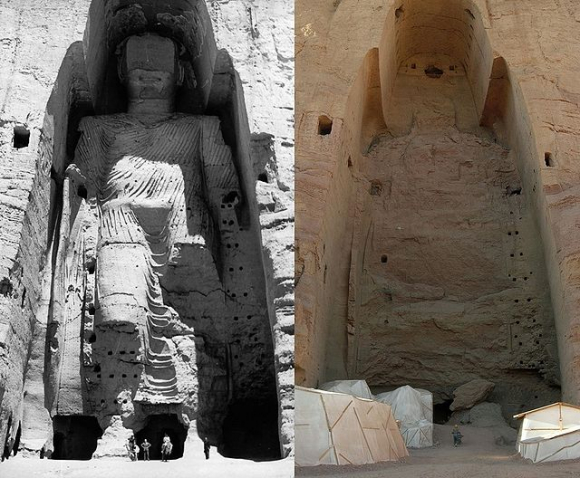
Before the destruction (1963) and after the destruction (2008) | Image Source: journals.openedition
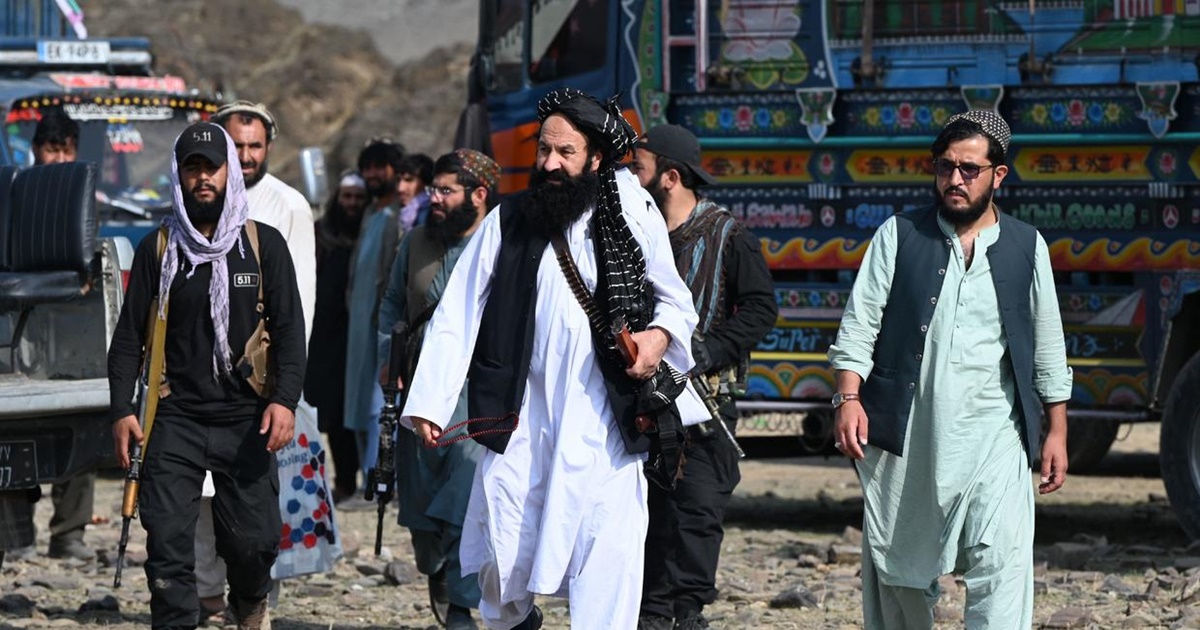
On March 2, 2001, that millennium-old mindset reached its most violent culmination. The Bamiyan Valley echoed with the cries of “Allahu Akbar” as the Taliban declared a 1,500-year-old masterpiece of human heritage to be nothing more than “false idols.” They justified their destruction with their religious explanation that keeping the statues is a "sin". They first tried to bring down the statues with guns and cannons, but they failed. They announced that they would sacrifice 100 cows as "atonement" (Kaffara) for the obstacles and delays in demolishing the giant statues. Initially, 12 cows were slaughtered in the courtyard of the Afghan presidential palace. The remaining cows were sacrificed in other parts of the country.
The Taliban, who initially failed to remove the historical monuments, then brought in a large amount of explosives. It took them three days to plant the explosives around the statues. The wires controlling the explosion were stretched to a nearby mosque. From there, the statues were blown up amidst chants of "Allahu Akbar." It took them about 25 days to completely raze the statues. After the destruction was complete, the Taliban celebrated by shooting in the air and dancing. As part of the celebrations, they sacrificed nine cows again. Using tons of high explosives, anti-tank mines, and rockets, they achieved what medieval invaders could only dream of. This was the final chapter of a systematic war against history—an obsession with becoming a 'But-shikan' that finally reduced the giants to dust.

.jpg)