Why Glorifying Tipu Sultan as a Hero Overlooks His Crimes Against Hindus and Distorts Indian History

On November 5, 2025, the Indian Union Muslim League (IUML) urged the Karnataka Congress government to organize a grand Tipu Jayanti on November 10, accusing the state of neglecting the event for the past two years. IUML leader C. Abdul Rahiman described Tipu Sultan as a patriot and warned that Congress leaders should resign if the celebration is not held.

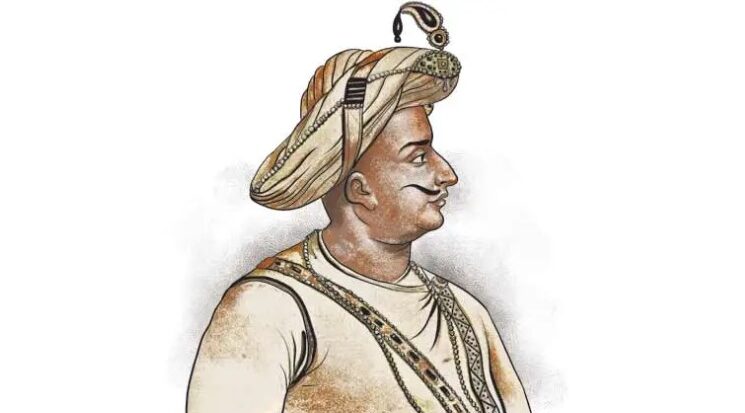
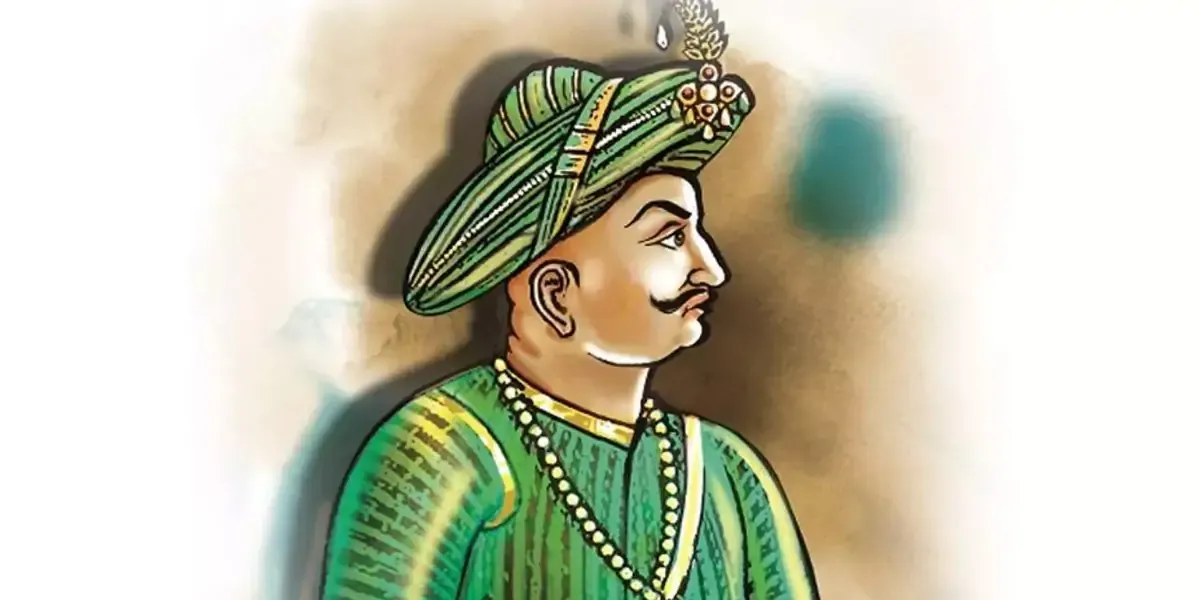
Tipu Sultan | Image Credit: Indian Express
Tipu Sultan is often portrayed in history textbooks as a secular ruler of Mysore who resisted British expansion in the late 18th century. While his military campaigns against the British are undeniable, the narrative of his secularism is far more contentious. In reality, Tipu Sultan’s reign was marked by religious imposition and ruthless persecution across South India.
One telling example is his interference in temple rituals. Under his rule, the traditional Hindu aarti ceremonies in Karnataka’s temples were forcibly renamed “Salaam Aarti.” The word Salaam, an Islamic greeting, replaced centuries-old Hindu worship terminology. This was not a mere linguistic change—it was a deliberate assertion of religious dominance over Hindu practices.
The renaming of a centuries-old Hindu worship ritual was only reversed in 2022-2023, was more than symbolic. Restoring the original terminology reclaimed cultural pride and corrected a misleading historical narrative that had long obscured the realities of Tipu’s rule. It also signaled a willingness to confront uncomfortable truths: Tipu Sultan’s reign was characterized by forced conversions, temple destruction, and systematic persecution of Hindus.
With India’s history sanitised to suit a certain narrative, much remains to be unearthed to reinstate the country’s lost heritage and cultural values, as well as to tell the rest of the world about the truth. Similar is the account of Islamic tyrant Tipu Sultan, dubbed the “Warrior of India” by Indian leftists and hardline Islamists.
8000 Temples Destroyed in the Malabar Region
According to historian Lewis B. Boury, the devastation Tipu Sultan inflicted on the southern part of India was harsher and more barbaric than the atrocities performed against the Hindu inhabitants in India by the infamous Mahmud of Ghazni, Alauddin Khalji, and Nadir Shah.
The Mysore Gazetteer asserts that over 8000 Hindu Temples were destroyed across South India by Tipu and his army. In his article, “Tipu Sultan: As known in Kerala”, Ravi Verma mentions several Temples that were destroyed by Tipu. Some of them were Triprangot, Thrichembaram, Thirunavaya, Thiruvannoor, Calicut Thali, Hemambika Temple, the Jain Temple in Palghat, Mammiyur, Parambatali, Venkitangu, Pemmayanadu, Tiruvanjikulam, Terumanam, Vadakhumnnathan Temple of Trichur, Belur Siva Temple, Shri Veliyanattukava, Varakkal, Puthu, Govindapuram, Keraladhiswara, Trikkandiyur, Sukapuram, Maranehei Temple of Aaalvancheiri Tambrakkal, Vengara Temple of Aranadu, Tikulam, Ramanathakra, Azhinjalam Indiannur, Mannur Narayan Kanniar and Vadukunda Siva Temple of Madai.
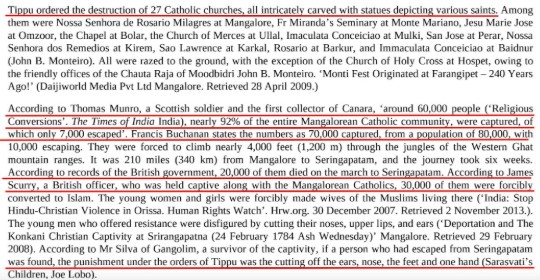
An excerpt from From: ‘Minutes of Maj Gen Thomas Munro; Impact of Christianity on Indian & Australian Societies’ Image Credit: X@ARanganathan72
Tipu Sultan also demolished the Thrichambaram and Thalipparampu temples at Chirackal Taluqa, the Thiruvangatu Temple (Brass Pagoda) in Tellicherry, and the Ponmeri Temple in Badakara, as per William Logan’s Malabar Manual.
According to the Malabar Manual, the Maniyoor mosque was previously a Hindu temple. Locals believe that it was transformed into a mosque during Tipu Sultan’s reign. Tipu Sultan’s military activities caused extensive damage to Hindu temples on an unprecedented scale. Tipu Sultan and his ruthless warriors enjoyed demolishing temples, smashing idols placed within, and chopping the heads of animals over the temple deity. These genocides were, in Tipu’s mirthful words, devout acts in the interest of Islam.
According to the Archaeological Survey of India (ASI), at least 3 temples in South India were demolished by Tipu Sultan’s army, such as the Harihareswara temple at Harihar, the Varahaswami temple at Srirangapatnam, and the Odakaraya temple at Hospet. Like other Islamic invaders in India, Tipu Sultan was known to brutally suppress the local Hindu population and forcefully convert several Hindus. In Tamil Nadu and Malabar, Tipu was referred to as ‘Killer of Brahmins and demolisher of Temples’.
Jehad Against the “Kafirs”
Tipu’s agenda for Hindus was evident from the fact that Colonel William Kirkpatrick discovered around 2000 letters written in Farsi in Tipu’s own handwriting in his palace following his death in the Fourth Anglo-Mysore War and the British capture of his capital, Srirangapattana, in 1799. Tipu refers to Hindus as “kaffirs” and “infidels” in all of his letters, arguing that they must be cleansed if the dominion of Islam is to be securely established in India.
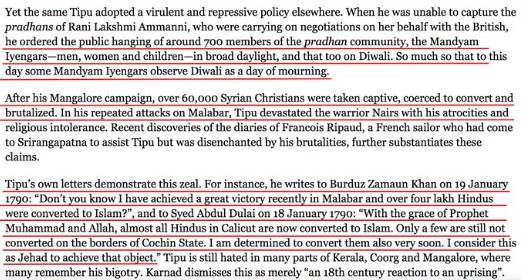
An excerpt highlighting 400,000 Malabar Hindus were converted to Islam by Tipu Sultan | Image Credit: X@ARanganathan72
In a letter dated March 22, 1788, to Abdul Kadir, member of a diplomatic mission from Tipu Sultan to the Ottoman Empire, and cited in K M Panicker’s article in ‘Basha Posini magazine’ dated August 1923: ‘Over 12,000 Hindus were honoured with Islam. There were many Namboodri Brahmins among them. This achievement should be widely publicised among the Hindus. Then the local Hindus should be brought before you and converted to Islam. No Namboodri Brahmin should be spared.’
Historian IM Muthanna, in his book ‘Tipu Sultan X-Rayed’, states that Tipu’s raids weren’t a compulsion for the expansion of his territory, but were simply a barbaric intent backed by religious bigotry and cultural invasion. Muthanna claims that he murdered 40,000 Hindus in Coorg and converted an equal number to Islam in his campaigns there.
In a letter dated January 18, 1790, to Syed Abdul Dulai, Tipu Sultan openly condones the killing and forced conversions of Hindus, and proclaims this as a ‘Jihad’. The letter reads: ‘… almost all Hindus in Calicut are converted to Islam. I consider this as jihad.’
In 1790, Tipu sent a letter to Syed Abdul Dulai (an army commander under his reign): “With the grace of Prophet Mohammad and Allah, almost all Hindus in Calicut are converted to Islam. Only on the borders of Cochin State are a few still not converted. I am determined to convert them also very soon. I consider this as “Jehad” to achieve that object.”
In 1788, Tipu had reportedly ordered his Calicut governor, Sher Khan, to convert the local Hindus to Islam. According to Nishan-e-Haidari, 200 Brahmins were forced to consume cow-meat by July 1788.
He also invaded Coorg in 1788 and devastated many towns and villages. Mir Hussein Kirmani, Tipu’s courtier and biographer, has detailed how the raid resulted in the burning of hundreds of villages in Kushalapura (now Kushalnagar), Talakaveri, Madikeri, and other locations. Tipu brags in a letter to Runmust Khan, the Nawab of Kurnool, about taking 40,000 Coorgis as prisoners, forcefully converting them to Islam, and incorporating them into the Ahmadi army.
Sadly, Textbooks Continue to Glorify Tipu Sultan
Despite archival evidence, letters, and eyewitness accounts that reveal Tipu Sultan’s violent religious persecution and forced conversions, Indian school textbooks still present him as a patriot who defended India against the British. This selective portrayal only prompts us to raise questions about whether these are attempts to whitewash Tipu’s bigotry.
For instance, a Karnataka State Board (KTBS) Class X Social Science textbook says, “Tippu Sultan died while fighting the British in 1799. With the death of Tippu Sultan, the British were happy as if the whole of India came under their rule.” Yes, the state textbook has highly glorified the fact that Tipu Sultan defended India against the Britishers; there are no mentions of temple destructions, forced conversions, or his jihad against kaffirs.
Similarly, the NCERT Class VIII history book, Our Pasts – III, describes Tipu in these glowing terms: “Tipu Sultan of Mysore was one of the most powerful enemies of the British.” Again, there is no acknowledgment of his atrocities in Malabar or Coorg, nor any reference to his persecution of Hindus and Christians.
According to the Times of India report, an expert committee appointed by the Karnataka government recommended that while chapters on Tipu Sultan be retained, “passages that glorify Tipu Sultan should be edited or toned down.” The committee found that the prevailing narrative focuses disproportionately on his “patriotism” while failing to address his campaigns against Coorgis, Kodavas, and the Nairs of Malabar.
Thus, due to this, the students have learned only a set of selective narratives about Tipu Sultan, his role as a freedom fighter. But nothing about his reign that witnessed numerous forced conversions, mass killings, and destruction of temples at an unprecedented scale.
Tipu Sultan’s Tainted Legacy
While many narratives glorify him as a patriot who resisted the British, historical evidence and letters expose him as a ruler who waged religious wars, destroyed temples, and forcibly converted thousands. Tipu Sultan’s legacy is a tainted one, and this narrative should also be equally highlighted, because cherry-picking facts means erasing history.
.png)