Why Indira Gandhi Sent Gayatri Devi, World’s Most Beautiful Maharani, to Tihar Jail?
Gayatri Devi's popularity and princely status were an irritant for Indira Gandhi. Gayatri Devi’s very presence in Parliament irritated Gandhi.

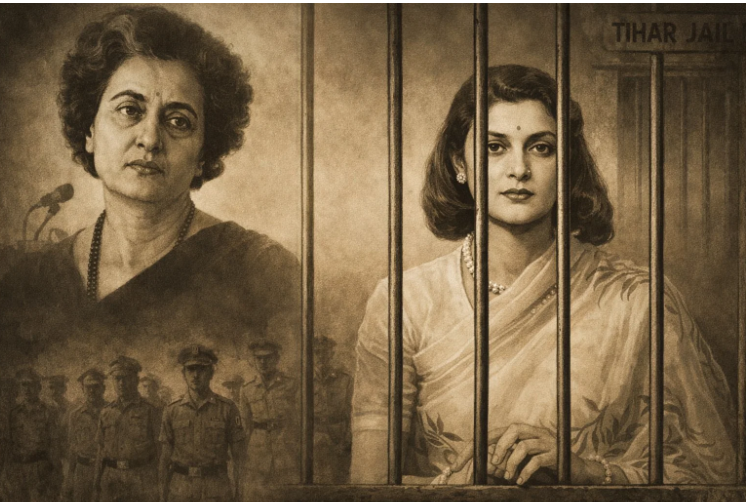
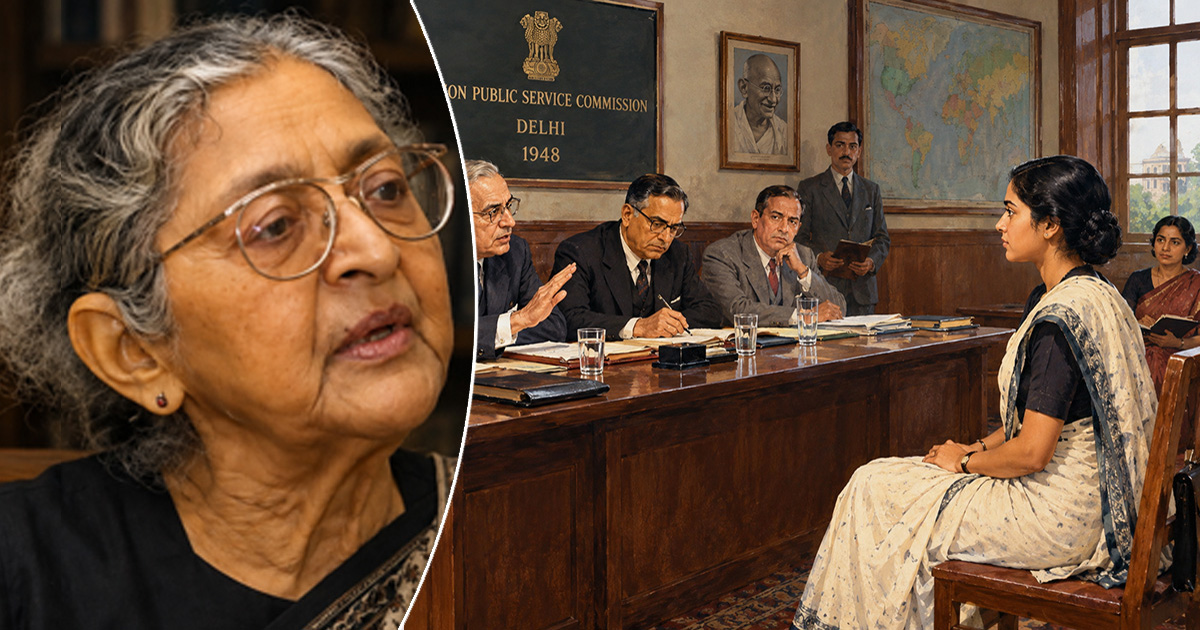
This image is AI-generated
“Tihar Jail was like a fish market. Filled with petty thieves and prostitutes screaming.” This was witnessed back in July 1975, when a Maharani, who had appeared on lists of the world’s most beautiful women, was inside India's most infamous prison. Draped in a chiffon saree and her trademark pearl necklace, this Maharani was none other than the Rajmata of Jaipur, Maharani Gayatri Devi, who found herself in the smelly Tihar prison, surrounded by criminals & lunatics. But why? Well, Gayatri Devi was jailed during the Emergency imposed in India in July 1975 by the then-Prime Minister, Indira Gandhi. Her crime? Under the sweeping powers of that period, any person, irrespective of their status, could be detained without trial. And that is why the Maharani of Jaipur became one of the most high-profile prisoners of that time. However, contrary to what one may feel upon reading this, Maharani Gayatri Devi’s imprisonment was not merely a consequence of Emergency laws, but a rivalry. One that wasn’t political alone, but rooted in personal tensions that had been simmering between her and Indira Gandhi for years. As we remember Maharani Gayatri Devi on her birth anniversary (23rd May), let us revisit how and why the Maharani was put behind bars.

Maharani Gayatri Devi | Image Source: Wikipedia
The Maharani & Gandhi Rivalry
Elegant, cosmopolitan, and fiercely independent, Gayatri Devi, the Princess of Cooch Behar and the third Maharani of Jaipur, was widely admired for her grace, beauty, and modern outlook. But Gayatri Devi was not just a glamorous royal. She was Indira Gandhi’s most formidable political rival. But how did she come to be so? The two women had known each other long before politics brought them into conflict. As young girls, both had studied at Patha Bhavana in Santiniketan, the school founded by Rabindranath Tagore. Their lives, however, would later move in dramatically different directions — one becoming India’s Prime Minister, the other emerging as not only the Maharani of Jaipur, but also one of the most popular opposition figures in Parliament.
Gayatri Devi entered politics in spectacular fashion. In the 1962 Lok Sabha elections, she contested from Jaipur on a ticket from the Swatantra Party, founded by C. Rajagopalachari. The party had positioned itself as a powerful ideological challenger to the Congress government. The result was historic: Gayatri Devi defeated the Congress candidate by a staggering margin of over 1,75,000 votes. At the time, this was the largest majority ever recorded in any democratic election in the world, earning her a place in the Guinness Book of World Records. Her victory transformed her into a political phenomenon, with Gayatri Devi quickly emerging as one of the most influential critics of the Congress government.

Gayatri Devi’s election campaigns for the 1962 polls | Image Source: media storehouse
However, her popularity and princely status were an irritant for Indira Gandhi. Gayatri Devi’s very presence in Parliament irritated Gandhi. Journalist Khushwant Singh later wrote that Gayatri Devi “brought the worst out in Indira Gandhi: her petty, vindictive side,” adding that Indira “could not stomach a woman more good-looking than herself” and even insulted her in Parliament. Noting the equation between the two ladies, journalist Khushwant Singh wrote: “Indira could not stomach a woman more good-looking than herself and insulted her in Parliament, calling her a bitch and a glass doll. Gayatri Devi brought the worst out in Indira Gandhi: her petty, vindictive side.”
Owing to Gayatri Devi’s immense popularity, even Congress thought of bringing her into the party. In 1965, Prime Minister Lal Bahadur Shastri reportedly offered her an opportunity to join the party. However, Gayatri Devi declined, given her firm opposition regarding Congress. When Indira Gandhi came to power in 1966 after Lal Bahadur Shastri’s death, her government increasingly clashed with India’s former princely families. The most dramatic move came in 1971, when the government abolished privy purses through the 26th Amendment to the Constitution — ending the payments that former princely rulers were receiving as part of their agreement to integrate into India.
The Emergency & Maharani’s Arrest

Indira Gandhi declares Emergency | Image Source: Indian Express
The most shocking reckoning came in June 1975, when then-Prime Minister Indira Gandhi imposed an emergency after her election to Parliament was invalidated by the judiciary. Civil liberties were suspended, the media were censored, and opposition leaders, journalists, activists, and critics of the government were arrested across the country.
Soon, the crackdown reached one of Indira Gandhi’s most visible critics, Gayatri Devi. At the time the Emergency was declared, the 56-year-old Rajmata was undergoing medical treatment in Bombay. This allowed her to escape the first wave of arrests. But when she returned to Delhi towards the end of July 1975, the atmosphere had changed dramatically. She visited Parliament only to find the opposition benches almost empty as most leaders had already been arrested. That same night, police officers arrived at her residence on Aurangzeb Road in Delhi, and Gayatri Devi was arrested under the Conservation of Foreign Exchange and Prevention of Smuggling Activities Act (COFEPOSA). She was accused of possessing undeclared wealth and gold, and income tax raids were conducted at her properties, including the Jaipur palace. Within hours, the Maharani of Jaipur was taken to Tihar Jail.
Life Inside Tihar
Nothing in Gayatri Devi’s life had prepared her for what she encountered inside Tihar. She was placed in a smelly room originally meant for visiting doctors. Outside ran a filthy open drain where prisoners relieved themselves. “There were no fans and mosquitoes seemed to devour us,” she had recalled. The prison environment was chaotic. Petty criminals, prostitutes, mentally ill inmates, and political prisoners were all housed together. Pregnant women were often rushed to hospitals at the last moment, and some even gave birth inside the jail.
Yet the Rajmata tried to maintain dignity and routine. She practiced yoga every day and was eventually allowed evening walks in the prison grounds. Disturbed by the presence of children in the jail, she arranged for slates and textbooks and started teaching them. She also brought in a cricket bat, football, and even managed to set up a small badminton court where she played with younger inmates. At night, she and another royal prisoner, the Rajmata of Gwalior, listened secretly to BBC broadcasts on a transistor radio that was smuggled into the jail. It was their only connection to uncensored news from the outside world.
But the months in prison took a toll. Gayatri Devi developed painful mouth ulcers and later suffered from gallstones. Medical treatment was often delayed. Her family’s legal efforts to secure her release moved slowly, a process her stepson described as a “game of snakes and ladders.” By December 1975, Gayatri Devi’s health had deteriorated severely. She was admitted to Delhi’s Govind Ballabh Pant Hospital with severe abdominal pain and diagnosed with gallstones. It was at this point that the government agreed to release her, but with conditions.
End of An Era
Before being granted parole, she was asked to sign a letter declaring that she was withdrawing from politics. “It was a set letter,” she later said. “I wasn’t the only one who wrote it. Many of us did.” On January 11, 1976, after spending 156 nights in Tihar Jail, Gayatri Devi was finally released on parole. Yet freedom was limited. Her Delhi home was bugged by the authorities, and she later remarked that being on parole felt “almost worse than being in jail, it was just a wider jail.”
When she returned to Jaipur, hundreds of people defied government restrictions to welcome her. A year later, in March 1977, the Emergency ended, and general elections were held where Indira Gandhi and the Congress Party suffered a dramatic defeat. When the news reached Jaipur, jubilant crowds gathered around Gayatri Devi. “We have taken revenge for what she did to you,” people had told her.
The story of Gayatri Devi’s imprisonment remains one of the most striking symbols of the Emergency era. A woman once listed among the world’s most beautiful and admired personalities was reduced to prisoner status. This is an episode that reminds us how power, politics, and personal rivalries shaped one of the darkest chapters of India’s democracy.