“A Bloodstained Monopoly”: Economist Adam Smith Exposes East India Company’s Decline & Famine in Bengal
India was once known as the Sone ki Chidiya — a golden bird, symbolising immense wealth and prosperity. Yet, by the late 18th century, following the arrival of the British East India Company, this prosperity was visibly eroding.

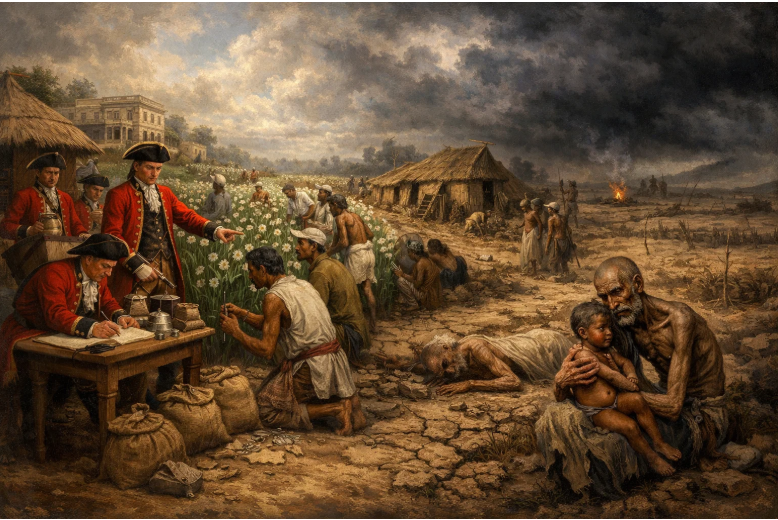
This image is AI-generated
India was once known as the Sone ki Chidiya — a golden bird, symbolising immense wealth and prosperity. For centuries, it stood as a thriving centre of trade, agriculture, and craftsmanship, attracting trade merchants from across the world. Yet, by the late 18th century, following the arrival of the British East India Company, this prosperity was visibly eroding. Regions that were once among the richest in the world, especially Bengal, were now witnessing economic decline. One of the earliest thinkers to systematically explain this transformation was the economist Adam Smith (Scottish by birth, yet a British since Scotland was already part of the Kingdom of Great Britain). Thus, in 1776, he did not celebrate the British East India Company or EIC as a champion of trade; instead, he called it a “strange absurdity,” a system where a private company exercised sovereign power. Smith argued that this dangerous fusion of profit and political authority led to exploitation, economic collapse, and, ultimately, human tragedies such as the Bengal famine.
Hence, despite being British himself, he delivered a scathing critique of the British East India Company, exposing a profit-driven regime that pushed Bengal into decline and resulted in the death of millions through calculated indifference.
Adam Smith | Image Source: Wikimedia Commons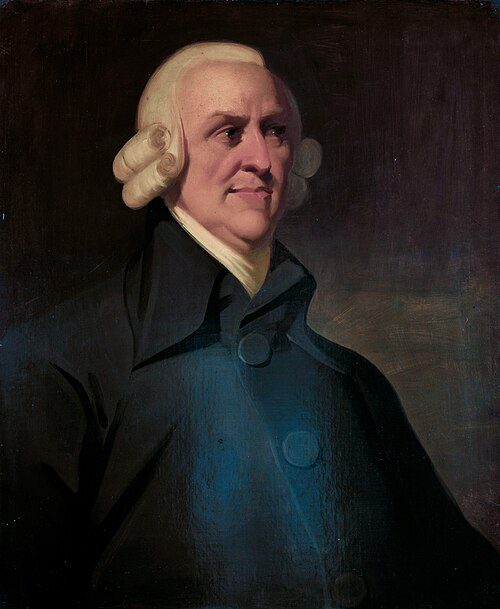
Smith Slams Britain’s “Bloodstained Monopoly” in India
Adam Smith’s critique of the East India Company was sharp. He saw the Company as a “nuisance in every respect” and a “bloodstained monopoly” that distorted both markets and governance. At the heart of his argument were three key criticisms.
First, he attacked the Company’s monopoly over trade. He argued that by restricting access to Indian markets, the Company forced producers in India to sell goods at artificially low prices, which exploited the labor. Second, Smith condemned the Company’s misrule and corruption. He stated that merchants were inherently ill-suited to govern territories. Their primary goal was profit, not public welfare. As a result, governance became brutal. Lastly, he opposed the Company’s territorial expansion. To Smith, the idea that a profit-seeking corporation could simultaneously act as a sovereign power was fundamentally contradictory, as the interests of the people would always be sacrificed for private gains.
To illustrate his argument, Smith drew a powerful comparison between Bengal and North America. He described North America as a “progressive state,” where capital was accumulating, and society was expanding; whereas in Bengal, once one of the richest regions in the world, was “declining”, marked by a shrinking population and falling productivity. The reason, Smith argued, was that Bengal was ruled by a commercial corporation whose primary aim was short-term profit.
EIC’s Control Over Bengal & Catastrophic Famine That Followed
The roots of this transformation can be traced back to 1765, when the Mughal emperor Shah Alam II granted the Diwani rights to the East India Company. This gave the Company control over revenue collection in Bengal, effectively making it the economic ruler of the region. What followed was a drastic shift in policies: Sharp rise in revenue demands and a rise in taxes to 50% of agricultural produce.
These policies reached their most devastating phase in the Bengal famine of 1770. The scale of the catastrophe was staggering, with an estimated 10 million people, roughly one-third of Bengal’s population, having perished. Entire villages were abandoned, agricultural lands lay barren, and survivors fled in desperation.
Great Bengal famine of 1770 | Image Source: BBC
For Adam Smith, excessive taxes imposed by the EIC were a central factor that led to such a catastrophic situation in Bengal. Despite the failure of crops and looming food shortages, the Company continued to demand high revenues, placing unbearable pressure on peasants. He also highlighted the forced cultivation of commercial crops such as opium and indigo, owing to which farmers were often compelled to replace food crops like rice with these cash crops. Thus, this led to a reduction in the availability of essential food grains. In one striking example, Smith describes how Company officials would order fertile fields to be used for opium cultivation under the pretext of preventing scarcity, when in reality, it was done to maximise profits.
Another critical factor was the Company’s monopoly over the grain trade. By controlling supply and restricting storage, Company agents created artificial scarcity. Thus, hoarding and speculation drove up prices, making food inaccessible to large sections of the population. He noted that the situation in Bengal mattered little to them, even though the region was “swallowed up by an earthquake.” Hence, he argued that such policies of the EIC turned a natural crisis into a man-made disaster because all that mattered to them was profit.
Public Outrage and Parliamentary Response
The devastation in Bengal did not go unnoticed. Reports of mass starvation and mismanagement reached Britain, sparking widespread outrage. The famine, combined with financial scandals within the Company, led to growing demands for reform. In response, the British Parliament passed the Regulating Act of 1773, the first serious attempt to bring the Company under state control.
The British Parliament passed the Regulating Act of 1773 | Image Source: GK Today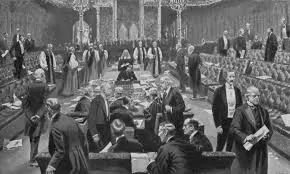
The Act created the position of Governor-General, with Warren Hastings as the first appointee, and introduced greater oversight over Company’s administration. Smith himself praised the government's move to restrict the Company. “I heartily congratulate you upon the triumphant manner in which the East India Bill has been carried through,” he said. Debates over reform continued in the following years, leading to proposals like Fox’s India Bill (1783) and later Pitt’s India Act (1784) sought to further regulate the Company’s activities.
Adam Smith’s critique of the British East India Company was not merely an argument, but a reality check of a regime that placed profit above people. In Bengal, he saw that a land once synonymous with abundance had been reduced to famine, owing to the EIC’s policies. His observations revealed how monopoly, misrule, and unchecked corporate power could dismantle thriving economies and devastate human lives.
In reflecting on Smith’s words today, one truth stands out: The fall of the Sone ki Chidiya was a consequence of choices—where governance became a tool of profit, and human welfare was reduced to an afterthought.