Rann of Kutch: Is it Desert Beauty? Or India's Strategic 'Power' Hub?
How India is turning the Rann of Kutch, where once nothing grew, and no one could go, into the foundation of its 'Power Empire'!

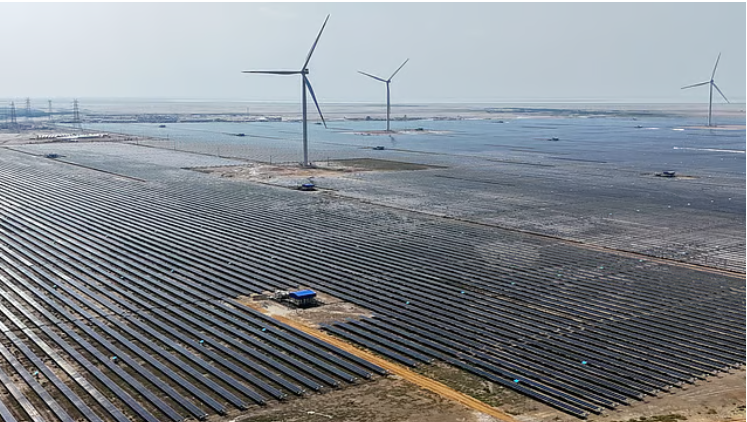
An aerial photograph shows wind turbines and solar panels installed at the Adani Green Renewable Energy Plant in Khavda, in Gujarat | Image Source: Gulf News
Every year, as June 17 arrives, we raise slogans like 'World Day to Combat Desertification'. We get worried as the Earth loses its strength and turns into a wasteland. It is true in our country as well, as many regions are falling into the clutches of desertification and turning into useless lands. But, how are we looking at those wastelands? How are we transforming them for national development with our intelligence? The living proof of this is the Rann of Kutch. In this article, let’s find out how India is turning that white desert—where once nothing grew, and no one could go—into the foundation of its 'Power Empire'!
Rann of Kutch is a white land. A flat plain extending as far as the eye can see. A salt bed that shimmers in the moonlight as if we are walking on the moon. But when you are near it, you realize it is a sensitive, tough, and politically crucial territory. However, this is a geographical border swinging between the sea on one side and the desert on the other. That’s why it would be our mistake to think of it as some useless land. This region, created so beautifully by nature, is turning into a magnificent power generation center, thanks to the Khavda Renewable Energy Park.
Khavda: Wasteland is now a 'Power' Center
The Khavda Renewable Energy Park is positioning the Rann of Kutch from a new perspective on the world map. The Gujarat government is developing this as a massive renewable energy park with a capacity of 30 gigawatts (GW). This center generates electricity by combining solar and wind energy. Prime Minister Narendra Modi laid the foundation stone for this mega project on December 15, 2020. Infrastructure development and ground-level works gained momentum in early 2023. Within this, Adani Green Energy has already made the first 1,000 MW segment operational. The land that was viewed as "barren" until now is transforming into a center that spreads light across the nation.
Power generation here continues based on solar energy during the day and wind energy at night. Out of the 30 GW, solar power accounts for approximately 26 GW, while wind power accounts for about 4 GW. This rapidly progressing project is estimated to become fully operational at its total capacity by 2029-30. Companies like Adani Green Energy started their first phase of production on December 31, 2023. Additionally, by February 2024, 551 MW of solar capacity from this park was integrated into the grid. This single park alone will fulfill 6% of India's target to achieve 500 GW of renewable energy by 2030.
The area of this project is 72,000 hectares (approximately 538 square kilometers). It can be described as one of the most massive projects in the world. Once fully available, it is estimated that the electricity produced by the Khavda Renewable Energy Park can meet the needs of more than 1.8 crore households. Moreover, it is said that at full capacity, its production will exceed the electricity requirements of countries like Belgium and Switzerland. This project, located close to the Pakistan border, will stand as one of the largest renewable energy parks in the world upon completion. This can be described as one of the largest energy transition projects undertaken by India.
Space View: Strategic Border Shield
NASA View: The massive 'Deep Blue Patch' of Khavda Solar Park transforming the Rann of Kutch | Image Source: science.nasa
This project is clearly visible even from space. In images taken by NASA satellites, this white land now appears as a massive 'Deep Blue Patch'. This is not just a project; it is a great experiment by India on how tough lands can be turned into national assets. Being very close to the Pakistan border, this project is also acting as a 'Strategic Border Shield'. Utilizing empty lands at the borders in this way is a big plus point for India.
Conclusion
Rann of Kutch is not just a beautiful white land. It is a challenge placed before us. Do we see this land only as a photo? Or do we understand it as a bridge between national development and the environment? The Khavda project clarifies one thing: the country will no longer leave this land empty. But the real test before us is—how we sustain that land while using it without destroying it; that is the real intelligence.