Jwalamukhi Shakti Peeth: Why Did Akbar Try to Extinguish the Temple's Eternal Flames? How Did He Fail?
Jwalamukhi Temple is one of the most sacred among the 51 Shakti Peethas, marking the spot where the tongue of Sati Devi fell. There is no idol worshipped here. Instead, nine natural flames (Nava Jwala) emerging directly from the earth and rock crevices are revered as the embodiment of the Goddess.

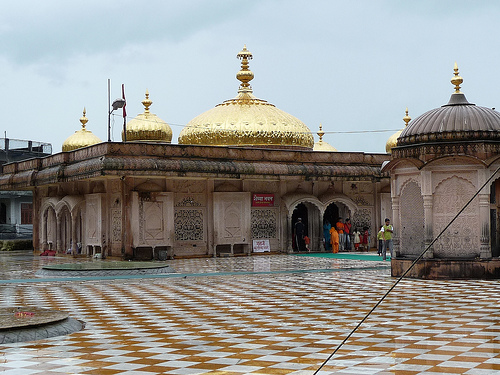
Jwalamukhi Temple | Image Source: Myosha Travels
"Enough is enough... demolish that temple. Pour water over those burning flames and extinguish them completely!" This was the brutal order issued during the 16th century (around 1570) by the Mughal ruler Akbar, during his assault on the sacred Jwalamukhi Devi Temple in Himachal Pradesh. The Jwalamukhi Temple and its eternal flames are considered the living manifestation of the Goddess. However, the Mughal emperor Akbar made every attempt to prove that this was not divine. He didn’t just try once, but multiple times. What happened next forms the core of this narrative—a story of how Akbar’s intense arrogance was completely shattered before the sacred, eternal flames of the Jwalamukhi Temple.
The Glory of Jwalamukhi Temple & The Miracle of the Eternal Flames
Jwalamukhi Temple is one of the most sacred among the 51 Shakti Peethas, marking the spot where the tongue of Sati Devi fell. There is no idol worshipped here. Instead, nine natural flames (Nava Jwala) emerging directly from the earth and rock crevices are revered as the embodiment of the Goddess. Burning continuously for centuries without the use of ghee, oil, or even a single wick, these flames stand as a powerful symbol of faith for millions of devotees.
The mystery behind these flames continues to baffle scientists to this day. Inside the sanctum sanctorum, water naturally bubbles up just a few inches above the ground. Surprisingly, these fiery flames erupt right out of those cold water bubbles. The coexistence of water and fire in the same spot is the ultimate divine secret of this shrine. The nine flames burning here bear distinct names—Mahakali, Annapurna, Chandi, Hinglaj, Vindhyavasini, Mahalakshmi, Saraswati, Ambika, and Anji Devi. Witnessing this sheer marvel, it wasn’t just ordinary devotees, but many powerful kings throughout history who recognized the significance of this Shakti Peetha and worshiped it with deep devotion.
The splendor of these flames, burning uninterruptedly in the mountains without any fuel, caught the attention of the Mughal ruler Akbar. As part of his imperial expansion, Akbar noticed the unshakeable faith and trust that the local Hindu kings placed in the Jwalamukhi Temple. However, Akbar decided to challenge the divine power behind these eternal flames and prove that the fire was not divine, but "merely caused by natural gas." To test this belief, he ordered his army to extinguish the flames completely.
Akbar's Failed Attempts to Extinguish the Eternal Flames
Acting on Akbar’s orders, the Mughal army entered the Jwalamukhi Temple premises and began a campaign of destruction, vandalizing the traditional sculptures and the Gopuram (the temple gateway). Following this, to permanently seal the main spot from where the Goddess's flames emerged, they diverted natural water streams flowing around the temple directly toward the flames. Consequently, thousands of liters of water gushed over the eternal flames; yet, they miserably failed to extinguish them. The fire continued to blaze resolutely beneath the rushing torrents of water.
When this attempt failed, Akbar chose an alternative method. According to historical accounts, they placed massive iron plates over the rocky crevices from where the flames erupted and sealed them tightly. They believed that cutting off the air supply entirely would snuff out the fire. However, the flames ripped right through those heavy iron plates, burning through the rocks and leaping upward once again. Terrified by the intense, uncontainable heat, the Mughal soldiers retreated.
These failed attempts were closely observed by Raja Todar Mal, Akbar's Hindu minister. He intervened and warned the emperor that if the attacks on the Jwalamukhi Temple continued in this manner, the foundations of the Mughal Empire in the Kangra hills would shake, leading to a massive rebellion from the local Hindu kings. It was this political and strategic warning from Todar Mal that prompted Akbar to change his mind, halt the temple demolition project, and back down. Thus, Akbar’s attempts to extinguish the eternal flames of Jwalamukhi Temple failed completely.
Local folklore suggests that Akbar later realized the greatness of the Goddess and, as penance for his mistake, offered a rare golden Chhatra (a parasol weighing one and a quarter 'Maund') to the deity. However, it is said that the Goddess rejected this arrogant offering; the moment Akbar placed the parasol down, it instantly transformed into an unknown metal (neither gold nor iron). To this day, scientists have been unable to identify the exact composition of that metal.
Nevertheless, the assaults on this temple did not end with Akbar. Prior to him, several other invaders and rulers, including Mahmud of Ghazni and Sultan Firuz Shah Tughlaq, had also attempted to destroy it. Yet, despite countless onslaughts, the glory of the Jwalamukhi Devi Temple, burning bright with its self-luminous power even today, stands as living testimony to the eternity of Sanatana Dharma.