Battle of Delhi 1737: How Peshwa Bajirao Humiliated the Mughal Empire Without Capturing Delhi?
The Battle of Delhi (1737) was triggered when the Mughal Emperor broke his promise to grant Bajirao governance over Malwa.

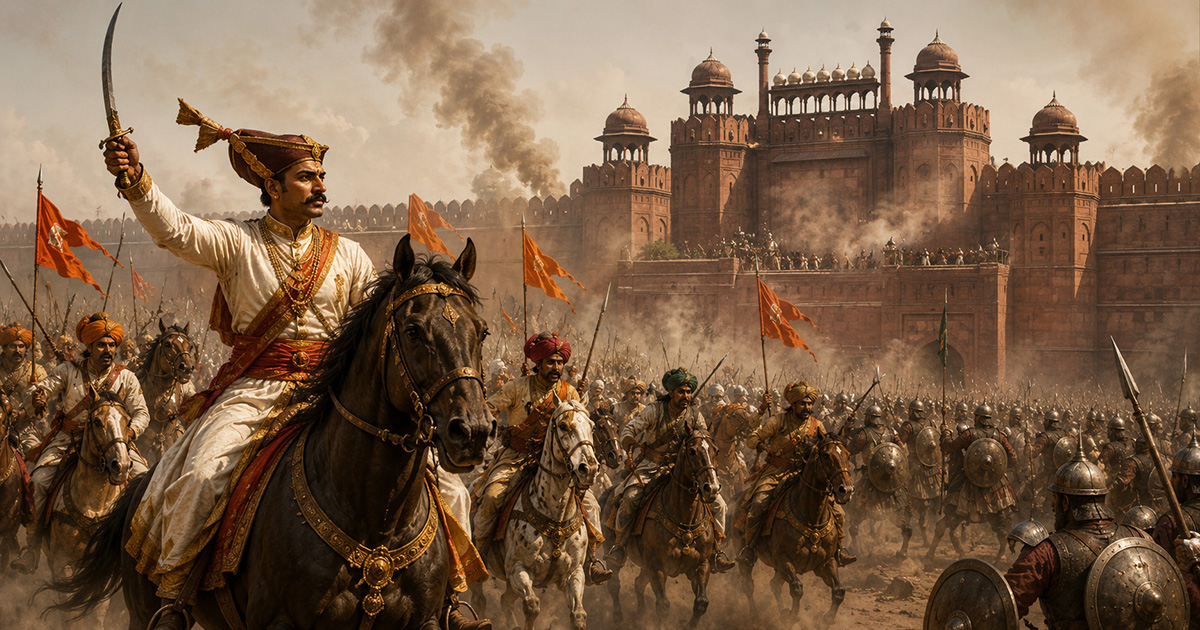
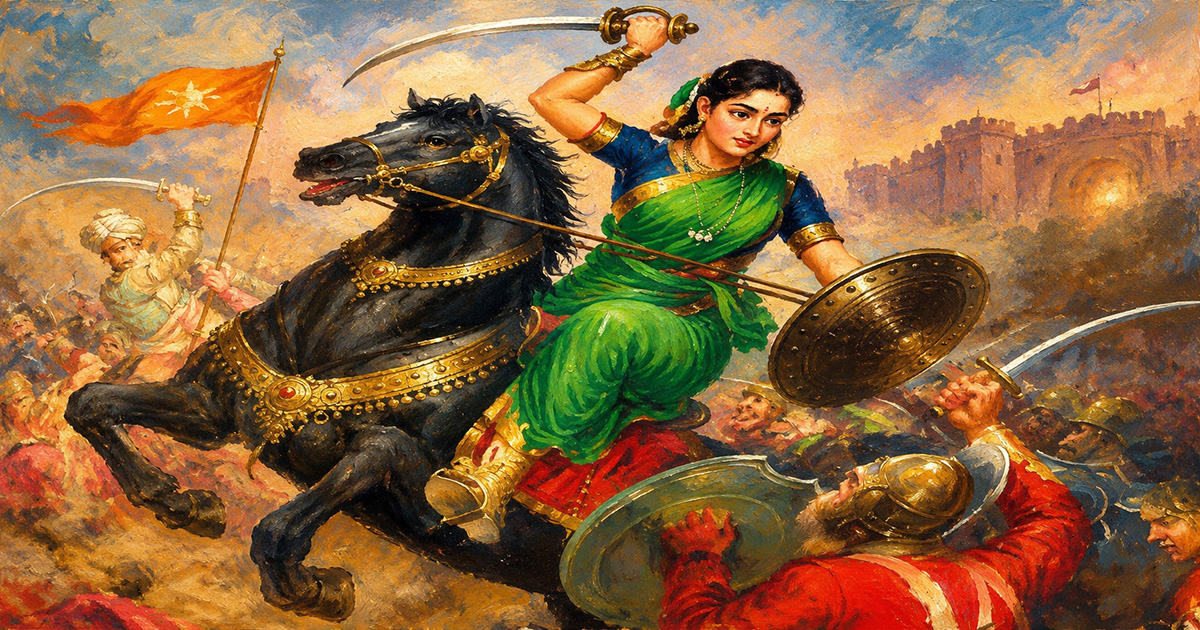
Peshwa Bajirao's battle of Delhi | This image is AI-generated
In March 1737, the impossible happened. A Maratha army from the Deccan appeared at the gates of Delhi, the capital of the Mughal Empire. Panic spread through the imperial court. Mughal commanders rushed to defend the city, while Emperor Muhammad Shah watched as the power that had ruled most of India for nearly two centuries was openly challenged. The man responsible for this audacious campaign was Peshwa Bajirao I, one of the greatest military commanders in Indian history. His march on Delhi was not intended to conquer the Mughal capital. Instead, it was designed to send a powerful political message: the Mughal Empire was no longer the supreme power in India.
The Battle of Delhi (1737) was triggered when the Mughal Emperor broke his promise to grant Bajirao governance over Malwa. After a minor skirmish, Mughal generals sent boastful, exaggerated letters celebrating the "annihilation" of the Marathas. Furious at this fake propaganda, Bajirao launched a lightning blitzkrieg to humiliate the Emperor. He believed that the Mughal Empire was in irreversible decline. After the death of Aurangzeb in 1707, the empire had been weakened by internal conflicts, rebellious governors, financial difficulties, and declining military effectiveness. Bajirao argued that the Marathas should not remain confined to the Deccan. Instead, they should strike at the root of Mughal power and expand into northern India. Chhatrapati Shahu Maharaj, who was the fifth Chhatrapati of the Maratha empire (May 18, 1682 – December 15, 1749), accepted his vision, giving Bajirao the mandate to pursue an aggressive northern policy.
To challenge the Mughal directly, Bajirao understood that defeating provincial governors would not be enough, and the real source of Mughal authority was Delhi. As long as the emperor remained secure in his capital, the illusion of Mughal supremacy would survive. The Peshwa therefore decided on a bold strategy: march directly to Delhi and demonstrate that the empire could not even protect its own seat of power.
In early 1737, Bajirao launched one of the fastest military campaigns of the eighteenth century. Moving from Gwalior, he deliberately avoided major Mughal concentrations and advanced with extraordinary speed. Keeping Agra several miles to his east, he drove his cavalry northward at a pace of more than seventy miles a day. The speed of the advance stunned Mughal commanders. Before the imperial court fully grasped his intentions, Bajirao had crossed Newataya, Barapula, and the area around the Kalika Mandir, today's Kalkaji Temple, and reached Kushakbandi near present-day New Delhi on 28 March 1737. The Mughal Empire had been caught completely off guard. With the Marathas now threatening the capital, Emperor Muhammad Shah hurriedly organized a defense.
On 29 March, Maratha forces raided several outlying areas near Delhi, creating panic inside the city. The emperor deployed thousands of troops outside the Red Fort to halt the advance. Yet Bajirao responded by sending some of his finest commanders, including Malharrao Holkar, Ranoji Shinde, Tukoji Pawar, and Yashwantrao Pawar. The two armies, each numbering roughly eight thousand men, clashed near Rakab Ganj, close to the area where Parliament House stands today.
The result was a decisive Maratha victory. More than four hundred Mughal soldiers were killed, and many others were wounded. Several Mughal officers fell during the fighting, and the surviving troops retreated behind the safety of the Red Fort's walls. Bajirao then shifted his camp to Malcha near Talkatora. Another Mughal force under Kamruddin Khan attempted to challenge the Marathas, but the fighting again went in Bajirao's favour. Maratha troops captured horses, artillery pieces, and even an elephant.
At this point, the Red Fort lay within Bajirao's reach. According to historical accounts, the Peshwa initially considered attacking and burning Delhi. However, he ultimately rejected the idea. There were several reasons. Delhi held immense political and symbolic significance for rulers, nobles, and landholders across northern India. Destroying the city could create serious political complications. Bajirao also understood that the Marathas could gain more by manipulating rival factions within the Mughal court than by overthrowing the emperor altogether.
Most importantly, Chhatrapati Shahu Maharaj did not favour the deposition of the Mughal emperor. A prolonged siege would also expose the Marathas to larger Mughal armies gathering nearby. Instead of destroying Delhi, Bajirao chose a more effective course. He demonstrated that the Marathas could reach the Mughal capital whenever they wished and then withdrew on his own terms.
The Delhi campaign changed the political landscape of India. For the first time, a power from the Deccan had ridden to the gates of the Mughal capital, defeated imperial troops, and exposed the empire's weakness before the entire subcontinent. The campaign showed that the Marathas possessed the military reach, speed, and confidence once associated with the Mughals themselves. As historian Aneesh Gokhale notes, the battle demonstrated that the Marathas could carry an army from the Deccan to the very gates of Delhi. The political dominance once enjoyed by the Mughals had begun to pass into Maratha hands.
Without capturing Delhi, Bajirao achieved something far greater: he shattered the myth of Mughal invincibility and announced the arrival of the Marathas as the foremost power in India.
.jpg)