When Rabindranath Tagore Gave Netaji Subhash Chandra Bose the Title of "Deshnayak": Know About Their Extraordinary Bond

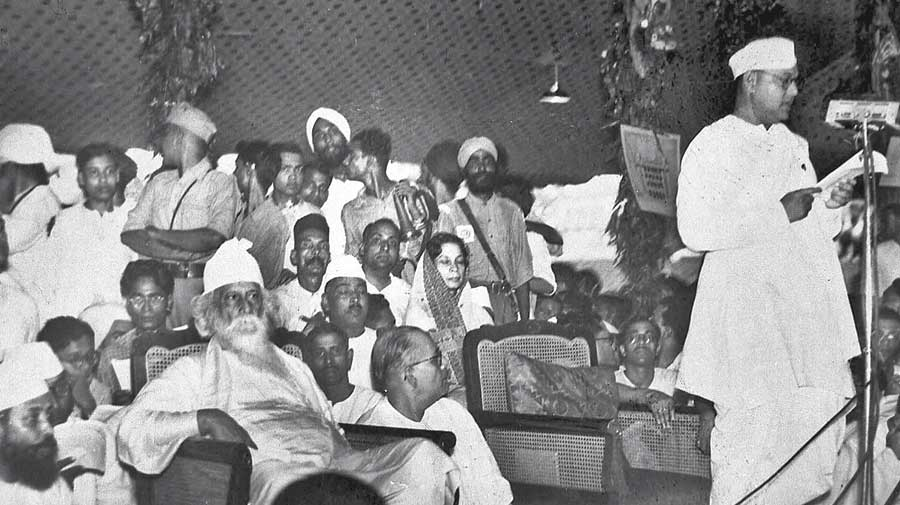
Netaji Subhash Chandra Bose and Rabindranath Tagore at the inauguration ceremony for Mahajati Sadan | Image Source: Telegraph India
In the history of the Indian independence movement, some unions were not merely political; they were beacons for an entire era. Such was the bond between Rabindranath Tagore, the poet who worshipped non-violence, and Netaji Subhash Chandra Bose, the "Son of Fire" who believed in armed struggle. What existed between them was not just mutual respect but a spiritual connection intertwined with an unwavering love for the nation. If one's contribution was poetry, the other’s was the revolution that breathed life into those verses. This is an analysis of how a poet stood as a protective shield through his words for a warrior at a time when he was politically isolated. On the occasion of Rabindranath's birth anniversary on May 7th, let us recall the historic moments where he provided monumental support to Netaji's struggle.

Rabindranath Tagore | Image Source: Pragyata
At the 1939 Tripuri Congress session, following differences with the Gandhi faction, Bose resigned from the presidency. Subsequently, the Congress High Command took stringent action against Bose, imposing a three-year ban. While the entire nation watched in silence, a voice rose from Shantiniketan. On March 29, 1939, Tagore wrote a private letter to Gandhiji. In the letter, he mentioned: "At the last Congress session, some rude hands have deeply hurt Bengal... Please apply balm to the wound." Gurudev, who usually distanced himself from politics, personally entering the arena for Netaji created a massive sensation back then. However, responding to Tagore's letter on April 2, 1939, Gandhiji briefly stated: "I love Subhas, but I cannot compromise on matters of discipline." (Collected Works of Mahatma Gandhi, Vol. 69 )
On May 3, 1939, when Netaji established the Forward Bloc, Tagore published a letter addressed to Subhas Bose in the Modern Review magazine, stating: "Subhas Chandra, I am a Bengali poet. I hail you as Deshnayak (Leader of the Nation)... Bengal's throne is ready for you." Furthermore, during Bose's visit to Shantiniketan, Tagore affectionately honored him and officially conferred this title. This event sparked a major controversy in Bengal politics—followers of Gandhi and Nehru criticized him severely, saying, "The poet is entering politics." Newspapers also published critical reports. Yet, Tagore ignored them all, recognizing the true patriot in Bose and standing by him as a pillar of support.
Netaji Subhash Chandra Bose, while giving his resignation from Congress in 1939 | Image Source: Netaji Subhash Bose Org 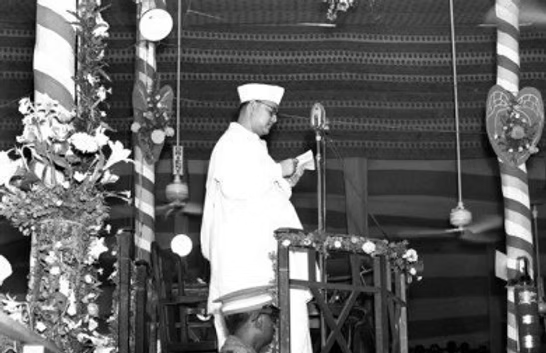
Not stopping there, the laying of the foundation stone for Mahajati Sadan by Tagore in Calcutta on August 19, 1939, at Bose's initiative, can be described as a landmark historical moment. At Netaji's request, Rabindranath Tagore personally came to lay the foundation stone for this building. Despite being unwell that day, Tagore attended for Netaji and addressed the gathering. He hoped, "This building should stand as a symbol of Bengal’s soul and India's aspiration for freedom." This proves that by conferring the title 'Deshnayak', Tagore did not limit himself to words but also stood physically by Bose's ideals.
While Gandhiji believed in a rural economy (the Charkha), both Tagore and Netaji believed that India's development would come through a scientific outlook and modern industrialization. Tagore believed in Cultural Nationalism and human universality, arguing that violence was immoral (Nationalism, 1917). Netaji believed in Political Nationalism and justified ethical violence for the sake of independence (The Indian Struggle). This progressive thinking brought the non-violent poet and the revolutionary together.
The "letter of introduction" written by Rabindranath Tagore to the Indo-German Society for Subhas Chandra Bose’s German visit in 1934 clearly illustrates the ideological differences between them. When Bose approached Tagore to write a letter to facilitate political discussions with German officials during his European tour, Tagore wrote it, but it was "half-hearted." In the letter, he introduced Bose as a "leader of Indian independence" but wrote in a cautionary tone that he should "act in accordance with German policies." Being anti-violence, Tagore feared that if Bose sought armed assistance, he might align with Germany. However, after the 1939 Tripuri crisis, when Bose left the Congress, Tagore provided full support. The letter to Gandhi on March 29 and the "Deshnayak" declaration in the Modern Review in May show how deeply their bond had evolved.
Netaji Subhash Chandra Bose and Rabindranath Tagore at the inauguration ceremony for Mahajati Sadan | Image Source: Telegraph India 
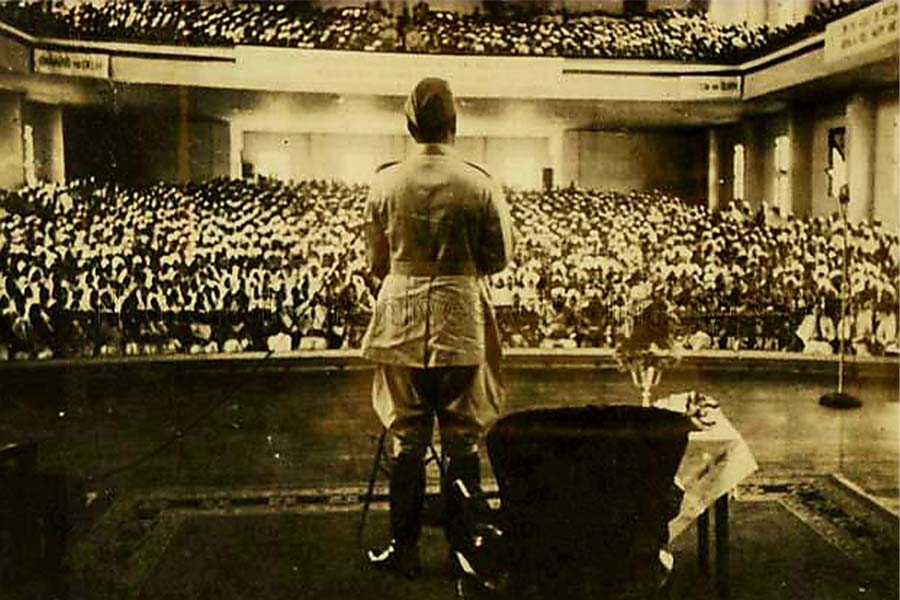
Even though Netaji escaped house arrest in 1941 to go abroad, and despite Tagore's passing (August 1941), his inspiration followed Netaji at every step. On September 11, 1942, at the inauguration of the INA in Hamburg, 'Jana Gana Mana' was sung for the first time as the national anthem. In the 1943 reconstruction of the INA, Tagore's song became the official anthem. The INA slogan "Jai Hind" and the tricolor flag were also influences of Tagore’s nationalist ideology.
The historic moment where a non-violent poet honored a revolutionary warrior as 'Deshnayak', and that warrior adopted his mentor's song as the National Anthem, remains a magnificent chapter in Indian history. If Tagore gave the nation its soul through his words, Netaji turned his blood into a shield for that soul; one dreamt of a free India, while the other risked his life to make it a reality, and to this day, they burn as a flame of inspiration in our hearts.