When 34 Revolutionaries Were Martyred in Tarapur, Bihar in 1932 for Swaraj

You must have heard many stories about India’s freedom struggle because it has a long history of rebellion against British rule. Many of these events are well remembered by people. However, there are also many important events that have been forgotten over time. One such incident is that of Tarapur in Bihar. On February 15, 1932, a group of revolutionaries made the supreme sacrifice by hoisting the tricolor at the police station in Tarapur, Bihar, where 34 freedom fighters sacrificed their lives. The fight to honor the martyrs of Tarapur has been going on for a long time, although now there is hope that this incident will get national recognition.
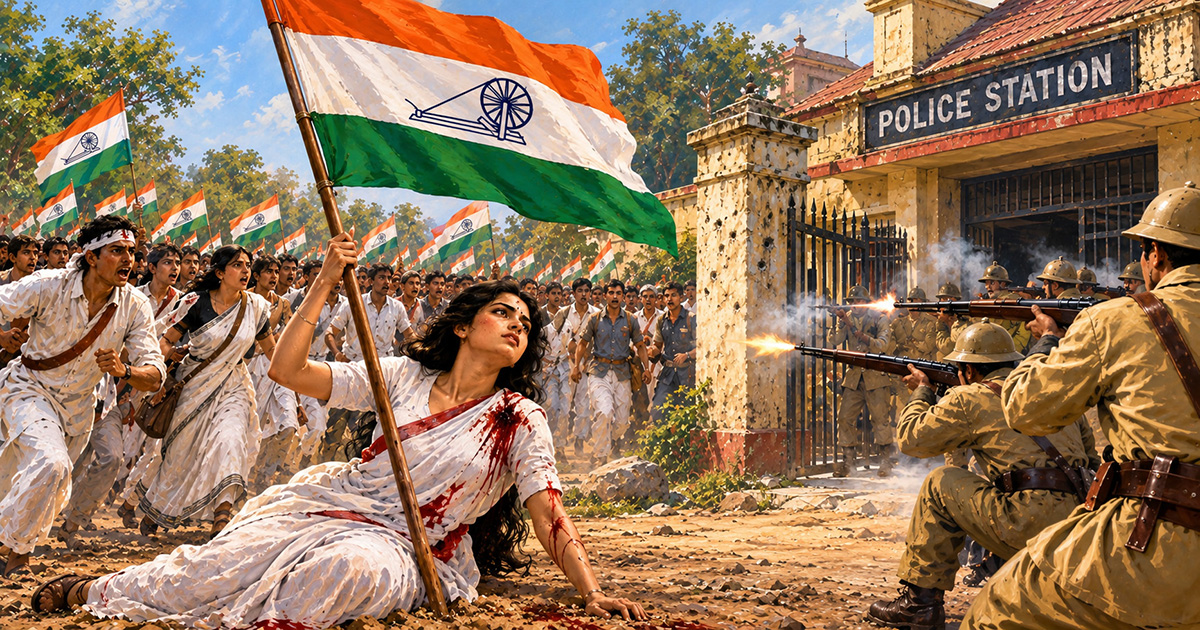
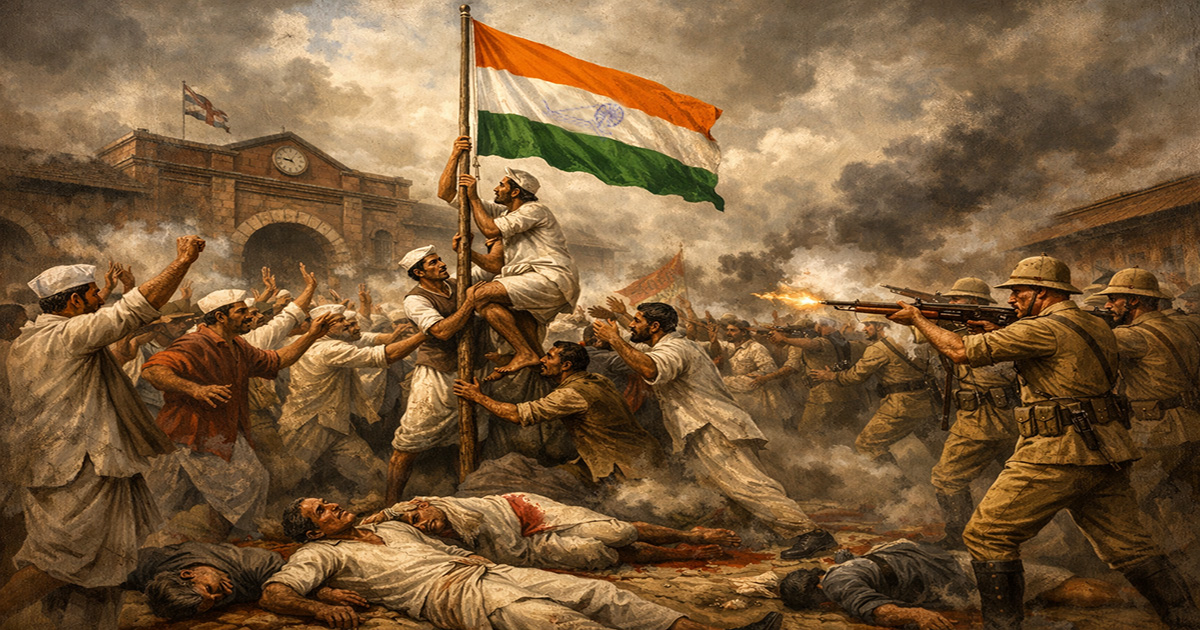
On the afternoon of February 15, 1932, a group of revolutionaries marched in Munger shouting slogans for freedom. Many people left their homes to join them. A crowd gathered near the Tarapur police station and shouted slogans of “Bharat Mata Ki Jai” and “Vande Mataram”. Historians say that despite firing on these unarmed freedom fighters from the police station, Madan Gopal Singh, Tripurari Singh, Mahavir Singh, Kartik Mandal, and Parmanand Jha hoisted the tricolour. However, 34 sons were martyred in this brutal action. Out of these, 13 people were identified, while the remaining 21 remained unidentified. To hide this major incident, the British loaded the bodies of many revolutionaries into vehicles and sent them to Sultanganj, and were dumped in the Ganges.

Dead bodies of revolutionaries of those who were killed were thrown away | Image is AI generated
The seeds of nationalism in Tarapur (Munger, Bihar) began to germinate during the historic revolt of 1857 and took shape after the partition of Bengal and Bihar. In the divided Bihar, it became a stronghold of revolutionaries. Its operations spread from Dhol Pahari to Devadhara Pahari. During the independence movement, the Himalayan “Dhol Pahari” of Tarapur was a camp of the Indian Liberation Army. Meanwhile, the Gandhi-Irwin Pact was broken by the British in 1931. The pact included conditions such as suspending the Civil Disobedience Movement, relaxing the Salt Laws, and releasing political prisoners, but this did not happen. Instead, Mohandas Karamchand Gandhi was arrested in early 1932, making it clear that the British government refused to abide by the pact. As a result, the head of the War Committee, Sardar Shardul Singh Kavishwar, issued a resolution for the revolutionaries to hoist the tricolour on all government buildings on February 15, 1932. His instructions were that a group of five satyagrahis in each police station area would march with the flag, while the remaining workers would stand 200 yards away and boost the morale of the satyagrahis.
On the other hand, the police had already received information about the plan to hoist the national flag, the tricolour, at Tarapur police station on February 15, 1932. British Collector Eoli and Superintendent of Police A.W. Flag were present in the police station premises along with armed forces. At 2 pm, a group of revolutionaries attacked the police station, and after facing beatings and lathicharge by the British soldiers, Madan Gopal Singh of the group finally hoisted the tricolour at Tarapur police station. Meanwhile, supporters standing at a distance, cheering on the marchers, became enraged by the lathicharge meted out to them. The enraged supporters started pelting stones at the police force, injuring Collector Eoli, who then ordered the police force to open fire on the unarmed protesters.
In this firing incident, the police force fired a total of 75 rounds, killing 34 revolutionaries and injuring hundreds. Three days after the firing, only 13 martyrs could be identified, including Shaheed Vishwanath Singh (Chhatrahar), Mahipal Singh (Ramchua), Sheetal (Asarganj), Sukul Sonar (Tarapur), Santa Pasi (Tarapur), Jonty Jha (Satkharia), Singheshwar Rajhans (Bihama), Badri Mandal (Dhanpura), Vasant Dhanuk (Lodhia), Rameshwar Mandal (Padbhada), Gabi Singh (Maheshpur), Ashrafi Mandal (Kashtikari), and Chandi Mahto (Chorgaon). In addition, 21 bodies were found, which could not be identified, and some of which were thrown into the Ganges River.
Now, a martyrs’ memorial stands in front of the Tarapur police station in memory of the martyrs, and people celebrate Tarapur Day here on February 15. A young social worker from the area, Jairam Viplav, has given it a new dimension and started a large-scale celebration of Tarapur Martyrs’ Day.

Tarapur martyr’s memorial in front of the Tarapur police station | News 18
For this, he organized a Tiranga Yatra in 2016, a Mashal Shobhayatra in 2017, and a bike rally from Tarapur to Munger in 2018. A tribute program was held at Jantar-Mantar in Delhi in 2019, and a large public meeting was held at the historic Dak Bungalow complex in Tarapur in 2020.
.png)