When Rani Lakshmibai Was Trapped in the Fort, It Was Jhalkari Bai Who Saved Her Life | The Untold Story of Sacrifice
When Rani Lakshmibai saw Jhalkari, she was stunned. The maid’s face, stature, and bearing were almost a mirror image of the Rani herself.

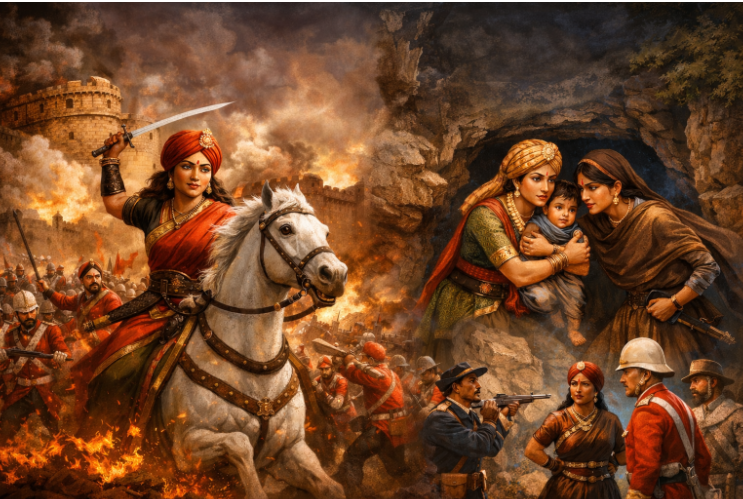
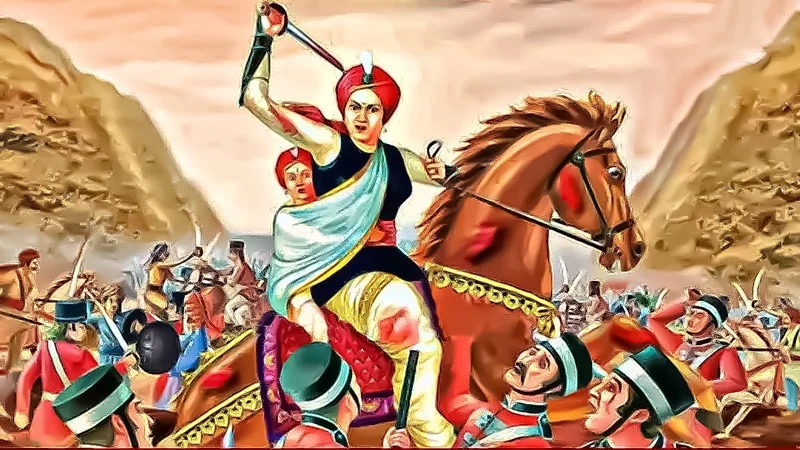
Jhalkari Bai dressed as Rani Lakshmi Bai | This image is AI-generated
In the grim shadows of the battle of Jhansi, one woman stepped forward and offered her life so that the legend of Jhansi ki Rani Lakshmibai could live on. Her name is Jhalkari Bai—the fearless, lesser‑known warrior who risked everything so that the queen could continue the fight for freedom.
Jhalkari Bai was born on November 22, 1830, in Bhojla village, near Jhansi, into an ordinary Koli family. After her marriage to Puran Singh, a brave gunner in Rani Lakshmibai’s army, Jhalkari herself aspired to join the ranks of the Rani’s soldiers. The opportunity came when women of the state gathered in the fort for Gauri Puja to honour the Queen.
When Rani Lakshmibai saw Jhalkari, she was stunned. Her face, stature, and bearing were almost a mirror image of the Rani herself. After hearing tales of her courage, Rani Lakshmibai brought her into her inner circle and admitted Jhalkari into the Durga Dal, an all‑women combat unit of the Jhansi army. Jhalkari quickly rose to become its commander, trusted not only for her strength but for her intelligence and loyalty.
In March 1858, General Sir Hugh Rose’s British forces laid siege to Jhansi Fort. The British army was larger and better armed; the air itself seemed to shake with the roar of cannons. Inside the fort, Rani Lakshmibai and her troops, including Jhalkari Bai and the Durga Dal women, held their ground with astonishing courage.
The women did not stand apart from the men—they carried ammunition, cared for the wounded, and even fired guns at the enemy. As the siege tightened, British shells pounded the walls, and breaches began to appear. The Rani’s commanders knew the fall of the fort was becoming inevitable. A traitor in the Rani’s army—Dulhare Rao—betrayed the fort, secretly opening a gate for the British troops.
At this critical moment, the Rani’s Generals and Jhalkari Bai advised her to escape from the fort with a small band of trusted soldiers. Under the cover of darkness, Rani Lakshmibai slipped out of the fort with her adopted son, Damodar Rao, and a few loyal soldiers, heading towards Kalpi, where she hoped to join other rebel leaders and keep the rebellion alive.
Now came the moment of Jhalkari’s supreme sacrifice. The plan was simple but audacious: Let the British believe that Rani Lakshmi Bai was still inside the fort, fighting them, so she would have time to put distance between herself and the enemy.
Jhalkari Bai dressed exactly as the Rani—same robes, same ornaments, the same royal turban, and warrior’s stance. Mounted on horseback, she rode to the front lines, took command of the soldiers, and led them in a fierce show of resistance. Her voice, manner, and presence perfectly mimicked the Rani; not even the closest officers could tell the difference. Inspired by her, the troops continued to fight, and the British forces believed they were still battling Rani Lakshmibai herself.
Meanwhile, the real Rani was already far from Jhansi, racing toward Kalpi under the cover of night. Eventually, as the fort’s resistance weakened, Jhalkari left the fort—not to flee, but to meet General Hugh Rose in person. She rode into his camp and declared, “I am Rani Lakshmibai; I have come to meet you.” The British were overjoyed as, finally, the queen of Jhansi had fallen into their hands, or so they believed.
It was only later, when the traitor Dulhare Rao informed General Rose that this was not the real queen, but her body double—Jhalkari Bai—that the truth emerged. When Rose asked whether he should shoot her, Jhalkari reportedly replied boldly, “Go ahead; I will die like the rest of my soldiers.”
A British officer named Stuart is said to have called her a “madwoman.” General Rose is reported to have replied, “If even one‑tenth of India’s women are like her, the British will have to leave India soon.”
Historians differ on her exact fate. Some say Jhalkari was released after the war and lived until 1890; others believe she died in battle on April 4, 1858, giving her life so that the queen could live to fight another day.
Jhalkari’s sacrifice ensured that Rani Lakshmibai could continue the struggle. She fought on in Kalpi and Gwalior, and on June 18, 1858, near Gwalior, she attained martyrdom in battle.
A commemorative postage stamp honoring Jhalkari Bai | Image Source: Mintage World
Today, Jhalkari Bai is remembered as the “shadow of Jhansi ki Rani” or the “second queen of Jhansi.” The Government of India has honoured her memory with a commemorative postage stamp, and her courage continues to inspire generations. She proved that India’s daughters are not mere witnesses to history—they are its makers, and that the flame of patriotism burns brightest in hearts that are willing to give everything for the motherland.