Satyabadi Bana Bidyalaya: How Gopabandhu Das Challenged British With Odisha’s Gurukul Revolution
The English texts, literature, western values, and their superiority were being taught, while demonizing the Indian traditions, history, and their values.

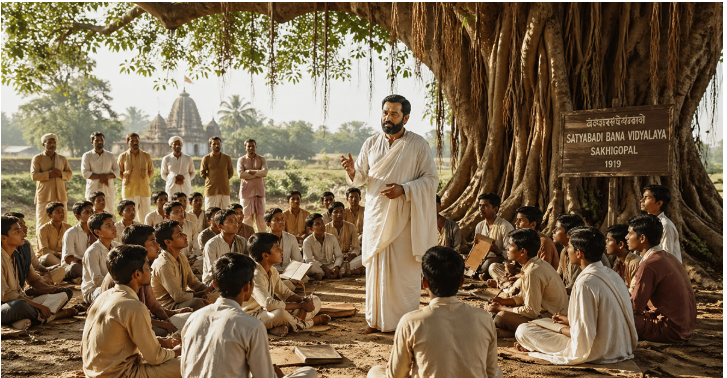
This image is AI-generated
During the early 20th century, the British Education system was shaping and colonizing the minds of the Indian youth by brainwashing them, teaching about their Empire’s greatness, and promoting the English Language and its values. At that time, a young visionary student named Gopabandhu Das, who had also studied in the English School, observed something deeply disturbing in the reality of Indian society. He learnt that the English texts, literature, western values, and their superiority were being taught, while demonizing the Indian traditions, history, and their values. The education system's objective was not to serve the motherland Bharat but to become subservient to the British Colonial Rulers. Satyabadi Bana Bidyalaya in the Sakhigopal pilgrimage center in the Satyabadi block of the Puri district, Odisha, India | Image Source: Wikipedia A stamp honoring Gopabandhu Das | Image Source: Reddit
Das witnessed the villages of Odisha and their lives being devastated by floods, the hope of people being crushed by extreme poverty, and the ignorance prevailing among the youth. Then Das realized something deeper and profound, that the English education system is not producing the welfare of society, but producing the servants of the British administrative machinery. After this, Das understood that India just doesn't need political freedom but a renaissance of the moral and intellectual awakening among the youth.
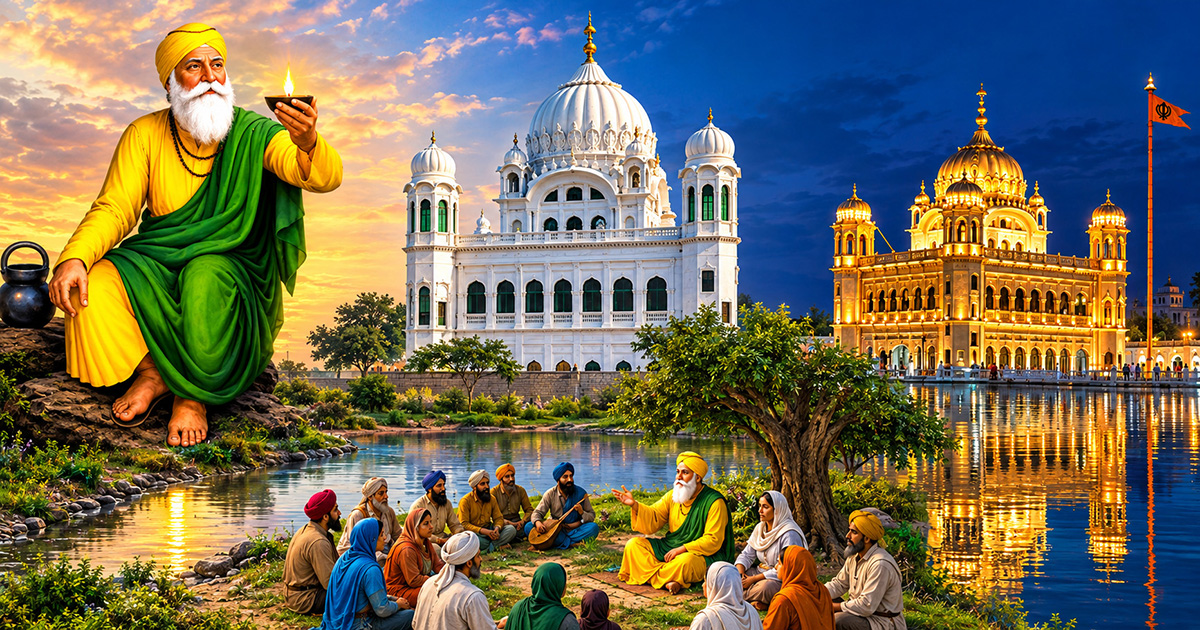
He was inspired by the Nationalist thoughts, ideas, and figures like Bal Gangadhar Tilak and the ancient-style Gurukul tradition and system. So in the year 1919, Das constructed a Gurukul-style school named Satyabadi Bana Bidyalaya in the Sakhigopal pilgrimage center in the Satyabadi block of the Puri district, Odisha, India. With no kind of colonial-style architecture, rigid benches, and a roof over it. The students sat down under the shadow of a banyan tree. It was not just an education but a rebellion against the British-style convent education system. 
The functioning of the school was noteworthy. With limited infrastructure and no such type of colonial-style classrooms, learning took place in the open space. In the curriculum, Odia was to keep them tied to the Indian identity, Sanskrit to ancient cultural heritage, and English as a tool for entering the modern world, not to be regarded as a marker of exclusivity. Math and science taught logical thinking, and history classes fired the imagination with India’s golden ages, heroes, and resilience in the face of foreign invasion. This indirectly nurtured self-respect and dismantled the superiority complex of the British system.
But the real teaching happened beyond the classroom. Discipline and service were the two pillars on which the school was built. Pupils were subjected to intense physical training as part of their education, and love and compassion were instilled through various activities. During a severe flood, the students joined in rescue and rehabilitation work to rebuild damaged houses, learning the value of compassion. They were reminded of the significance of service as an aspect of education. Sharing meals also helped to undo caste barriers, quietly challenging ingrained discriminations and social fragmentation imposed by society and colonial rulers. Each activity went towards holistic personality development.
financial problems
The Vidalaya had to face certain financial problems, but received sizable donations from the local villagers, support from the nationalist leaders, contributions from the teachers, and the limited student fees. This opened the way for the functionality of the Vidyalaya. 
A new breed of young people emerged from the sprawling banyan trees of Satyabadi, not subservient job seekers, but citizens capable of questioning, contributing, and leading. Gopabandhu Das, the founder of Satyabadi, was not just establishing an educational institution; he was orchestrating an awakening. While British institutions were cultivating conformity, he was fostering independence. In the context of cultural repression, he championed self-dignity, and while slavery was the order of the day, he encouraged thoughtful discourse leading to the eventual creation of a free India.