Rani Lakshmi Bai: The Jhansi Queen Whom No Camera Captured

Rani Lakshmibai of Jhansi is one of India’s greatest heroes, a fearless queen who fought the British in 1857 and became a symbol of resistance. Yet more than 160 years after her death, one question still sparks heated debate: Is there a real photograph of Rani Lakshmibai? The controversy over her photographs reveals the blurred lines between history, imagination, and digital myth-making.
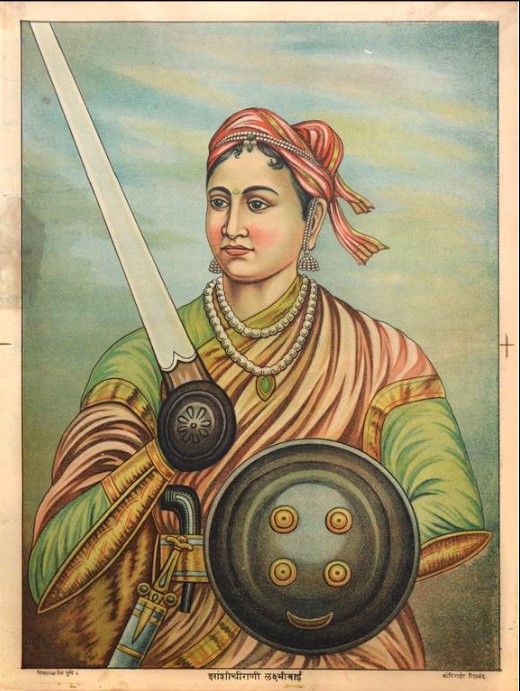
Rani Lakshmi Bai, the queen of Jhansi | Image Credit: The Indian Portrait
The Canvas Before the Camera
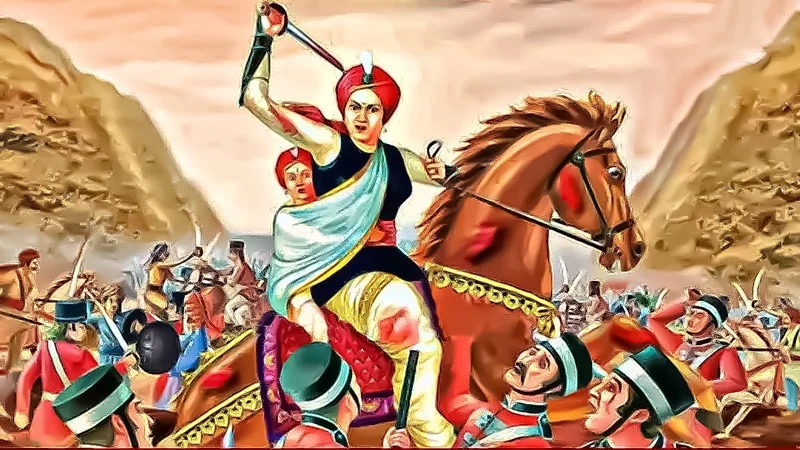
After her death in 1858, early images of the Rani that appeared were not photographs, but lithographs and paintings inspired by imagination. One famous lithograph from the late 19th century shows her on horseback with a sword and a child on her back. These artworks shaped the “image” of Rani Lakshmibai that Indians still recognise today.
They were often printed by nationalist publishers who wanted to honour her bravery. They helped elevate Lakshmibai into a symbol of resistance, yet they also cemented a single visual idea: The Rani as imagined by others, not captured by a camera.
The Viral Photograph That Started the Storm
Around the 2010s, a black-and-white portrait of a stern-looking woman in royal clothes began circulating online. It was shared widely on Facebook, WhatsApp, school projects, and even by some media pages. Posts claimed it was the real photograph of Rani Lakshmibai, taken by a “German photographer named Hoffman” in the 1850s.
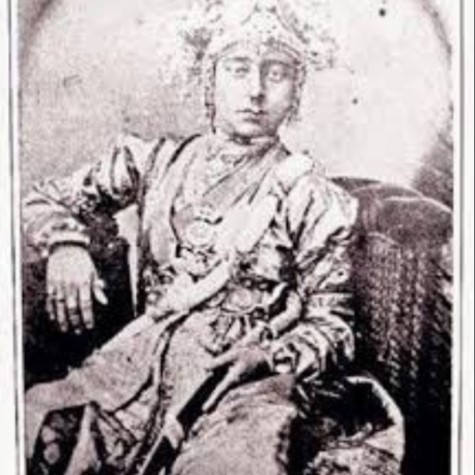
A photograph that was supposed to be of Rani Lakshmi Bai, clicked by German photographer Hoffman | Image Credit: Rare Book Society
But when historians dug deeper, the truth collapsed. Reverse image search traced the photo not to Jhansi, but to a princess of Tanjore. Historian Gordon, writing in reply to a blog post, revealed that the image is actually kept in the Royal Collection, captioned as “HH The Princess of Tanjore” and clicked by the Bourne & Shepherd studio. It is an album print from the 1870s, almost two decades after Rani Lakshmibai died in 1858.

The album showcases the supposed photograph of Rani, was actually a photograph of the Princess of Tanjore | Image Credit: Scroll
The pose, clothing, and modern look also raised doubts. As the blog noted, such staged studio photographs of Indian women were extremely rare in the 1850s — especially of a widowed queen fighting for her kingdom.
What We Actually Know
Historian Pramod Kumra pointed out that photography did exist in India by the 1840s, but it was mostly used by British officials, missionaries, and a few princely families. Jhansi was not a photography hub, and the Rani’s final years were spent in war, travel, and turmoil.
What survives are late 19th and early 20th-century artistic depictions: Oil paintings, lithographs, and calendar prints. Historian Mahmood Farooqui also noted that portrait photography for Indian women was not the norm in the 1850s. Additionally, given her political situation, social customs, and the chaos of 1857, it is highly unlikely that she ever sat for a studio portrait.

A drawn image of Rani Lakshmi Bai | Image Credit: EBNW Story
The Only Historical Description of Rani Lakshmi Bai’s Appearance
While we have no photo, we do have a rare and important written account describing her appearance. In 1854, Australian novelist and journalist John Lang briefly met Lakshmibai. He described her in The Mofussilite: “Her face must have been handsome when she was younger (the Rani was about 27 years old when Lang met her), and even now it had many charms. The expression was also very good and very intelligent. The eyes were particularly fine, and the nose very delicately shaped. She was not very fair, though she was far from black. She had no ornaments, except a pair of gold earrings.”
Lang even told her that if the Governor-General saw her greatness and beauty, he would return Jhansi to her. This remains the only detailed description we have from someone who actually saw her. “If the governor-general could only be as fortunate as I have been, and for even so brief a while, I feel quite sure that he would at once give Jhansi back again to be ruled over by its beautiful queen,” Lang had said.
Why the Controversy Matters
The desire for a real photograph comes from a simple human need: To see heroes the way they lived. A photo makes history feel real and personal. Rani Lakshmibai’s image is central to Indian nationalism: Statues, schoolbooks, and films all repeat her likeness as a symbol of courage and defiance. If that image turns out to be based on fiction, it raises questions about how visual memory is constructed and perpetuated.
Fact-checking platforms such as Factly and Telugupost have repeatedly debunked the viral photo claims. Still, each time the image resurfaces, thousands of new users encounter it for the first time, demonstrating the persistence of visual misinformation. In an era of digital virality, emotion often trumps authenticity.
The Power of an Image
A photo feels like a bridge across centuries, bringing a historical figure into tangible existence. The same instinct has driven similar controversies worldwide—from Cleopatra’s supposed portraits to the endless debates about Shakespeare’s face.
For India, the desire to visualise Rani Lakshmibai reveals an emotional need: to see the freedom struggle not as abstract history but as lived experience.
Separating Myth and Memory
Perhaps the truth is that we will never know exactly what she looked like. But that absence doesn’t weaken her story; it strengthens it. Rani Lakshmibai’s power has never depended on a single image—it rests in the narratives of bravery passed down through generations.
When we encounter yet another ‘real’ photo on social media, the best tribute we can pay to the Rani’s legacy is scepticism rooted in respect. As historians remind us, myths and memory both shape nations—but only truth preserves their dignity.
.png)