Battle of Saraighat: How Ahom Kingdom’s Use of Secret Routes of Boatmen Defeated Mughal Scouts

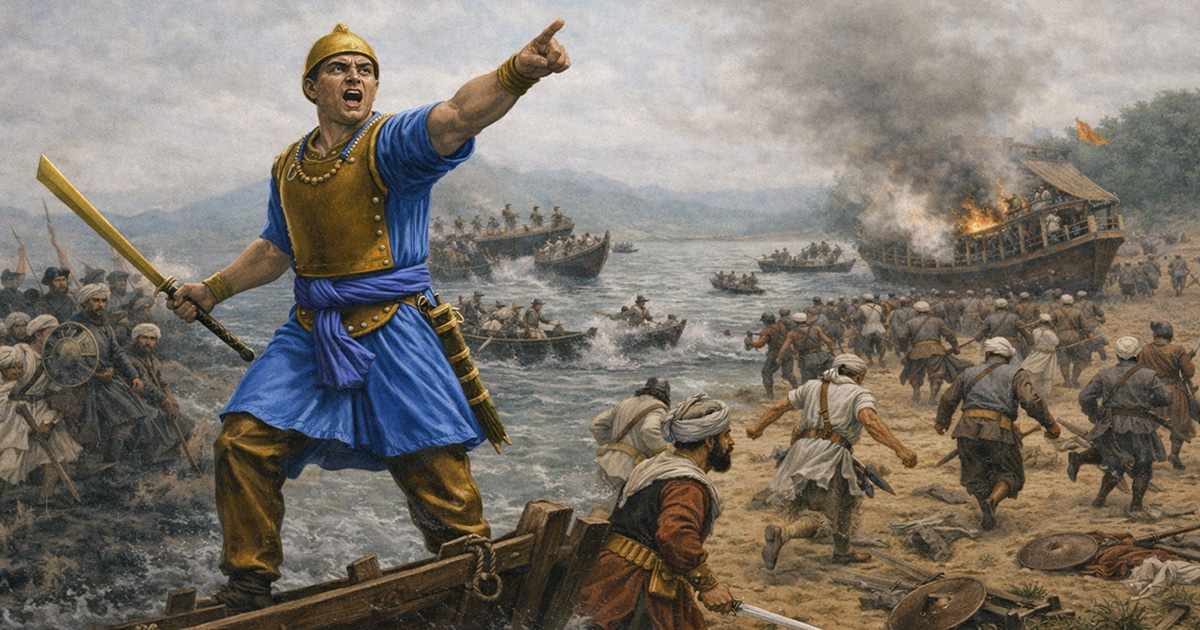
The Battle of Saraighat is considered one of the most important historical events during the Ahom kingdom (1228 CE–1826 CE). This battle played a crucial role in shaping the history of the Brahmaputra Valley and Northeast India. The battle took place on February 18, 1671, at Saraighat, near Guwahati. Considered one of the last major attempts by the Mughal Empire to expand into Assam and the surrounding regions, the Ahom dynasty was able to defeat the Mughals through intelligence, using the secret routes of boatmen to mislead Mughal scouts.

The Battle of Saraighat (A depiction on a stone plate in Saraighat War Memorial Park in North Guwahati)
Today, we explain how the strategy helped the Ahom kingdom in defeating the Mughals through the secret routes used by boatmen on the Brahmaputra River during the Battle of Saraighat. The Battle of Saraighat proved that if you have geography and local knowledge on your side, even a powerful empire can be defeated.
Preparations for the Battle of Saraighat
In 1671, the Ahom kingdom was facing a major attack from the Mughal Empire. On one side was the Mughal army, led by Raja Ram Singh, son of Mirza Raja Jai Singh, and on the other was the Ahom kingdom, led by Lachit Borphukan. It was then that the Ahom King Chakradhwaj Singha and General Lachit Borphukan understood that the Mughals had to be defeated not by force, but by intelligence. Hence, the Ahom Kingdom fought the Battle of Saraighat, not merely a military conflict, but through the extraordinary use of strategy, intelligence, and local knowledge. The secret routes of the boatmen helped in understanding the river’s currents, and this very strategy of misleading spies brought victory to the Ahoms.

Statues of Lachit Borphukan and his Army
Because Guwahati is situated on the banks of the Brahmaputra River and surrounded by hills on all sides, its geographical position made it relatively secure from external invasions. Lachit Borphukan understood that the Mughals had limited experience in naval warfare, and he intended to exploit this weakness. He identified a specific area called “Andharubali,” which connected the Nilachal Hills and the Takuchi region on the southern bank of the Brahmaputra with Ashwakranta on the northern bank. In his view, this location was the most strategically suitable area for battle against the Mughals. The southern bank of the Brahmaputra was directly under the command of Lachit Borphukan, while the northern bank was entrusted to Raja Alun Burhagohain, the prime minister of the Burhagohain and the military commander of the Ahom kingdom. Burhagohain was assigned the responsibility of constructing the necessary forts and defensive structures on both banks of the river.
In February 1669, Ram Singh arrived at the frontier fort of Rangamati. All the commanders of the Ahom army assembled in Guwahati and offered prayers at the Kamakhya Temple. Each commander was then provided with a designated number of soldiers along with the required weapons and ammunition.
The Ahom’s Strategy of Using Boatmen to Mislead Mughal Spies

Site map of the battle of Saraighat
The Brahmaputra is not just a large river. It is connected to numerous small canals, narrow waterways surrounded by sandbars, and temporary river branches formed during the monsoon season. Understanding the significance that the river held for the Ahom kingdom, the Mughal forces sent numerous spies before the battle to assess the navigability of the Brahmaputra River, to find out the location of the Ahom fleet, and to gather information from local boatmen and fishermen.
However, only the local boatmen knew these secret routes. The Ahoms used these paths to secretly move troops and supplies, to change boats in the darkness of night, and to take positions for surprise attacks. The Mughal spies found no trace of these routes. Only the boatmen knew every bend, sandbar, and hidden channel of the river; they knew where large boats would get stuck, and they understood which routes would lead the enemy into a trap. Lachit Borphukan devised a secret plan using these boatmen.
The Ahoms not only hid in the currents of the Brahmaputra River, but also deliberately spread misinformation—some boatmen were sent to the Mughal camp, where they said, “There is not enough water on this route, boats cannot pass,” “There are no Ahom boats in that direction,” when in reality, the Ahom fleet was using those very routes. They also employed other tactics, showing small boats during the day while hiding the main fleet, moving empty boats to create the impression that troops were being relocated, and silently changing their actual positions at night. This gave an impression to the Mughal spies that the Ahoms were retreating out of fear.
Nonetheless, the main objective of all these preparations was to lure the Mughals into the narrow waterways of Saraighat, which prevented the large Mughal warships from maneuvering properly, while the lighter Ahom boats could move swiftly. It was in this location that the Mughal strength weakened.
As a result, the Mughals could not understand where the Ahom boats were coming from, where the main force was hidden, or how large an attack awaited them. And it was due to this series of misunderstandings that the Mughal army suffered a devastating defeat in the Battle of Saraighat. After the defeat, the Mughal soldiers were forced to retreat from Guwahati. The Battle of Saraighat was a historic milestone in the reign of the Ahom kingdom. This battle holds special significance in the history of the Ahom kingdom, which ruled this region continuously for almost 600 years. The extraordinary leadership and military prowess of Ahom general Lachit Borphukan, who defeated the Mughals and recaptured the previously occupied territories, are still remembered with respect today.
.png)


.jpg)