Direct Action Day: When Calcutta Burned and Partition Became Inevitable

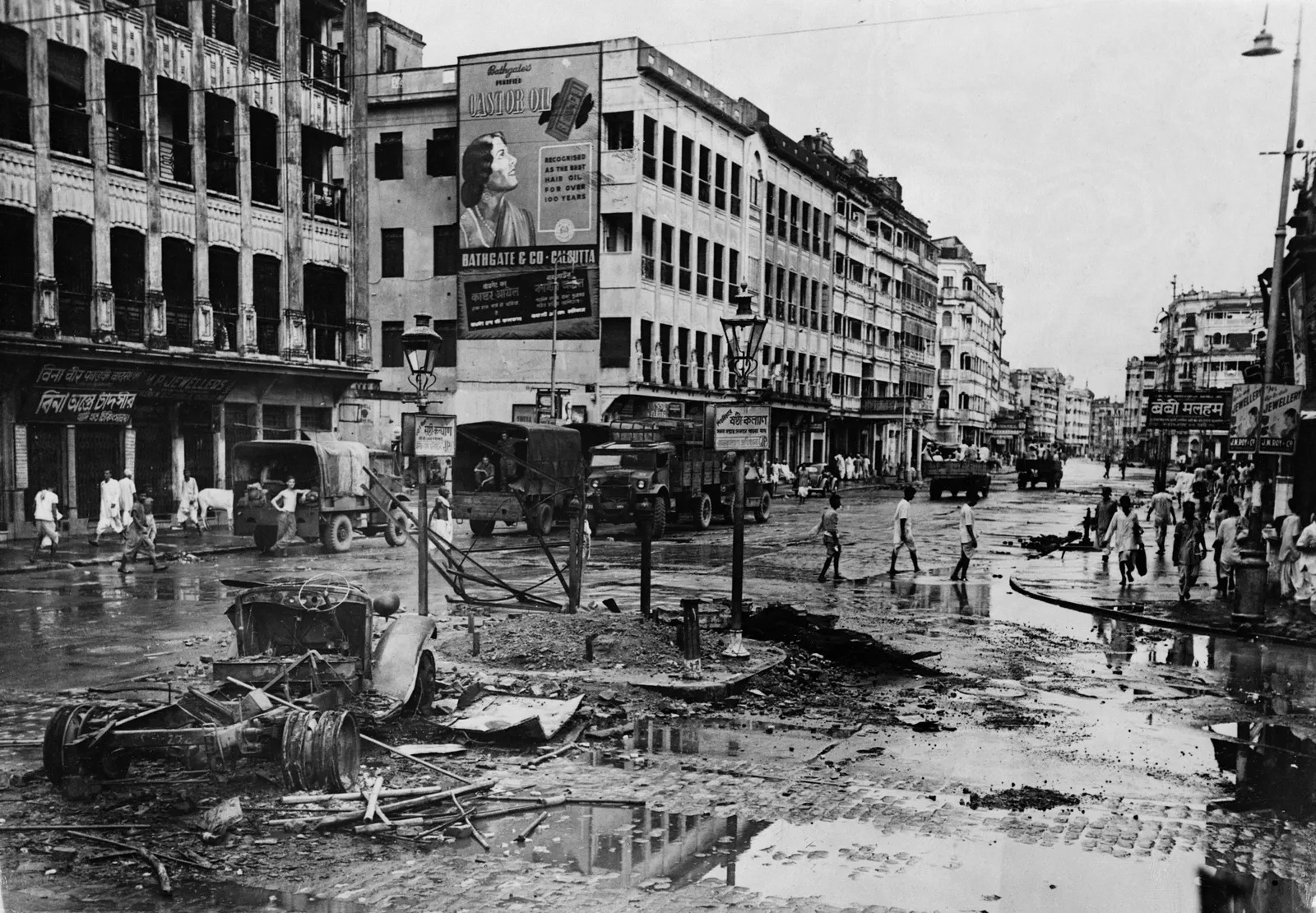
On 16 August 1946, Calcutta plunged into a blood-and-fire inferno. What was initially a political rally–Muhammad Ali Jinnah’s “Direct Action Day” call for Pakistan–gave way to one of the most horrific communal riots in recent Indian history. Bengal’s capital was a killing ground for four days, where between 4,000 and 10,000 people lost their lives, tens of thousands were hurt, and entire neighborhoods were reduced to smouldering heaps of ash. But aside from the sheer mortality figures, Direct Action Day signaled something much larger: political, administrative, and moral failure that broke the vision of Hindu-Muslim unity. It was here, in Calcutta’s streets, that Partition became all but unavoidable.
The Political Spark: Jinnah’s Ultimatum By mid-1946, the tenuous consensus between the All-India Muslim League and the Indian National Congress had fallen apart. The Cabinet Mission Plan—a bid to develop loose federal India—was sunk after Jawaharlal Nehru announced Congress would not be bound by “groupings” that basically granted the Muslim League a veto. Incensed, Jinnah hardened his position. On 29 July 1946, he urged Muslims to demonstrate their strength by a mass mobilization—”Direct Action”—in order to claim Pakistan. Bengal, with its Muslim majority and unstable politics, was selected as the setting. Calcutta would be the price to be paid.
Suhrawardy’s Bengal: A Government That Chose Collapse While Jinnah may have struck the match, Bengal Premier Huseyn Shaheed Suhrawardy let the fire spread unchecked. A devoted League man, Suhrawardy not only allowed huge rallies on 16 August but allegedly promised supporters police would be “restrained.” In the very center of Calcutta, the Muslim League held a rally at the Maidan, which attracted thousands. “Larke Lenge Pakistan” chants echoed through the air. Within hours of dispersal, mobs spilled into Hindu neighborhoods. Eye-witnesses remember shops plundered, temples set aflame, and men pulled out into the streets to be cut down to death. A retired policeman gave evidence: “He [Suhrawardy] had told us that he had organized police and military deployments… The moment the crowd broke up, they started attacking Hindus, setting fires to shops, plundering houses.” The Premier himself remained in the Police Control Room, allegedly preventing officers from taking independent action. The outcome: four days of uncontrolled bloodshed. Bipan Chandra would go on to write baldly: “Suhrawardy’s Muslim League Ministers in Bengal were widely regarded as either complicit or criminally negligent during the carnage.”
The Violence: Calcutta Becomes a Killing Field The riots quickly escalated to mutual massacres. Inciting speeches had already heightened the city; when violence erupted, neither side held back. Looting and arson swept markets.
- Hindus were dragged from homes, mutilated, and slaughtered in front of their kin.
- Temples were also desecrated in reprisal.
- Women raped and slaughtered; children hurled off balconies.
Historian Claude Markovits summed it up chillingly: “Not only were victims brutally killed, they were also grotesquely mutilated. What was new in Calcutta was the sheer scale of the phenomenon.”
By the end, Calcutta resembled a war zone—blackened buildings, corpses littering alleys, and families fleeing in desperation.
British Inaction: A Calculated Withdrawal The British, who were themselves shaken by World War II, looked on dispassionately. Prime Minister Clement Attlee’s Labour government had already determined that Britain could not hold on to India for more than a little while longer. War-weary militarily and financially, Delhi and London officials appeared more concerned with orchestrating a withdrawal of order rather than preserving lives at Calcutta. Viceroy Wavell got minimal assistance from London; even Attlee himself acknowledged Britain could “no longer afford to garrison an expansive empire.” Most British officials quietly assumed Partition was the only viable solution—and likely even a good idea, to cripple a unified India. Colonial police and army were sent too late, too insufficiently. The complacency allowed communities to look after themselves—and kill each other.
The Aftermath: A Nation Torn Beyond Repair Calcutta killings did not stop in Calcutta. They started a chain reaction: retaliatory killing in Noakhali, Bihar, Punjab, and elsewhere. What was once political discourse was now a struggle for survival. The vision of a plural, united India lay in ruins. As historian Mushirul Hasan remarked, “Direct Action Day was not merely a riot—it was the point of no return.”
By 1947, Partition had become a certainty. Direct Action Day had etched the line of blood across Bengal, and soon across India. Direct Action Day was not just a communal riot. It was a well-planned confrontation by Jinnah, consciously facilitated by Suhrawardy’s Bengal government, and exacerbated by British indifference. These combined forces made Calcutta the crucible where India’s destiny was forged. The violence in August 1946 did not only murder thousands—it murdered trust. And with no trust left, Partition was all there was to the future.
.png)