The Death of Swami Vivekananda: A Legacy Beyond Mortality

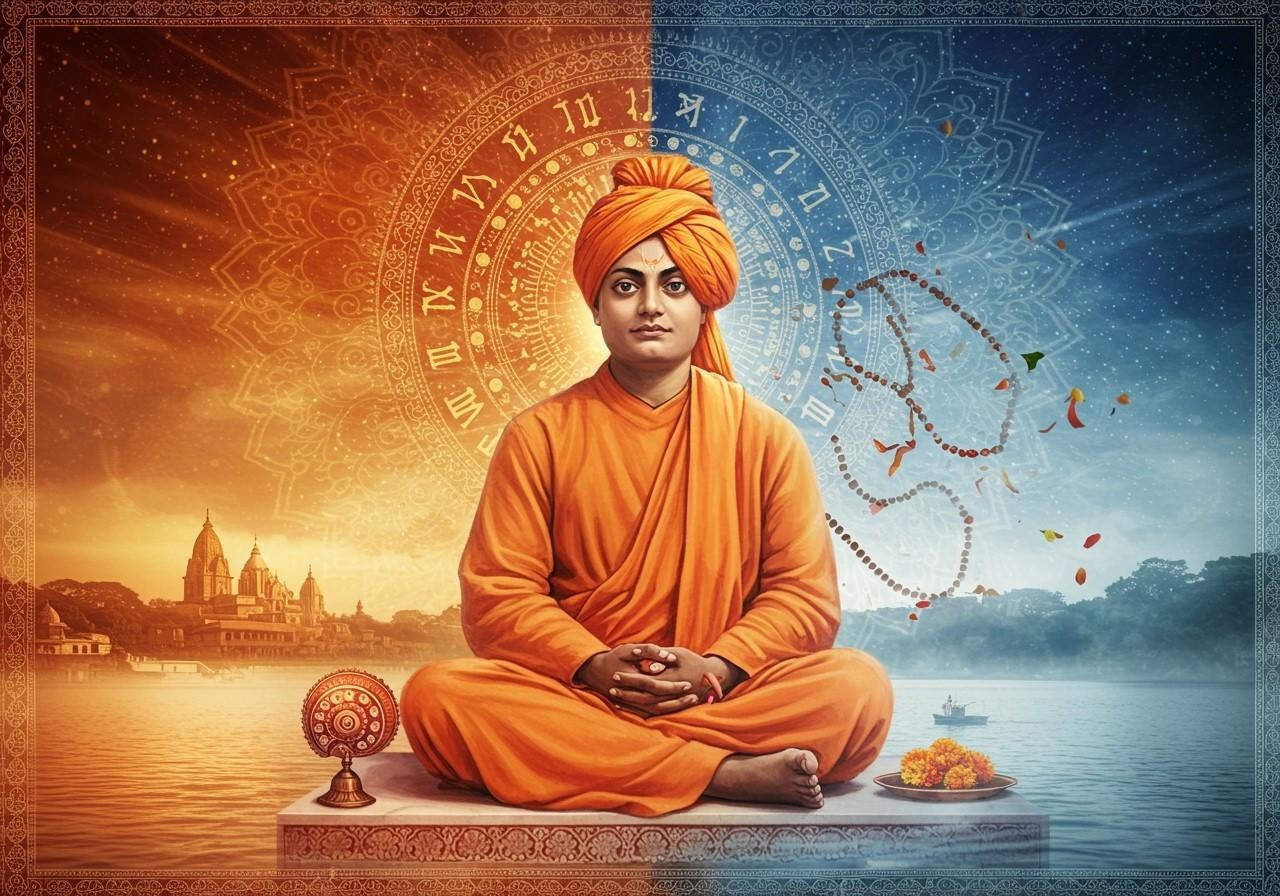
On the evening of July 4, 1902, India lost one of its most powerful spiritual visionaries and national icons, Swami Vivekananda. The news of his death shook not just India, but also reverberated across the globe. At the age of just 39, Vivekananda’s earthly journey came to an end, but his ideas, mission, and teachings continue to shape India’s soul and inspire seekers worldwide. His death was not just a biological event, it marked the dawn of a spiritual revolution and a revival of Indian pride during the dark days of colonial rule.
Early Life and Spiritual Foundations
Born as Narendranath Datta in Kolkata on January 12, 1863, into a well-educated, aristocratic Bengali Kayastha family, Vivekananda was always spiritually curious. From his childhood, he displayed an affinity toward meditation, prayer, and philosophical inquiry. He was nicknamed “Naren” or “Bile” by his family and was known for his prodigious memory, physical vigor, and questioning intellect.
His father, Vishwanath Datta, was a rationalist and attorney, while his mother, Bhuvaneshwari Devi, was a deeply religious woman. This blend of rationalism and spirituality shaped young Naren’s worldview. Despite his exposure to Western logic through education, he yearned to understand the existence of God in a personal way.
In 1881, Naren met Sri Ramakrishna, the mystical priest of Dakshineswar Kali Temple. Initially skeptical of Ramakrishna’s intense devotion and spiritual ecstasies, Naren’s rational mind clashed with the saint’s divine experiences. But over time, he accepted Ramakrishna as his spiritual guru.
Ramakrishna recognized Naren’s potential early on and declared him his spiritual successor. In 1886, shortly before his death, Ramakrishna initiated Naren and a few other disciples into monkhood. Naren later took the monastic name “Swami Vivekananda”, an identity given to him by Maharaja Ajit Singh of Khetri before his voyage to the West.
Wanderings Across India and Rise as a Monk
From 1888 to 1893, Swami Vivekananda traveled across the length and breadth of India, observing the poverty, caste divisions, and spiritual decay under British rule. These travels hardened his resolve to awaken India’s collective soul. He realized that true nationalism must be rooted in spirituality, strength, and social upliftment.
He also recognized the need for global awareness of India’s rich philosophical heritage. This idea led him to represent Hinduism at the World’s Parliament of Religions in Chicago in 1893.
Chicago 1893: Awakening the World to Hinduism
On September 11, 1893, Vivekananda addressed the Parliament with the famous words “Sisters and Brothers of America.” The audience erupted in applause. This wasn’t just an introduction, it was a cultural awakening. In his speeches, Vivekananda eloquently articulated the depth of Hindu philosophy, Vedanta, and Yoga. He spoke of religious tolerance, the divinity of all beings, and unity in diversity, principles that the modern world still grapples with.
His impact was profound. American newspapers described him as “an orator by divine right” and the “greatest figure in the Parliament of Religions.” Overnight, he became a global spiritual leader, challenging the West’s colonial view of India as a land of snake charmers and superstition.
Vivekananda’s core philosophy was universal and timeless: “Each soul is potentially divine.” He taught that liberation could be achieved through selfless service (karma yoga), devotion (bhakti yoga), discipline (raja yoga), and knowledge (jnana yoga). He simplified Vedanta for the modern mind and urged Indians to blend spirituality with action.
Back in India, he called upon the youth to develop muscles of iron, nerves of steel, and minds like thunderbolts. He linked nationalism with service, asking people to worship God by serving the hungry, the poor, and the downtrodden. His ideals laid the foundation for future freedom fighters.
Inspiration to India’s Freedom Movement
Swami Vivekananda’s influence on India’s independence struggle was immense. Netaji Subhas Chandra Bose called him the “maker of modern India.” Mahatma Gandhi said that after reading Vivekananda’s works, his love for the country grew a thousandfold. Sri Aurobindo saw in him a bridge between the ancient and the modern, the spiritual and the national.
While he didn’t fight with weapons, Vivekananda’s sword was his speech, his pen, and his philosophy, infusing courage and self-confidence in a colonized society.
On July 4, 1902, coincidentally American Independence Day, Swami Vivekananda passed away while meditating in his room at Belur Math. His disciples believe he consciously left his body in a state of deep meditation, known as Mahasamadhi. Medical reports cite the rupture of a blood vessel in the brain as a possible cause.
He had prophesied that he would not live past 40, and he died at 39. His body was cremated beside the Ganga, opposite the place where his guru Ramakrishna had been cremated 16 years earlier.
Swami Vivekananda’s death was not the end, but the continuation of a mission. He ignited a spiritual and national awakening that reshaped India’s future. He brought back Hindu pride, gave youth a sense of purpose, and reshaped India’s global image.
His Ramakrishna Mission continues to promote education, healthcare, and disaster relief based on his principles. His birthday, January 12, is now celebrated as National Youth Day across India.
Vivekananda in Today’s World
In an age of stress, identity crisis, and spiritual confusion, Vivekananda’s teachings are more relevant than ever. His call for fearlessness, self-belief, and service to mankind resonates deeply with modern youth. His message of interfaith harmony is essential in a polarized world.
He also spoke on women’s empowerment, scientific temper, and caste reform, issues still central to India’s progress. He urged people not to escape the world but to transform it through inner strength.
Swami Vivekananda’s death was not a sunset but the beginning of a blazing dawn. He lit the fire of national consciousness and reconnected India with its soul. His timeless teachings remain a guiding star for all who seek courage, wisdom, and service.
His words still echo: “Arise, awake, and stop not till the goal is reached.” Even in death, Swami Vivekananda continues to live within every Indian heart that beats for strength, truth, and spiritual awakening.
.png)