The Monk Who Built the First Hindu Temple in San Francisco—and Died Within Its Walls

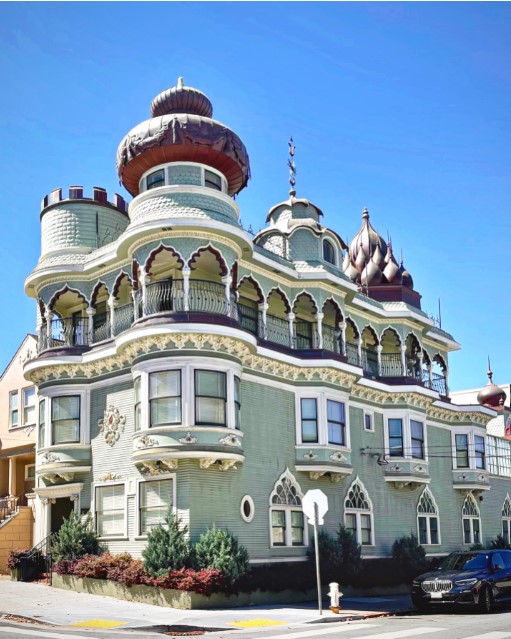
On a foggy December morning in 1914, a thunder occurred inside San Francisco’s Old Vedanta Temple. Amid the smoke and splintered glass lay Swami Trigunatitananda, wounded by a bomb thrown by one of his own students.
Two weeks later, on January 10, 1915, the Swami surrendered his life, becoming the first martyr of the Ramakrishna Vedanta Movement in the West. Yet the temple he built still stands today as one of the first Hindu temples of the West. How did he build this temple? We take you through this story of the monk who built a temple in 1902.
A Dream Across Oceans
Twelve years earlier, in 1902, Trigunatitananda had arrived in San Francisco, a city of ambition and invention, but with little understanding of India’s thought. Inspired by his teacher, Swami Vivekananda, he sought not just to preach Vedanta but to give it form through a temple that would stand as a model of Indian education.
“We shall build a temple here — one that proclaims the oneness of mankind,” he declared to his small circle of followers. Surprisingly, they had no money, no land, and no precedent — only faith. However, within months, donations trickled in: Five dollars from a teacher, a handful of coins from laborers, a widow’s jewelry, and one large gift from an anonymous woman devotee.
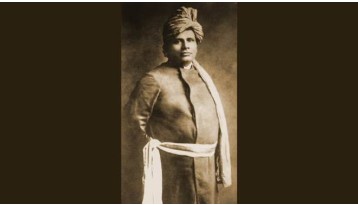
Swami Trigunatitananda: The founder-monk who built the first Hindu temple in the Western Hemisphere
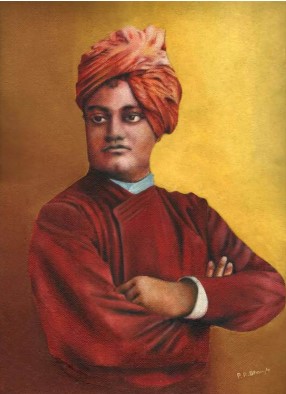
Swami Vivekananda (1863-1902): The spiritual predecessor whose vision the Swami sought to realize in America
The Impossible Construction: Five Months of Devotion
In early 1905, once the land on Webster Street was secured, the Swami approached architect Joseph A. Leonard, a skilled designer open to experimentation. He handed Leonard rough sketches, drawn by his own hand on folded papers — bulbous domes, pointed arches, slender minarets, towers that blended Bengal’s temple traditions with California’s castle architecture.
“It must represent the meeting of East and West,” the Swami explained, a symbol of multi-cultural unity.
Leonard studied the designs carefully. The commission was unconventional, the budget minimal, the timeline absurd, but he sensed the Swami’s sincerity. “It can be done,” he said, “if we start immediately and work without pause.”
And so, on August 21, 1905, the puja was very unique: Sanskrit chants mingled with English hymns; Hindu priests in traditional dress stood beside Christian witnesses and Jewish observers. The Swami himself worked the trowel, his fingers pressing earth and stone in a gesture that seemed to join two worlds.
What followed was unprecedented: A race against time and nature itself. The Swami appeared on the scaffolding each morning as fog rolled across the Bay. He meditated in pre-dawn darkness, then climbed among the workers, blessing each stone, each beam. He lived frugally, eating sparse meals, sleeping in the incomplete structure, his presence a constant reminder of the sacredness of the work.
The Funds and the Faith
The total construction cost was approximately $70,000—substantial for 1905 but minuscule for a structure of such grandeur. Yet no grand donation ever arrived. Instead, the temple was financed by a thousand small acts: Temple worship collections, Sunday dinners organized by devotees, lecture fees donated entirely, the sale of Vedantic texts, and Sanskrit manuscripts. The Swami personally toured the city, speaking in churches, at universities, in drawing rooms, converting his speeches into practical support.
The Architecture of Universality
The temple that rose from those funds was architecturally stunning: A deliberate syncretism. Its exterior featured Mughal arches reminiscent of the Taj Mahal and Indo-Islamic monuments; its domes were modeled on Bengal’s sacred architecture; its towers echoed medieval European castle keeps. Inside, the sanctum retained Hindu iconography, yet the meditation hall was designed to welcome all faiths. Sanskrit, English, and even Pali prayers were inscribed on its walls.
The completed Vedanta Temple showcasing its unique fusion of Eastern and Western architectural traditions, with distinctive white domes
By January 7, 1906, construction was complete. What had seemed impossible, a fully functional Hindu temple built in five months by a spiritual community with minimal resources, was realized. On its dedication day, hundreds gathered. The Swami performed rituals, but also invited Christian clergy to bless the sanctuary and Jewish scholars to speak from its pulpit. The temple doors opened not to exclusivity but to universality.
Witnesses reported the Swami’s words that evening: “If we have built this with pure intention and unswerving faith, even an earthquake shall not shake it. God will protect what is built for Him.” The same year, the temple survived the San Francisco earthquake.
Legacy and Continuity: A Civilisational Continuity
The Old Vedanta Temple at 2963 Webster Street stands today much as it did in 1906. It remains not merely a building but a statement that India’s ancient spiritual tradition could flourish in foreign soil and endure against natural catastrophe.
This is the nature of civilisational continuity: great individuals plant seeds that outlast their bodies.

.png)