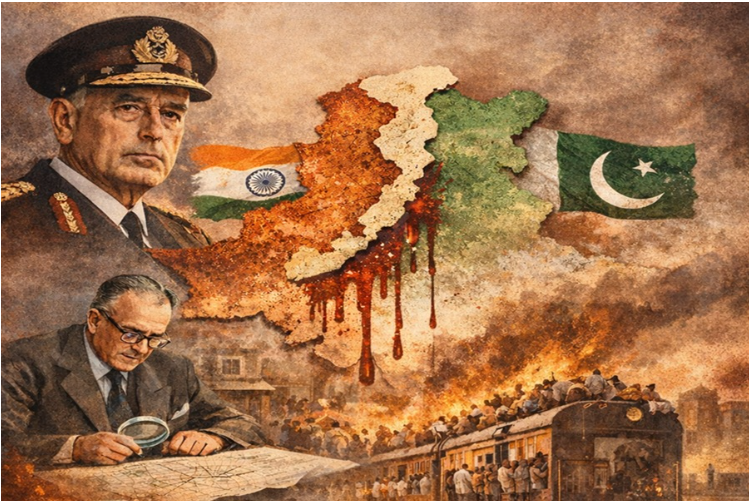
The Slaughters India Forgot: Blood-Soaked Partition in Bengal, Gujarat, and Punjab

The Partition of India in 1947 is often remembered through political negotiations and the birth of two nations, but buried beneath official narratives lies a blood-soaked history of unspeakable horrors. Across Bengal, Gujarat, and Punjab, mass slaughters unfolded with chilling brutality, entire trains turned into slaughterhouses, villages razed, and thousands butchered in the name of religion and revenge. These massacres, erased or silenced in mainstream history, left behind survivors with shattered families and unhealed wounds.
1. Punjab’s Blood‑Soaked Trains & Village Pogroms In March 1947, with the collapse of the Unionist coalition in Punjab, Muslim League National Guards launched a calculated assault on Sikh and Hindu villages in Rawalpindi Division. Over a few days, 2,000–7,000 Hindus and Sikhs were slaughtered, while systematic rape, forced conversions, and mass burials became common. Entire communities were wiped out in places like Thamali and Bhagpur, where villagers perished, places of worship were burnt, and survivors recount forced circumcisions, a brutal effort to erase religious identity.
Train Massacres: Kamoke, Amritsar & Gujarat Refugee trains became orchestrated death traps. At Kamoke (September 24, 1947), a Muslim mob, backed by League National Guards and railway staff, halted a refugee train carrying 3,000–3,500 Hindu-Sikh civilians. In the ensuing massacre, official figures cite 408 dead, although survivors suggest thousands were killed and around 600 women abducted for forced conversions. A contemporary report described an attack lasting 40 minutes, with 340 killed and 250 wounded.
Barely a month later, on September 22, the Amritsar train massacre saw Sikh jathas slaying approximately 3,000 Muslim refugees, with another 1,000 wounded. Armed with guns, swords, and spears, these attackers brutally cleared trains bound for West Punjab.
Then came the January 1948 Gujarat massacre: a refugee train from the NWFP, carrying 2,400 Hindus and Sikhs, was diverted to Gujrat station. Once abandoned by its engine, the train was set upon by armed Pashtun mobs. Approximately 1,300–1,600 refugees were killed, with only around 750 managing to escape, some after British Gurkha soldiers ran out of ammunition.
Village-Level Sieges and Targeted Extermination
In Western Punjab, particularly in Sheikhupura, the violence against Hindus and Sikhs reached genocidal proportions. Muslim militias, often led by Zaildars (landed elites) and local Muslim League leaders, orchestrated coordinated attacks on non-Muslim villages. Over just two days, an estimated 10,000 to 20,000 Hindus and Sikhs were slaughtered. The violence was not random; local police, civil officers, and even segments of the military aided or deliberately ignored the killings. Eyewitnesses recount horrific scenes of mass rapes, abductions of women, and children being thrown into burning homes. Entire villages were razed, and survivors had to flee without aid or justice.
2. Bengal’s Hidden Carnage & Noakhali Riots (1946–47)
The Noakhali riots erupted in October 1946 in present-day Bangladesh’s Noakhali and Tipperah district, fueled by long-standing economic resentment, Hindu moneylenders versus impoverished Muslim peasants, and communal agitation. Organised Muslim League, backed mobs attacked Hindu communities on Kojagori Lakshmi Puja, killing thousands (5,000 according to survivor and academic estimates), burning homes and temples, forcibly converting Hindus, abducting women, and using sexual violence as a systematic weapon. In one harrowing first‑person account, Mrs. Barmala Roy describes mobs dragging men into fires, murdering them in front of religious idols, and looting female survivors. This was not impromptu mob fury, it was a premeditated, coordinated attack involving militias like the Miyar Fauz and Kasemer Fauz.
Despite clear warnings from intelligence, both the Muslim League provincial administration under Huseyn Suhrawardy and the British colonial government delayed interventions, imposed media blackouts, and impeded timely relief efforts. The result was mass displacement, nearly 150,000 Hindus fleeing across Bengal, and deepening communal fissures. Muhammad Ali Jinnah’s earlier “Direct Action Day” in Calcutta had already set the stage for this bloodbath.
Direct Action Day, Calcutta Killings
On 16 August 1946, the Muslim League called for a mass strike, declaring “Direct Action”. Violence erupted across Calcutta, with organised attacks on Hindu neighborhoods using iron rods, lathis, firearms, and incendiary tools. The carnage, estimated at 5,000–10,000 dead, with tens of thousands displaced, was orchestrated on the orders of Suhrawardy, who deliberately restrained police, effectively unleashing brutal mobs. A particularly horrific episode occurred at Kesoram Cotton Mills in Metiabruz, where laborers were massacred under Muslim League leadership. This event is widely regarded as the inflection point pushing Bengal toward fracturing, and sowed seeds for the Noakhali massacres that followed.
Hindu killings in East Bengal post‑Partition Following Partition in 1947, violence against Hindus in East Bengal surged. Although less documented than pre-Partition riots, these mass killings, abductions, and forced conversions continued unabated, prompting waves of migration into India. Survivors report entire families wiped out, women kidnapped, and villages emptied of Hindu populations . Relief efforts struggled amid chaotic administration and little political will; reconstructing exact death tolls remains difficult due to scant records, but the violence was a clear continuum from the pogrom-era atrocities.
Role of Akalis, Muslim League militia, tribal lashkars While Bengal saw militant actions by Muslim League‑affiliated groups like Suhrawardy’s private militias (e.g., Miyar Fauz, Kasemer Fauz), the Akalis played a very important role in organising Sikh defense against Muslims in that region. Muslim League militias were key instigators in Calcutta and Noakhali, with leadership from Suhrawardy and Husseini providing direction, weaponry, and impunity. In rural contexts, tribal lashkars reinforced communal pogroms, targeting vulnerable villages for clearance and conversion. These were not spontaneous mobs, but coordinated communal militias with political backing, whose actions starkly reflect how local leadership weaponised identity and fear to commit genocide.
3. Gujarat’s Ghost Train of Gujrat (1948) In the dark of January 11–12, 1948, a passenger train carrying nearly 2,400 Hindu and Sikh refugees from Bannu (NWFP) was diverted at Khushab Junction and left stranded at Gujrat station in Pakistan’s Punjab. The locomotive was hijacked; only the vulnerable carriages remained, packed with fear-stricken families hoping for safety across the border.
Post‑Partition Refugee Train Massacre (Jan 11–12) Once the escort, about 60 Gorkha soldiers, exhausted its ammunition, thousands of Muslim Pathans attacked, wielding rifles, swords, sickles, and spades. Between 1,300 and 1,600 refugees were massacred, approximately 150 wounded, and only around 750 survived. A survivor’s niece recounts Parvati Devi’s memory of “blood dripping” on her sleeping brother, the first chilling shot that turned their water-swirls into death.
Local Complicity, Erasure from Public Memory Evidence strongly suggests the attack was premeditated: the train’s diversion, the engine’s escape, and the delayed rescue indicate railway staff and possibly stations’ network officials were complicit. For decades, this tragedy remained buried under the political aftermath of 1947; only in recent years, survivors felicitated in 2022–23 by local leaders in Faridabad, have these stories emerged into public consciousness.
Role of Akalis, Muslim League Militia, Tribal Lashkars While direct proof of Akali or Muslim League National Guards involvement in this specific train atrocity remains elusive, context shows that Muslim League paramilitary militias and tribal lashkars (Pathan fighters) orchestrated similar train attacks during Partition. For example, in Punjab (Kamoke, Rawalpindi), Local railway officials and Muslim League National Guards frequently aided mobs targeting refugee trains. Tribal lashkars mobilised Pathan fighters for cross-border operations (e.g., Operation Gulmarg), showing their coordinated reach. Anecdotally, survivors note how attackers, possibly trained or armed by these groups, rushed in with military precision once escorts were neutralised. A Sikh encyclopedia even indicates that Pakistan military and Pathan lashkars “put to death wounded refugees” deliberately.
4. First Person Testimonies
Parvati Devi – Gujrat Train Massacre (Jan 1948) Parvati Devi’s family, like countless others, was forced to abandon their ancestral home in the North-West Frontier Province (now Khyber Pakhtunkhwa, Pakistan) under mounting pressure from local Muslim leaders and neighbours. What began as subtle isolation turned into open hostility, warnings became threats, and social ties collapsed under the weight of religious divide. Surrounded by growing unrest and fearing for their lives, her family boarded a train meant to carry them to safety. But that illusion shattered when the train was mysteriously diverted from Khushab toward Gujrat city railway station in Pakistan’s Punjab—a place they were never supposed to be.
As night fell, a single bullet pierced the darkness, striking Parvati’s mother. It was the first shot fired, but not the last. What followed was a brutal onslaught: a mob of armed Muslim men, driven by vengeance and communal hatred, descended on the train with rifles, swords, spades, and knives. The 60-odd Gorkha regiment soldiers aboard resisted valiantly, defending the passengers through the long night. But when their ammunition ran dry, the defense crumbled. Those who survived the firefight were hunted down, slaughtered ruthlessly by a Muslim mob determined to ensure no one was left alive.
Chunni Lal Bhatia Then there’s Chunni Lal Bhatia, also a passenger on that same Gujrat-bound train. He huddled with his father through a night of violence, narrowly escaping a Pathan abducting mob at daybreak, rescued only by arriving troops. Both Parvati and Chunni were recently among survivors felicitated on Partition Remembrance Day, keeping their raw testimonies alive.
Peshawari Lal Bhatia Peshawari Lal Bhatia, just six years old during Partition, fled Peshawar with his family aboard a refugee train that quickly turned into a nightmare. He remembers bullets piercing through carriages, people collapsing around him, and lifeless bodies being thrown off the train like garbage. Amid the carnage, he saw something haunting, money hidden inside torn clothing of the dead, wrapped in bandages or sewn into garments. Decades later, the image of blood, chaos, and desperation still haunts him. In an August 2023 interview, he said, “We were children, but that day we became old.
Mother of Rose Kumar – September 21, 1947 Massacre On September 21, 1947, Rose Kumar’s mother, just eleven years old then, was aboard a refugee train fleeing Pakistan when it was ambushed by mobs. She witnessed her parents and brother slaughtered in front of her eyes. Blood filled the train compartment as attackers showed no mercy. Out of the entire carriage, only three people survived, including her. Though she physically escaped, her soul never left that train. For the next seventy years, she lived in silence, haunted by the memory, her trauma becoming part of her daughter’s inheritance. It wasn’t just a massacre, it was the end of her childhood.
Avtar Singh – Village Siege and Loss Avtar Singh was just a boy when his village in Punjab was attacked during the Partition. He watched in horror as his entire family was slaughtered, his mother and sister killed before his eyes. A neighbor woman, in a desperate act of mercy, flung his sister’s body into a well and urged Avtar to run. He fled, barefoot and bleeding, joining a caravan of refugees. For ten days, he wandered through bloodied fields and broken towns, finally reaching a refugee camp. Traumatised, he didn’t speak for weeks.
5. Psyche of Violence: Who Killed Whom and Why
Neighbours Turned Executioners: When Trust Collapsed Overnight
One of the most harrowing realities of Partition violence was the transformation of neighbours into murderers. In Sialkot, a region known for its syncretic culture, families who had shared meals and marriages for generations found themselves on opposite sides of hate. Local Muslims, often egged on by League propaganda or seeking abandoned property, turned on their Hindu and Sikh neighbours. Entire families were dragged from homes, women were abducted, and men hacked to death with farming tools. Survivors often remarked that the most brutal attacks came not from strangers but from people they knew by name.
As documented in literary and real-life testimonies, this betrayal was rooted not just in religious hatred but opportunism. Property looting, seizing of homes, and vendettas over land or caste animosities were cloaked under the veil of communal duty. A resident of Sialkot, interviewed in multiple oral history projects, said, “My father’s best friend became our killer. He wanted our haveli.”
Dhaka and the Role of Hate Sermons and Mass Mobilisation
In Dhaka and across East Bengal, violence followed a similar pattern but with a heightened influence of religious sermons and propaganda. During the Direct Action Day riots in 1946, local mosques played a pivotal role. Imams, responding to League leadership’s call for “Muslim India,” began delivering incendiary speeches labelling Hindus as “enemies of Islam.”
This communal radicalisation from the pulpit created a psychological frame where violence felt not only justified but sacred. Multiple eyewitnesses in Dhaka and Noakhali recount how mobs emerged after Friday prayers, with machetes and kerosene, chanting “Allah-o-Akbar,” targeting Hindu homes. It was not spontaneous, it was organised. Mobs knew which homes were wealthier, which families had daughters of marriageable age, and which temples stored gold.
Ludhiana: Class, Caste and Revenge Murders
In Ludhiana, the violence escalated into caste-infused class warfare. Upper-casteHindu landlords were often the targets, not merely for their religion but for their economic standing. Land hunger, long-simmering caste rivalries, and resentment against feudal systems exploded during Partition. Poorer villagers, who previously worked as labourers or tenants, turned on landlords and seized property.
.png)