When Raman Represented Flagless Bharat in 1930 at Nobel Banquet: Remembering Bharat Ratna C.V. Raman

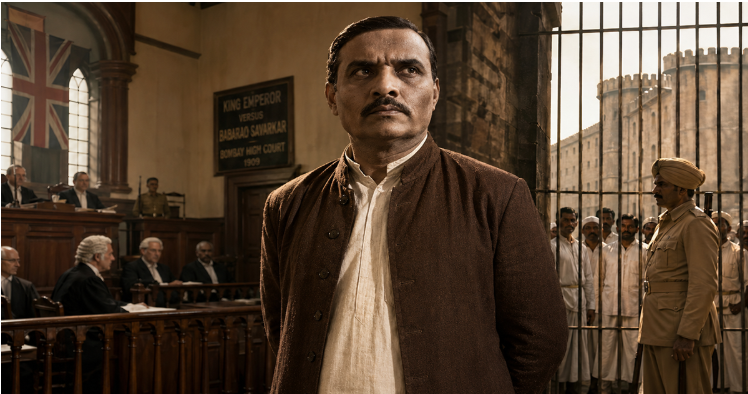
It is a common ritual in many award ceremonies to display the national flag of the winner’s country during the event. Imagine what Bharat Ratna C.V. Raman must have felt when, at the Nobel Banquet in 1930, he had to sit beneath the British Union Jack—a symbol of India’s colonial struggles at the time.
Let us rewind back to the grand concert hall of Stockholm in December 1930, when surrounded by a sea of Western faces, Sir Chandrasekhara Venkata Raman stood as the sole Indian laureate, an emblem of his entire nation’s hopes and dreams. Yet, beneath the pomp of this historic occasion lay a bittersweet truth: there was no Indian flag in reality to represent the winner.
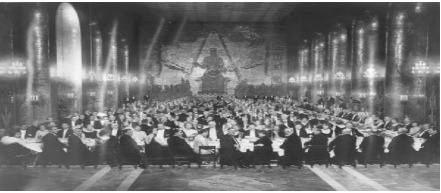
C.V. Raman at the Nobel banquet, the one in white turban | Credit: Citizen Matters
Instead, the British Union Jack—the banner of colonial rule—hung overhead. This stark absence struck Raman profoundly. In his own reflections, it was upon turning to look at this symbol of foreign domination that the full weight of his representation of a flagless India hit him, moving him deeply.
As C.V. Raman returned to his seat after receiving the Nobel Prize for Physics for his discovery of the “Raman Effect”, he was completely overwhelmed and had tears down his face. This was the extraordinary journey of a man who propelled flagless Bharat to the world stage of science and beyond.
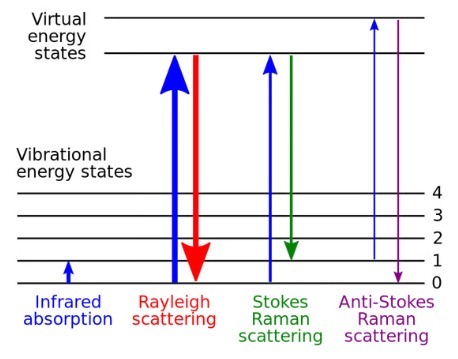
The Raman Effect | Credit: Moxfyre, based on the work of Pavlina2.0/Wikimedia Commons
Raman started his research to understand the scattering of light in 1921, which ended on 28 February 1928. 7 years before he won the Nobel, he began his work on Quantum Physics and the Raman Effect. As early as 1925, 5 years before he was awarded the Nobel, he had written to industrialist G.D.Birla for financial assistance to procure a spectrograph—a scientific instrument for his work. In his letter, he wrote, “If I have it, I think I can get the Nobel Prize for India.”
Three years after this, in 1928, Raman shared his discovery in a letter to Nature, a top science journal. Prof. R. W. Wood, a well-known physicist from Johns Hopkins University, replied, saying that Raman’s discovery was impressive and he had verified it completely. This discovery helped scientists explore new parts of the infrared spectrum and supported the quantum theory.
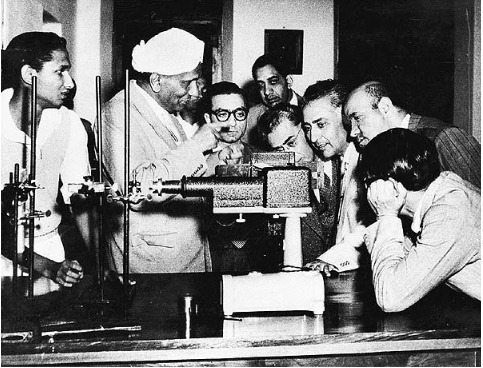
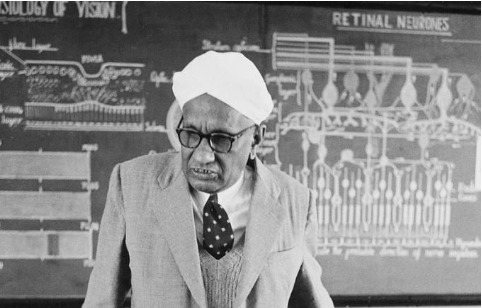
C.V. Raman explaining the “Raman Effect” | Credit: Library KV Pattom
In 1929, Lord Rutherford spoke about Raman’s discovery during a Royal Society meeting. He said it was important for studying molecules and would open new research opportunities. Many scientific papers about the Raman Effect came out quickly—about 150 in a year, and 350 by mid-1930.
Raman received many honors. He was given the Matteucci Gold Medal for the best physical discovery, was knighted by the British government, invited to speak at the Faraday Society in London, and earned honorary degrees and memberships from universities and scientific groups.
Even though India was still under British rule, Raman’s achievement brought international attention to the country.
In fact, he was so confident about his work that he was expecting an announcement in 1928 and 1929, much to his disappointment, newspapers carried no good news.
In 1930, Raman was so confident that much before the Nobel Prizes were announced, he purchased two steamship tickets (for his wife as well) to Stockholm. This bold step reflected an extraordinary confidence that his work would soon be recognized on the world stage.
His wife, Lokasundari Ammal, recalled the events at the Nobel Banquet. At the banquet after receiving the Nobel Prize, Raman spoke simply but powerfully about Bharat. He talked about the greatness of ancient India and how its rich culture and teachings still mattered. He mentioned Buddha’s message of peace and kindness, showing that India’s spirit was alive even though the country was under colonial rule.
Raman’s Nobel Prize was more than a personal accolade; it became a beacon of India’s intellectual potential and a source of national pride. It laid a foundational stone for Indian science, inspiring future generations to uphold the values of perseverance, innovation, and patriotism. Despite the flagless ceremony, Sir C.V. Raman’s discovery and his dignified representation of India announced, in no uncertain terms, that India’s spirit could never be overshadowed by colonialism.
.png)