Karyakarta Vikas Varg – II, Closing Ceremony

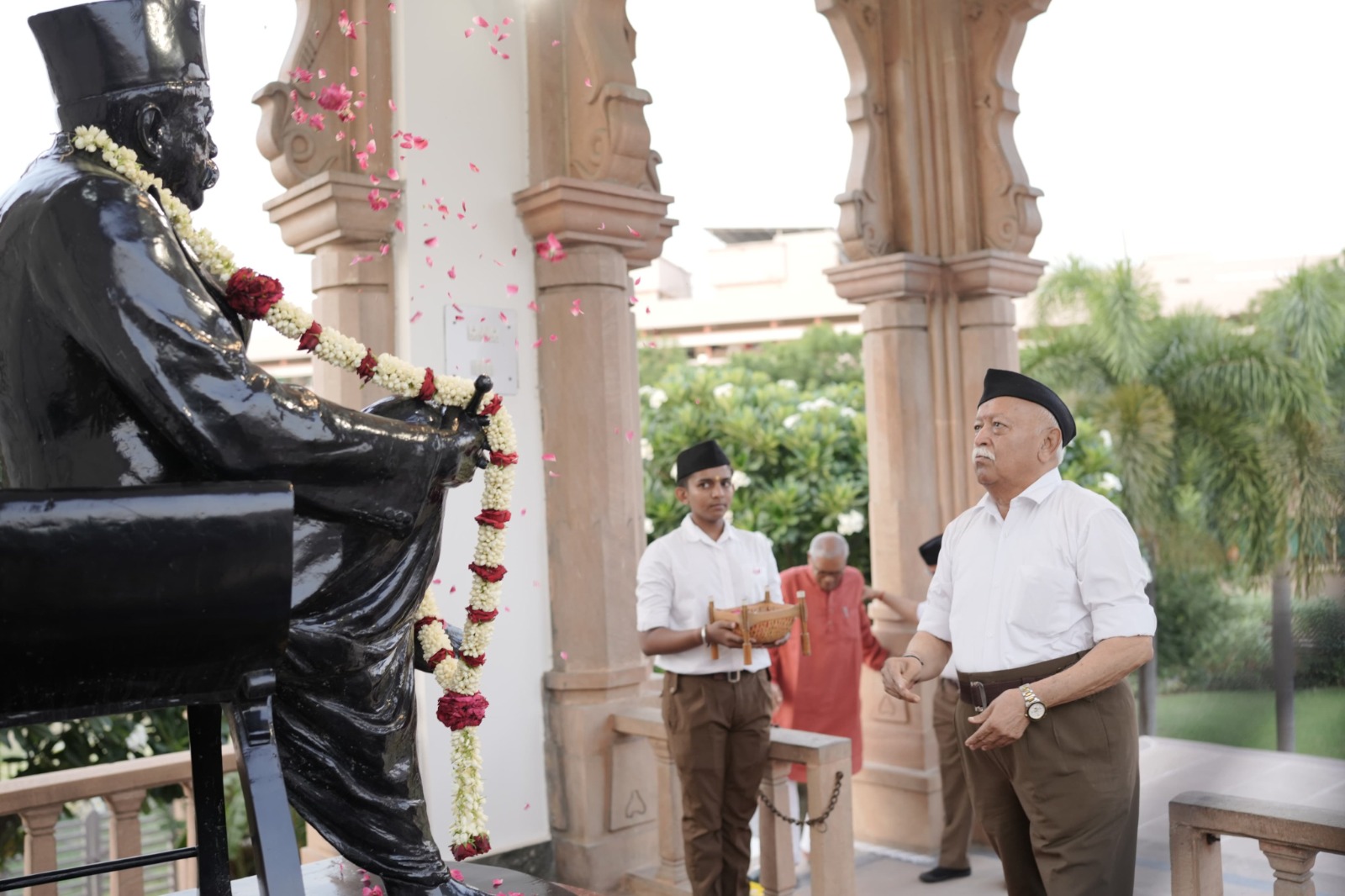
In today’s program, we are graced by the presence of our esteemed chief guest Shri Arvind Netam ji, the respected chief officer of this training camp, the honorable Sanghchalak of Vidarbha Prant, the revered Sanghchalak of Nagpur, distinguished invited guests, respected citizens, revered mothers and sisters, and our beloved Swayamsevak brothers.
This concluding ceremony is taking place at a special moment. This training camp is being held just before the Sangh’s centenary celebrations. We are currently in the hundredth year, which will be completed on Vijayadashami. After that, the plans we have made for the centenary will continue throughout the coming year.
However, a sudden situation emerged in the country over the past few days. The brutal attack in Pahalgam, where terrorists entered our land and killed our citizens, has deeply saddened everyone. Naturally, there was sorrow, anger, and a strong desire for justice, that the culprits must be punished. Action was taken, and justice was served.
Throughout this entire incident, the strength and bravery of our armed forces shone brightly once again. It also became evident that the various types of research and development we undertake in the field of defense are proving to be effective. Along with the courage of our soldiers, those responsible for making decisions and ensuring action, the people in positions of governance and administration, their perseverance was also clearly visible..
Across our entire political sphere, among leaders from all political parties, we witnessed a mature sense of understanding and mutual cooperation, where differences were set aside in the national interest. And the entire society has presented a remarkable display of unity during this time.
If this spirit remains permanent—if it does not fade with time and continues forward—it becomes a great symbol for our nation. In this atmosphere of patriotism, we have forgotten all our differences. Rivalries have been set aside, and even competitors are cooperating…in the interest of the nation. This image that has emerged is truly a reflection of an ideal democracy. It is our sincere wish that this continues in the future as well.
What will happen and how—it is difficult to say—but everyone feels that this is the way things should be. Because we also know that even after all of this, the problems have not disappeared. As long as crooked mindsets exist, as long as the ghost of “Two-Nation Theory” continues to linger in people’s minds, the threats to our country will remain. They claimed to want peace and were separated on that basis, but began spreading unrest the moment they were separated. Until this duplicity ends, these dangers will persist.
Undeniably, the nature of warfare has undergone significant changes. Since they cannot win in a direct confrontation, they are now resorting to a “thousand cuts policy” using terrorism as a tool, launching cyber wars, and whatnot. A type of proxy war was initiated. This is ongoing—despite repeated changes in s, despite the world condemning it time and again, it still doesn’t stop.
The methods of war have changed. It’s no longer about fighting face-to-face and deciding the victor. Today, war can be waged by sitting at home and pressing a button—missiles can be launched remotely. New and evolving technologies of warfare are now before us.
In this context, the actions of countries around the world have also been tested. Who truly stands with truth and integrity? Who acts only out of self-interest, and in that direction? And who, even while appearing as friends, are our true adversaries. Driven purely by their selfish motives? All of this has now been revealed through this test.
That’s why it becomes clear that when it comes to our national security, we must become self-reliant. We are a nation rooted in truth and non-violence—we have no enmity with any country. But evil still exists in the world, and as long as it does, there will be people who commit such acts without reason. Therefore, we must always remain fully prepared and completely alert for our own defense.
We must invest in new and advanced technologies and pursue dedicated research. The Chief of the Army has already said that they are studying every experience, analyzing where we need to progress further, and what steps are required. This process must continue. Of course, the army, the government, and the administration all have their roles to play—but real strength comes from society itself.
During the Second World War, Hitler concentrated all his might and bombed London for an entire month, trying to force it into submission. The leadership of the country began to consider surrender—should we give in? The army was devastated. The air force was non-functional. The navy was gone. And Hitler’s ally, Mussolini, was ready to mediate peace. Even someone like Prime Minister Churchill began to wonder what should be done.
Churchill informed the King of England that, though he personally did not wish to surrender, his cabinet was pushing for a treaty to avoid further destruction, as they had no means to resist anymore.
Then the King asked him—“Who chose your cabinet?” Churchill replied, “The people did.” So, as the story goes, Churchill went into the London Metro and spoke with ordinary citizens. Most of them did not fully understand the cost of war, its consequences, or military strategy, but their hearts were filled with patriotism. They told Churchill, “We will never surrender. We will fight. We’ll fight in the streets. And even if we have nothing left, we will fight with kitchen utensils.”
They could not imagine what such a battle would entail, but their spirit was unwavering. Inspired by this, Churchill returned to Parliament, abandoned the idea of a treaty, and delivered his historic speech, saying, “We will fight in the air, we will fight on the seas, we will fight everywhere, and even if we don’t win this war, our next generation—wherever the British Empire remains—will continue the fight. But we shall never surrender.”
Where did Churchill get this strength? After the war, he was honored and called the “Lion of England.” But Churchill humbly replied, “I am not the lion.. The lion were the people of England. I only roared on their behalf.”
The true strength of a nation lies in the strength of its society, and for this, our society must remain extremely vigilant. India is a land of diversity — cultural, linguistic, regional, and religious — and with that come many challenges. Often, one group’s concern does not even register with another. What benefits one community may sometimes cause harm to another.
In such a complex web of diversity, making decisions for the country and steering it in one direction becomes a delicate balancing act, like walking a tightrope. This naturally leads to some dissatisfaction within the society. But when it comes to the national interest, these grievances cannot take precedence.
Above all, we must ensure that no section of society is pitted against another. Harmony and goodwill must define our interactions. Creating animosity intentionally, provoking unnecessary disputes, reacting impulsively, or taking the law into one’s own hands — all of this is unacceptable.
There was a time when we lived under foreign rule, and the rulers wanted us to fight amongst ourselves. They had to fight for the troublemakers, and the innocent were forced to defend themselves. But today, we live under our own government, under the rule of the Indian Constitution.
So now, resorting to violence, using foul or abusive language, or reacting thoughtlessly are things we must leave behind. We need to think calmly and rationally. There will always be people who incite, provoke, or try to play the victim. There are those who use inflammatory language and attempt to divide society for their own gain.
We must not fall into their trap.
Some individuals seek to inflame tensions or trigger conflict to serve their personal interests, even when unity has been preserved for centuries. Others, driven by overconfidence, may act irresponsibly in pursuit of selfish goals.
But we must refrain from such conduct. What we need is mutual goodwill, moral conduct, noble thinking, and cooperation. That alone will ensure the continued strength and unity of our nation.
We, the people of this country, speak different languages, worship different deities, follow different food habits, customs, and traditions. The diverse interests and relationships we see today have emerged due to this very diversity.
But our roots lie in unity, not in diversity.
Rabindranath Tagore once said that India’s foremost spiritual mission is to demonstrate unity in diversity and to harmonize diversity on the foundation of unity. That unity must remain our foundation — we must remain mindful of it.
The test lies in navigating our diversity. I will speak my language, and I take pride in it. I have my own form of worship, which is dear to me. These are my unique traits — precious to me — and they must indeed be preserved and protected.
But above all, we must remember that our shared unity supersedes everything. Despite all our differences, as a nation, we are one. As a society, we are one.
The true strength of a nation lies in the strength of its society. That is why our society must remain vigilant — and united. India is a land of immense diversity. There are numerous kinds of diversity, and along with them, complex problems. Often, one group’s problem is not even acknowledged by another. What benefits one may be harmful to another.
Making decisions for the nation amidst this web of complexities is like walking a tightrope — a constant balancing act. This naturally breeds dissatisfaction and unrest in society. That is understandable — even justifiable.
However, in the face of national interest, such justifications are not valid. We must ensure that no section of society is pitted against another under any circumstance. Harmony and goodwill must guide our interactions.
Acting out of emotional excess, provoking conflict where it is unwarranted, or taking the law into one’s own hands in reactionary anger — none of this is acceptable.
There was a time when we were under foreign rule. The rulers thrived on our divisions and supported troublemakers. The innocent were often forced to fight. But today, we are self-governed — under the Constitution of India.
Hence, violence in social dealings, the use of abusive language without cause, and irresponsible reactions must all be abandoned. We must think calmly and clearly.
There are those who provoke, who cultivate victimhood, who incite through inflammatory speech. We must not fall into their traps. There are those who want to stir conflict in society for personal gain.
Even if divisions are sown, we have remained one people for centuries — and we will remain so. There are also some who, out of overconfidence and self-interest, act with recklessness. We must not follow that path.
What is needed is mutual goodwill, moral conduct, noble thought, and cooperation.
We, the people of this land, speak different languages, worship different deities, follow different food habits, rituals, and traditions. Yet, despite these differences that exist today due to our diversity, our roots lie in unity, not in diversity.
Rabindranath Tagore said: The principal mission of India is to demonstrate unity in diversity and to harmonize diversity on the foundation of unity. That unity must be our anchor.
We must remember it. Diversity is where the test lies. I will speak my language — I am proud of it. I have my own mode of worship, and it is dear to me. These are my unique traits — precious and worthy of protection.
But above all, our unity must take precedence.
Despite all our differences, as a nation, we are one. As a society, we are one. We are bound by the eternal flow of Sanatan culture that shapes our conduct.
Outwardly, our civilizations may appear different — our clothes, songs, dances, languages, ornaments, homes, pilgrimages, food habits — all differ. But the values that underpin us are the same. We share the same ancestors — we are not separated by different lineages. That myth was created by the British.
We are one. We don’t need to become one — we already are. We just forgot. We must reclaim that oneness.
In truth, the whole world is one — humanity is one. India must awaken the world to this realization.
This is the true purpose of our independence, attained on 15 August 1947. And for that, we must prepare ourselves.
While embracing our diversity, we must uphold unity and steer humanity’s development forward on that foundation. India must set an example for the world — because the world needs it.
In that context, the points raised by our guest speaker today are highly important. All of us must reflect on them. We, the volunteers of the Sangh, already are.
Why must development and environment be at odds? Can’t they go hand in hand? Of course, they can — but the plans must be rooted in unity.
Our tribal brothers and sisters are an inseparable part of our society. We have many deities, and as you said during your address, they are all equally valid.
Despite all this diversity, we are still one society.
If we are one, there is no need to request help — helping each other is our natural duty. That is the very essence of the Sangh’s work — serving the whole Hindu society.
I won’t speak on the technical issue of “code” you referred to — that’s a separate matter. But as far as society is concerned, this segment too is an inseparable part of us. We will support it to the best of our capacity.
You mentioned the government — your concerns will reach the right ears. But you know better than anyone that governments take time, and rarely consider all factors simultaneously.
So what strength do governments really possess? It is the strength of society.
If the government or administration doesn’t respond, it’s not the end. Society still stands.
You spoke about the PESA Act. How that law is used must ensure no new divisions arise in society, no one feels excluded. And yet, the law must function effectively.
If you want an example, see the work of our volunteers in Nashik district. A beautiful model of implementation can be found there.
I mentioned Chetaramji Pawar to you yesterday. A similar approach is being followed in Betul and nearby areas. It will happen in Bastar too. You needn’t request it.
Your visit has reminded us of our responsibilities. Wherever we go, we strive to serve. What we now need is to expand our reach. That is all.
Everything you said, we will strive to do in our way.
As for the issue of religious conversion — why must it happen? Our tradition accepts that there can be diverse paths based on individual interest.
So what if there is no hearing in the government or administration—there is society. You spoke about the PESA Act and the law. The point is how to use that law in such a way that no divisions arise in society. No one should feel that something different is happening. Even so, the PESA law should fulfill the purpose for which it was brought.
If you want to see an example of this, then our Swayamsevaks have worked through various organizations. There is work in the Nashik district, and how it should be implemented is beautifully demonstrated there. I was told yesterday the name of Chetaram Ji Pawar. In Betul and its surrounding areas too, planned work of this kind is ongoing. It must be happening in Bastar as well.
We are already here for you—no need to request. I say that by coming here, you have given us a sense of duty. Wherever we go, we carry out all this. The only thing is that our reach should increase.
So, all the things you have mentioned—whatever we can do in our own way, we will surely do.
Now, about the issue of religious conversion. Why should conversion happen? We believe that it is our tradition to have diversity in paths according to one’s interest:
Ruchinam vaichitryat na hi khalu vicharah pathyusham nrinam, eko gamyah tvamasi payasamarnava iva.
That is, the ways of worship, food habits, culture—these are all different according to taste, nature, circumstances, and thought. This is completely natural. Everyone goes in the same direction if they go rightly. If there is no selfishness in between, if there is no distortion, if no one uses this to serve their own interest—then there is no harm, everyone goes toward the same goal. If this is true, then why convert?
Once the missionaries asked Gulabrao Maharaj: “If all paths are true, then why not become Christian?” He replied, “If all paths are true, then why become Christian?”
If someone, from their own heart, changes their way of worship, no one in our tradition has ever objected. There is recognition—Rorena Narayan Vaman Tedka became so. But to convert someone with greed, temptation, or force, or to say that your path is wrong, your ancestors were wrong, and we are correcting you—that becomes a kind of abuse.
Conversion is a form of violence. We have never supported it.
We have no enmity with any sect or community. We have reverence for Jesus Christ, Prophet Muhammad, and others. We too are participants in that reverence. But everyone should walk their own way.
And that is why, those who went due to greed, temptation, or force, if they now want to come back, they should be accepted. Because it is a correction.
That is why we are with you in all these matters. The Adivasi society is not a separate society. I have often said, our culture was born from the jungles and fields.
That’s why the tribal society is our root. In their own languages, the philosophy they describe… it goes close to the Nasadiya Sukta. Friendship towards the environment, seeing sacredness everywhere, asking the trees and plants, worshipping nature—where else is this tradition other than India? This is India’s tradition.
Today we call ourselves Hindus—how did we become Hindus? And that’s why, by considering our society as an integral part of ourselves, we put in our full effort, and in our own way, we work based on the strength of our society. We will work. And we don’t take contracts. We work, meaning we, and those for whom the work is meant, will work together—because that’s the way work is done. One must shape one’s own destiny. Leaders, slogans, policies, parties, incarnations, governments, ideologies, great personalities—these can be supportive, but if we have to go ten steps forward, then five steps have to be taken by us ourselves. I am not talking about today; this has always been the case.
The cause of all transformations is society. And hence, by our conduct and by our example, we must create an atmosphere of change in society, so that society brings about its own transformation. Then changes in policies become inevitable. Patience is required. This is our independent country, this is our society. For a thousand years we were under foreign rule, so we got used to fighting, used to rebelling. Then it was necessary. But now, the people are our own. Sometimes we forget this sense of belongingness, yet patiently waiting, keeping ourselves in check—if this is done, then this transformation will come.
As we just said in the song before you, “Nishchit Hoga Parivartan, Jaag Raha Hai Jan Gan Man”—for the task of creating this awareness among the masses, a nationwide group of dedicated workers must be formed. This is the work of the Sangh, and they are doing it. We do it in our own way, by our own strength. We do not call anyone for help. If someone comes on their own, they are welcome. We help everyone, and that’s why our pace is a little slow. We will now increase that pace. But the speed of a bicycle cannot be equal to that of a car.
We do it in our own method, on our own strength. We do not call out to anyone. Whoever comes on their own, we welcome them. That’s why our pace is a little slow. We will increase it, but the speed of a bicycle cannot match that of a car. And for what we have to do, the bicycle must be ridden. But I can say with full confidence that if all of us work together to shape our destiny, then the solutions to these problems will emerge, and they will emerge correctly. With patience and continuous effort, while waiting, we must continue working. In such all kinds of work, we are with everyone, and we will always be with them—because the Sangh exists for this very purpose.
This is the kind of training that takes place in these camps. For 98 years, this camp has been taking place in Nagpur. It started in 1927. Over time, the format evolved, but workers from across the country come together in such camps, and through their efforts, the atmosphere of the nation changes. We have experienced this. In 1925, at the time of the founding of the Sangh, what was the mindset of society, what was the environment, and now, as we near 100 years, what is the mindset of the Sangh, what is the environment?
If something is done with great noise and excitement in four days, it ends in two days. Savarkar ji once said when he came to a Sangh program: “The work we do is like a torrential rain. It pours down heavily, everything gets scattered, and then it’s gone. The water also flows away, and the moisture dries up. It’s of no benefit to any crops.” Your work is like a gentle rain—it seeps into the soil, nourishes the seeds buried in the ground, awakens the dormant seeds, and crops grow from them.
That is the method of the Sangh. That’s why sometimes it may seem like you should act more. But in reality, all the things you’ve said—I have already told our workers in your presence: we don’t need to form a separate committee. Our working committee functions at that level. Fortunately, all of Sangh’s committees are made up of active individuals—not just in name. As interaction happens with them, things will move forward.
So, you people need not fear at all. We are all together, and we will all do this. But it has to be done across the entire society. And if it is to be done across the whole society, then workers are needed who live out these values in their own lives, who love the society, and who treat everyone as their own, without any sense of discrimination in their hearts. And creating such workers is the task the Sangh is doing. What you saw is just one example of it.
My prayer is that this work is not just of the Sangh—we all have to work together to shape our destiny. And in our collective destiny lies the destiny of the nation. All this work is being done to shape that destiny.
Therefore, a philosophical or curious view is not enough—active participation is necessary. I place before you the request that you join in with as many Swayamsevaks as possible in the nation-building work being done by the Sangh’s Swayamsevaks. With this, I conclude my words.
.png)