Matangini Hazra: An Indomitable Symbol of the Indian Freedom Struggle

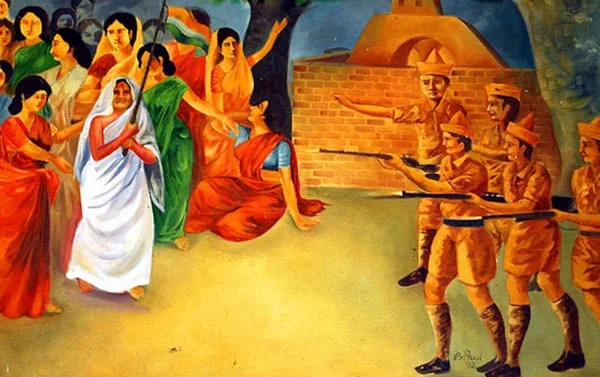
The contribution of women in India’s freedom movement was not secondary—it was central. Shoulder to shoulder with men, women fought with courage, sacrifice, and determination to secure India’s independence. Among the foremost names that emerge in this context is Matangini Hazra, a fearless freedom fighter from Bengal.
The Final March – September 29, 1942
When the Quit India Movement swept across the nation in September 1942, Bengal too rose in rebellion. On 29 September 1942, thousands of people surrounded police stations in Tamluk, Mahishadal, Sutahata, and Nandigram as part of the resistance. Leading one such massive procession towards Tamluk police station was an elderly woman—flag in one hand, conch shell in the other, chanting “Do or Die! Quit India!”
That woman was none other than 73-year-old Matangini Hazra. Her defiance was unbearable for the British forces. As the police opened fire, the first bullet struck her left arm, yet she refused to let the tricolour touch the ground. Even as she staggered, she lifted the flag high with her other hand, conch still clutched tight, shouting “Vande Mataram!”
The second bullet hit her right arm, forcing her to kneel, but she wrapped the flag around herself, protecting it till her last breath. Finally, a shot to her forehead ended her life—but not her spirit. That day, Matangini Hazra fell, but she rose as a legend of India’s freedom struggle, symbolising the strength of women in the movement.
Early Life and Family
Matangini Hazra was born on 17 November 1870 (though some historians suggest 1869) in Hogla village under Tamluk police station in present-day Medinipur district, Bengal. Her parents, Thakurdas Maity and Bhagabati Devi, raised her in extreme poverty. Known affectionately as “Matu”, she had little access to formal education but showed early fascination for the independence cause.
Marriage and Widowhood
At just 12, she was married off to Trilochan Hazra, a wealthy 60-year-old widower from Alinan village. Within six years, she was widowed and childless. At 18, Matangini found herself abandoned by her in-laws and lived in a small hut on the outskirts of her village. This tragic turn became the starting point of her lifelong journey of service and struggle.
Widowed young, she survived by husking rice but found inspiration in the words of Swami Vivekananda: “For the next fifty years, the only God for Indians should be the Motherland.” This teaching deeply influenced her. During recurring smallpox epidemics in Bengal, she served the sick and poor tirelessly, earning admiration for her selflessness.
Her public life began when she came in contact with Congress leaders like Ajay Mukherjee and Satish Samanta. Listening to their stories of Gandhi and his ideals, she began spreading his message across villages.
Her direct involvement in the freedom movement started in 1905 during the anti-Partition of Bengal agitation. She organised local women, raising the slogan of freedom. Arrests and police brutality did not deter her spirit. A staunch Gandhian, she spun her own thread on the charkha and joined every mass movement.
At the age of 62, in 1930, she officially pledged to join the freedom struggle by taking part in a Civil Disobedience procession at Krishnagar. From there, she never looked back.
Arrests and Defiance
- 1930 – Salt Satyagraha: Matangini joined the protest at Contai (Kanthi), defying the salt laws. She was arrested but released soon after.
- 1932: Arrested again for participating in protests and unfurling the national flag at government offices.
- Black Flag Protest: When Lieutenant Governor Anderson visited Tamluk, she broke through police barricades, waving a black flag and shouting “Go back, Governor!” She was arrested again but released after six months.
- 1933: Attended the Congress conference at Serampore, where she was injured during police lathi-charge.
- 1935 Floods: She devoted herself to relief work, earning the affectionate title “Gandhi Buri” (Old Lady Gandhi) among locals.
Role in Quit India Movement
In August 1942, when Mahatma Gandhi gave the call of “Quit India”, Bengal became a hub of activity. In Tamluk, leaders like Satish Samanta and Ajay Mukherjee planned to set up a parallel national government. Matangini Hazra, then 73, became one of their most trusted organisers.
On 29 September 1942, leading nearly 6,000 protestors, she marched at the forefront with the national flag and a conch shell. Even after being shot multiple times, she refused to let the tricolour fall. Her final words—“Vande Mataram”—echoed as she breathed her last.
From Homemaker to Revolutionary
At a time when widows in Bengal were bound by strict social codes, Matangini broke every barrier. From a destitute housewife, she rose to become a fearless revolutionary, leaving behind an extraordinary example of courage and sacrifice.
Her influence in Tamluk went beyond her personal participation. She mobilised hundreds of women, encouraging them to step out of their homes and join the struggle. Her leadership not only energised the Quit India movement locally but also made her a symbol of women’s empowerment in India’s freedom fight.
Honours and Legacy
- After independence, several schools and roads were named after her.
- In 1977, her statue—the first ever of a woman—was installed in Kolkata.
- In 2002, on the 60th anniversary of the Quit India Movement, the Indian Postal Department released a commemorative stamp in her honour.
A Death That Became History
Matangini Hazra’s martyrdom was not just a tragic incident; it became a part of history. Her life represents the indomitable spirit of Indian women in the freedom struggle—ordinary homemakers who transformed into extraordinary revolutionaries.
Her story remains a reminder that India’s independence was not just won by the speeches of leaders, but also by the silent courage of countless women who gave their all—Matangini Hazra being one of the brightest among them.
.png)