Operation Searchlight: Professor Jyotirmoy Guhathakurta: Killed at Dhaka University in 1971

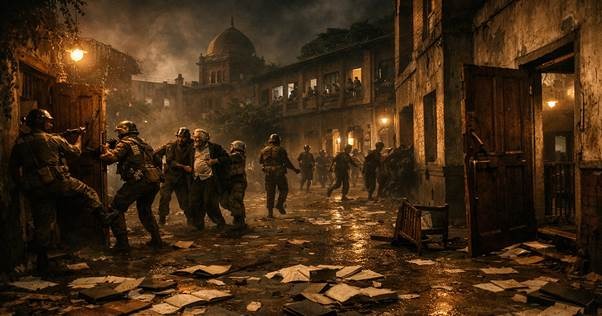
This image is AI-generated
On the night of March 25–26, 1971, Pakistan’s military regime launched a large-scale crackdown in Bangladesh (then East Pakistan) to suppress the Bengali rebellion, which had grown after the refusal to transfer power despite the Awami League’s electoral victory and long-standing demands for political autonomy and linguistic rights. The operation, code-named Operation Searchlight, was carefully planned and brutally executed to dismantle resistance by targeting those seen as shaping Bengali political consciousness. Among the primary targets were students, teachers, intellectuals, political activists, and religious minorities, as well as institutions that served as centres of dissent.
Dhaka University, widely regarded as the intellectual and cultural nerve centre of the Bengali movement from the Language Movement of 1952 to the mass protests of 1969–71 was therefore singled out. That night, student halls were stormed, unarmed students were shot inside their dormitories, and teachers were dragged out of their homes and executed, turning a centre of learning into a killing ground. Among those killed was Professor Jyotirmoy Guhathakurta, a senior academic of the University of Dhaka and Provost of Jagannath Hall, the Hindu student residence. His killing stands as one of the many documented instances of the Pakistan Army’s brutality during Operation Searchlight, reflecting how educators were deliberately targeted alongside students.
From this massacre, we bring you his story—to understand what exactly happened in March 1971, and why, in that moment of history, teaching itself was treated as a crime.
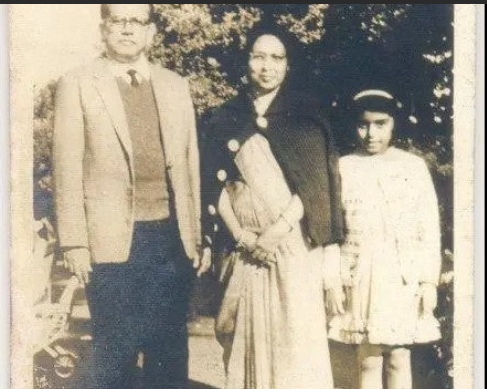
Professor Jyotirmoy Guhathakurta with his family | Image Source: Awaz The Voice
Nighttime Attack by the Pakistan Army
That night, shortly after half past midnight, the Guhathakurta family was jolted awake by the sound of gunfire. The bursts grew louder and closer until the air itself seemed to shake. Fearing the worst, they crawled under the bed, listening as the city around them was torn apart. When the firing briefly subsided, Mrs. Guhathakurta peeped out and saw a convoy of military vehicles stop at the barricade near the crossroads. Pakistani soldiers entered the residence, pulling off the chains on the gate as troops began kicking at the doors, an officer smashed the window of their daughter Meghna’s room, slicing through the mosquito net with his bayonet. As the curtain was pulled aside, Mrs. Guhathakurta handed her husband his panjabi (Knee-length kurta) and quietly told him to prepare for arrest. The officer entered through the kitchen door, shoved aside the maid, and stepped into the verandah. After questioning the household, he dragged Professor Jyotirmoy Guhathakurta through the garden. There, after asking his name and religion, the officer fired two shots—one to the neck and one to the back. The bullets left him paralysed but conscious, lying near the gate as the soldiers moved on.
It was not a random killing at, according to the Military Intelligence, his closeness to students was considered dangerous. He had been classified as an “extremely dangerous individual”—not because he carried weapons, but because he was popular among students, intellectually active, seen as influential within the university and associated with people like M.N Roy ,founder of radical humanist ideas. In a time of repression, a thinking teacher was seen as a threat. Operation Searchlight was not only about crushing armed opposition, but about dismantling the intellectual foundations of Bengali society. By targeting teachers alongside students, the military aimed to silence ideas, break morale, and instil fear across institutions of learning.
Was Education Treated as Subversive and Dangerous?
Professor Guhathakurta’s shooting reflected this broader strategy—where education itself was treated as subversive, and the act of teaching became reason enough to be eliminated.
Before that night, Jyotirmoy Guhathakurta’s life had been shaped by books, classrooms, and a quiet devotion to learning. Born on 10 July 1920 in Mymensingh, then part of British India, he grew up in a household where education was central—both his parents, Kumudchandra Guhathakurta and Srimati Sumati, were schoolteachers. He distinguished himself early, graduating with BA Honours in English from the University of Dhaka in 1942, securing first position in his class and earning the Pope Memorial Gold Medal ,he joined the Department of English at Dhaka University in 1949, where colleagues and former students later remembered him as a rigorous yet humane teacher, closely engaged with student life. In 1963, he travelled to King’s College London on a British Council scholarship to pursue doctoral research on classical myths in dramatic literature. After completing his PhD in 1967, he returned to Dhaka University and later became Provost of Jagannath Hall, a role that placed him in daily contact with students during a period of rising political tension, after being shot on the night of 25 March 1971, he did not die immediately. Paralysed but conscious, he remained alive for five days in a city paralysed by curfew and fear, where hospitals functioned with limited staff and emergency medical care was difficult to access. On 30 March 1971 , he died of his injuries, bringing to an end the life of a teacher whose career had been devoted to learning and instruction.

Dismembered head of an intellectual killed on 14 December 1971 at Rayer Bazar, Dhaka| Image Source: Rashid Talukdar
His killing took place within the broader context of Operation Searchlight, which left 50,000–200,000 Bengalis dead in the initial crackdown and around three million killed during the Liberation War. Massacres such as Chuknagar , Kulna district killed 10,000 of bengali in one day and the Jalladkhana killing field 20,000–25,000 buried making one of the largest killing fields of the country. Sexual violence was widespread, with 200,000–400,000 women raped by the Pakistani military among 202,527 survivors remained in the country and 131,250 were refugees. The war also triggered a humanitarian crisis 10 million fled to India, 20–30 million were internally displaced, and about 5,000 war babies were born and adopted by Christian missionaries and orphanages outside the country. These events formed part of a systematic campaign that reshaped Bengali society.
.jpg)