World Saree Day: How the Sacred Patola Found Its Home in Patan

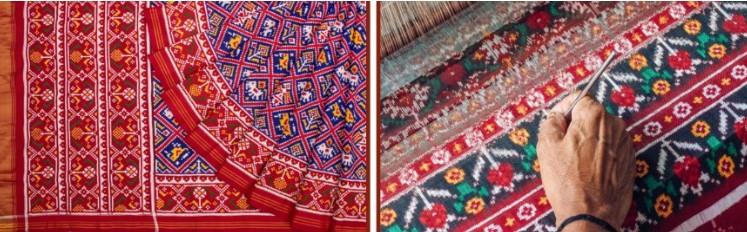
On World Saree Day, when millions celebrate the legacy of South Asia’s most iconic garment, the Patola stands apart as a weave wrapped in myth, precision, and royal patronage. Though the saree dates back to the Indus Valley Civilization, Gujarat’s textile heritage gave India one of its most exceptional contributions — the Patan Patola. Gujarat has been a centre of weaving for thousands of years, and among its most treasured crafts is this double-ikat silk saree whose patterns endure for generations. The story of how Patola arrived in Patan is not just a cultural tale, but a moment shaped by a king’s devotion and a community’s skill.
Around 1175 CE, Gujarat’s Jain king, Kumarpal, used a fresh Patola every day for worship, as silk Patola was considered sacred in Jain tradition. At that time, Patolas were imported from Mungi Paithan near Jalna in Maharashtra, where they were treated as ordinary cloth and even used as bedding by the ruling family before being exported abroad. For Kumarpal, this desecration of a sacred textile was unacceptable. Historical accounts and legends converge on one fact: The king brought 700 Salvi weavers—masters of the Patola craft—from the Deccan to Patan, converted them from Digambar to Shvetambar Jainism, and settled them permanently in his kingdom. This migration marked the beginning of Patola’s new identity in Gujarat.
Multiple oral traditions describe why Kumarpal relocated the artisans: Some say he was angered by Jalna’s misuse of Patolas; others believe he wished to avoid dependence on another kingdom for ritual garments; still others link the weavers to the spoils of war during his conquest of Jalna. Regardless of the version, Patola production vanished from its earlier centres and began flourishing in Patan. While Paithani sarees continued to be woven 76 km from Jalna, the Patola evolved as Gujarat’s unique masterpiece, gaining religious significance among Jains, Bohra Muslims, Nagar Brahmins, and Kutch Bhatias. Motifs like elephants and parrots became customary in Hindu wedding rituals, symbolising prosperity.
The Patola’s origins lie in the Sanskrit word Pattkulla, meaning “silk cloth,” and its early references appear in texts such as the Narsinh Purana, linking the weave to South Indian rituals. Over the centuries, Patola became a symbol of wealth and purity, worn only by affluent families or gifted during sacred ceremonies. Merchant communities were even granted special privileges to preserve the Patola tradition. As its cultural footprint spread, Patola became a prized possession in Gujarati families — not merely attire but an heirloom that embodied devotion, identity, and lineage.
The Patola’s prestige is rooted in its astonishing technical complexity. Woven using the double-ikat method, every thread of warp and weft is tied, dyed, and aligned with near-mathematical precision before weaving begins. A single saree requires 18–19 stages, uses 4–5 colours, involves 4–5 artisans, and takes up to six months to complete. The Salvi families still follow natural dye techniques using agate, flower bark, gulal, and fruit peels — formulas known only to them. Their designs are so enduring that Gujarat’s famous saying, “Fāṭe pan phīṭe nahi,” declares that even if the cloth tears, its design never fades. In 2013, Patan Patola received the GI tag, securing global recognition for this extraordinary craft.
Economically, Patola weaving sustains nearly 300 artisans in Patan today, with the Patola House near Fatipal Gate serving as the primary centre of production. But the livelihood is fragile — the craft is labour-intensive, time-consuming, and impossible to mechanise. Authentic Patolas range from ₹1.5 lakh to ₹6 lakh, not due to luxury pricing but because of the sheer manual precision, months of effort, and the rare double-ikat expertise involved. As 28th-generation weaver Rahul Salvi notes, “No machine can replace this.” Cheap imitations flood the market, but they cannot replicate the craftsmanship, the mathematics, or the cultural weight of a real Patola. The economics of the weave reveal a truth: Patola is not just a saree — it is a living heritage that survives only because skilled hands continue to devote half a year to create a single masterpiece.

.png)

.jpg)