Why Vande Mataram Became the Soul of India’s Freedom Struggle: Facts You Should Know

Historical Background
India in 1882
In 1882, India remained under British colonial rule, marked by economic exploitation, oppressive taxation, and infrastructural control. The Indian nationalist movement was gaining momentum via moderate political groups like the Indian National Congress. Educated elites were voicing dissent, setting the stage for more vocal resistance in the following decades.
Written by Bankim Chandra Chattopadhyay in 1876, ‘Vande Mataram’ was a poem originally in his Bengali novel ‘Anandamath’. The first two verses of the poem were taken as the national song of India in October 1937. The song was later set to music by Rabindranath Tagore. The song has also been translated into numerous other Indian languages such as Tamil, Kannada, Odia, Malayalam, Assamese, Hindi, Marathi, Punjabi, Urdu, and others.
Who was Bankim Chandra Chattopadhyay? Bankim Chandra (1838–1894), a deputy magistrate and pioneer of the Bengali novel, infused literature with nationalism. He edited Bangadarshan magazine, mentored writers like Tagore, and inspired Indian identity. His striking mix of literary brilliance and patriotic fervor earned him the title “Sahitya Samrat.”
The Context of Anandamath Published in 1882, Anandamath dramatizes the 18th-century Sannyasi Rebellion during Bengal’s famine. Featuring ascetic rebels who chant “Vande Mataram,” it forged a spiritual-political cry. Praised as a nationalist blueprint, it profoundly influenced freedom fighters and was later banned by the British.
Composition of Vande Mataram (7 Sept 1882) Bankim Chandra Chattopadhyay completed Vande Mataram in 1882, embedding it in the serial publication of Anandamath. Historical evidence suggests Bankim led a literary meeting in March–April 1882, where the poem was sung publicly prior to its novel release.
Date Significance: First Public Recitation
Though composed in 1882, its first political performance occurred in 1896 at the Indian National Congress in Calcutta. Rabindranath Tagore’s rendition catalyzed its adoption as a nationalist hymn and later, in 1937, as India’s national song.
Language and Script: Sanskritised Bengali Vande Mataram was written in Sanskritised Bengali, Shadhubhasha, blending Bengali structure with classical Sanskrit vocabulary, intended to evoke ancient cultural unity. It originally appeared in Bengali script.
Literary Features: Style, Verse, Structure The poem juxtaposes vivid Motherland imagery, rivers, fertile plains, and goddess symbolism—with metrical precision suited to ragas like Malhar. Initially two purely Sanskrit hymnal stanzas (c.1872), the later political militant verses appeared in Anandamath in 1882.
Vande Mataram was formally designated India’s National Song on 24 January 1950 by the Constituent Assembly. President Rajendra Prasad declared it deserved “equal honour…with Jana Gana Mana.” In November 2022, the Centre reaffirmed both hold equal respect, as stated to the Delhi High Court.
Lyrics Breakdown
Verse‑by‑verse Explanation Vande Mataram opens with reverent praise, “salutations to thee, Mother”, progressing to vivid descriptions of her blessings: fertile fields, flowing waters, cool winds. The later verses elevate her as Durga, a divine protector who empowers her children. Each verse builds from an affectionate invocation to the militant, nurturing deity.
Symbolism: “Mother”, “Green Fields”, “Seven Streams”, “Mountains” The song evokes fertile plains (“green fields”), plentiful water (“seven streams”), and majestic mountains, portraying India as life‑giving. The repetitive imagery affirms the motherland’s abundance and sanctity. It blends pastoral imagery with classical sacredness, fostering deep emotional bonds with the land.
Representation of Bharat Mata Bankim’s hymn and Abanindranath Tagore’s 1905 painting collectively personify India as a mother: nurturing, knowledge‑bestowing, and protective. This portrayal transcended religion to evoke cultural unity. Though later politicized, early representations emphasized civilisational spirituality over sectarian identity.
Religious and Cultural Significance
Vande Mataram evokes reverence through divine personification, honoring the motherland as a goddess. This spiritual invocation birthed a strong emotional and cultural identity, transforming patriotic sentiment into shared devotional practice.
The Concept of Mother Goddess (Shakti) By depicting the nation as Mother Goddess, the song infused political devotion with spiritual strength. It appealed to India’s ancient Shakti traditions, empowering citizens to see freedom as divine duty. This symbolic fusion boosted resonance across regions rooted in goddess worship.
Fusion of Hindu Iconography with Nationalism Verses referencing Durga and Lakshmi merged religious iconography into nationalism, casting patriotism as worshipful devotion. This fusion fueled unity, especially during Swadeshi and Congress rallies, but also introduced religious symbolism into public life.
Controversies: Verses & Religious Inclusivity Muslim voices objected to goddess references in later stanzas, citing conflicts with tawḥīd. In 1937, Congress adopted only the first two, secular verses for public singing, preserving unity while respecting religious diversity.
Musical Adaptations
Rabindranath Tagore’s 1896 Composition At the 1896 Indian National Congress in Calcutta, Rabindranath Tagore presented a slow, solemn tune he composed, later recorded on a 1904 gramophone disc. This version, based on Tagore’s own melody, became the foundation for its association with formal nationalist ceremonies.
Other Composers’ Classical Renditions From 1925–1940, many maestros like Omkarnath Thakur, Dilipkumar Roy, Vishnupant Pagnis, and Keshavrao Bhole composed Vande Mataram in ragas such as Deshkar and Sarang, showcasing its adaptability and classical richness. AIR broadcasts by Thakur in 1947 further amplified these renditions.
Role of AIR, Bollywood & School Songs All India Radio broadcast Vande Mataram in classical ragas, notably Thakur’s full rendition on 15 August 1947. Hemant Kumar’s 1952 film adaptation of Anand Math and Lata Mangeshkar’s playback version popularised it. Schools nationwide embedded it in daily assemblies, fostering patriotic unity.
Political Significance in the Freedom Movement
The slogan of the Swadeshi Movement After the 1905 Bengal Partition, Vande Mataram became the rallying cry of the Swadeshi movement, uniting Hindus, Muslims, and Sikhs in anti-British protests. Its sustained chants at meetings and protests energized the populace and intensified resistance against colonial policies.
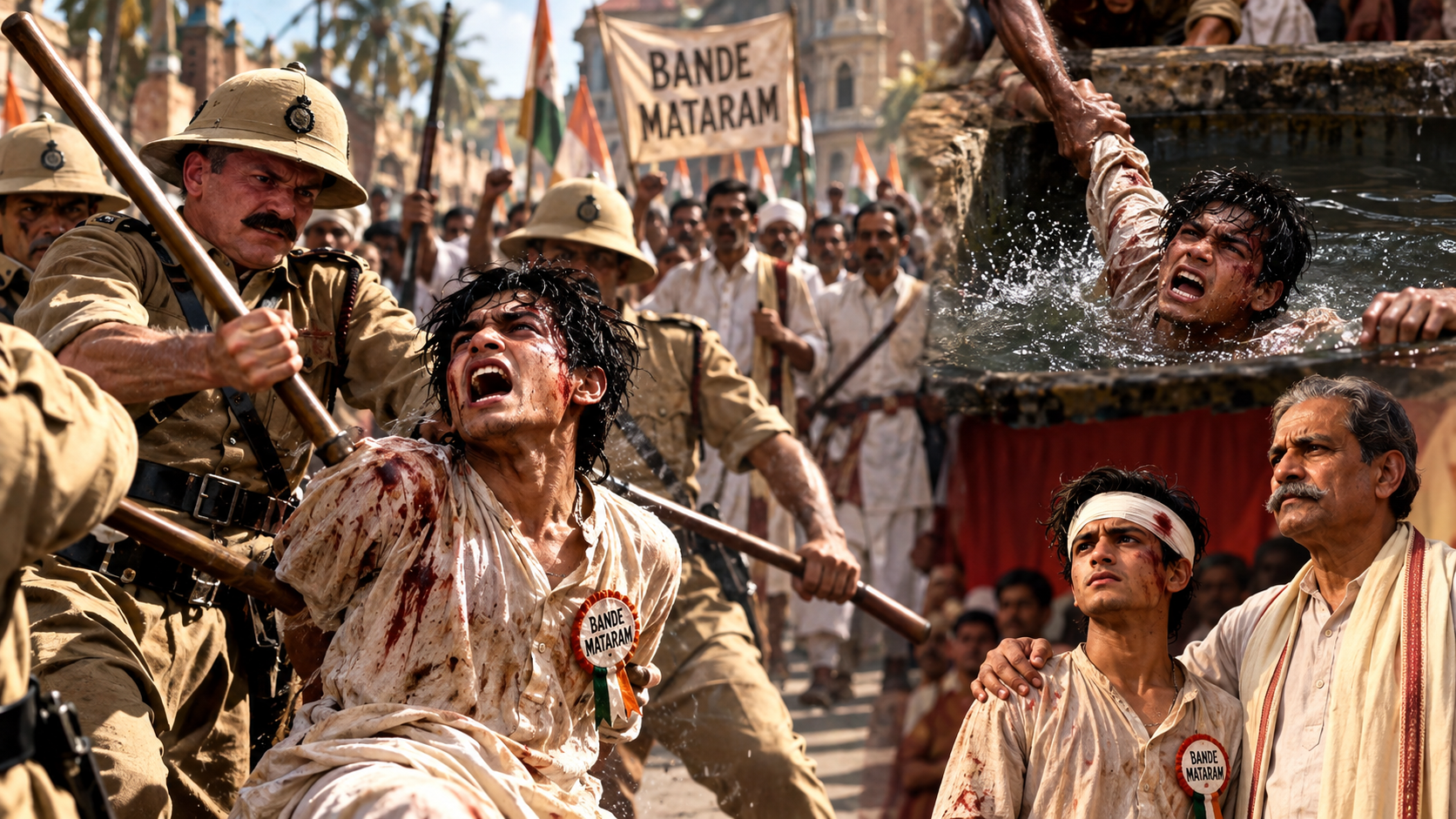
Banned by the British: Why It Was Seen as Dangerous The British banned Vande Mataram during the Swadeshi era, viewing its message as incendiary and subversive. Public singing was prohibited under anti-sedition laws to suppress patriotic fervor. Defiant protesters continued their recitation, leading to arrests, underscoring its symbolic power.
Usage by Revolutionaries (Bhagat Singh, Subhas Chandra Bose, etc.) Revolutionary leaders and martyr figures frequently invoked Vande Mataram. At executions, heroes like Satyendra Bardhan chanted it to the gallows. Leaders like Madan Lal Dhingra, Madame Cama, and Subhas Chandra Bose integrated their messages into revolutionary literature and broadcasts abroad.
Vande Mataram vs. Jana Gana Mana
Why is Jana Gana Mana the National Anthem, not Vande Mataram? On 24 Jan 1950, President Rajendra Prasad announced in the Constituent Assembly: Jana Gana Mana shall be the National Anthem; Vande Mataram, the National Song. The choice favored Jana Gana Mana due to its secular tone and INA association, while Vande Mataram carried religious imagery. Forbes india
Timeline of Decisions & Legal Provisions
- 1937: Congress Working Committee approves the first two verses only.
- 1950: Constituent Assembly formalizes Jana Gana Mana (Anthem) and Vande Mataram (National Song).
- 1971: Prevention of Insults to National Honour Act safeguards Anthem (not song).
- 2022: Govt affirms both deserve equal respect.
Role in Indian National Congress
First Recitation (1896 INC Session by Tagore) At the 1896 Indian National Congress in Calcutta, Rabindranath Tagore offered the first political recitation of Vande Mataram, setting it to melody. This moment transformed the poem from literature into a collective anthem of nationalism within Congress proceedings.
Use in Freedom Rallies From the Swadeshi movement (1905) onward, Vande Mataram became the rallying slogan of anti-colonial demonstrations. Protesters chanted it during strikes, marches, and public meetings, despite British bans, demonstrating enduring patriotic fervor.
Political Importance in Pre‑Independence Debates Within Congress, Vande Mataram sparked intense discussions about religious symbolism and inclusivity. Despite factional opposition, particularly from Muslims, the 1937 Working Committee adopted only its first two secular stanzas to balance unity and diversity.
Modern-Day Usage
Ceremonial Functions: Parliament & School Assemblies Parliament resumed playing Vande Mataram alongside the anthem in sessions since 1992. Schools, like Kolkata’s Zirat Colony High, have integrated daily and weekly singing. Tamil Nadu’s Madras High Court mandated weekly renditions in education and government institutions to foster patriotism.
Films, TV Shows & Patriotic Events The 1952 film Anand Math featured Hemant Kumar’s Vande Mataram, revived by A. R. Rahman’s 1997 album, marking the independence anniversary. In Goa (2025), CM sang it at school events marking its 150-year milestone. It also fronts sports arenas after victories.
Vande Mataram held deep symbolic and emotional significance during India’s Independence period, especially around August 15, 1947.
Broadcast on AIR – 15 August 1947 On the morning of India’s first Independence Day, Vande Mataram was broadcast on All India Radio in a classical rendition by Pandit Omkarnath Thakur. This moment was historic, chosen by the government to reflect cultural pride and patriotic unity.
Ceremonial Use in Parliament The song was played in the Constituent Assembly sessions alongside Jana Gana Mana. On January 24, 1950, two days before the Constitution came into effect, President Rajendra Prasad declared Vande Mataram as the National Song, to be treated with “equal respect” as the anthem.
Mass Singing & Public Celebrations Across cities like Delhi, Kolkata, and Mumbai, freedom rallies and flag-hoisting events included the public singing of Vande Mataram. It stirred emotional unity and became synonymous with India’s hard-earned freedom, often sung before and after speeches by freedom fighters.
.png)