When Christian Workers Toiled for Saffron Flag: How Vasudhaiva Kutumbakam Philosophy Laid Foundation of Indigenous Navy

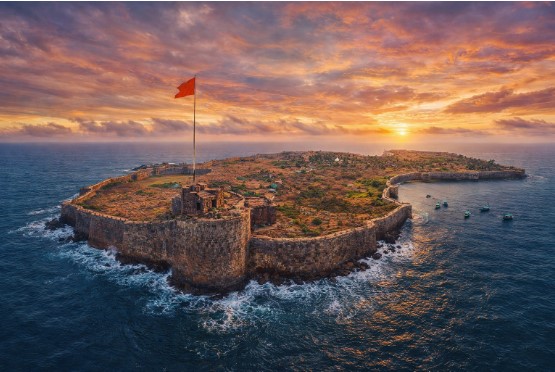
An ocean all around, a fort in the middle. Encircled by 30-foot-high walls, the fort stands utterly impregnable. No matter which direction you look at the fort from, you’ll see the fluttering saffron flag! What if you’re told that even Christian workers worked intensely for this saffron? Shock is natural! But this is a piece of history that’s often concealed.
It’s commonly known what Hindus have done for the saffron flag of victory. Yet, skilled Christian artisans were also employed for this task. Today’s story is built on this very fact, this very history. And it was Chhatrapati Shivaji Maharaj who made it possible.
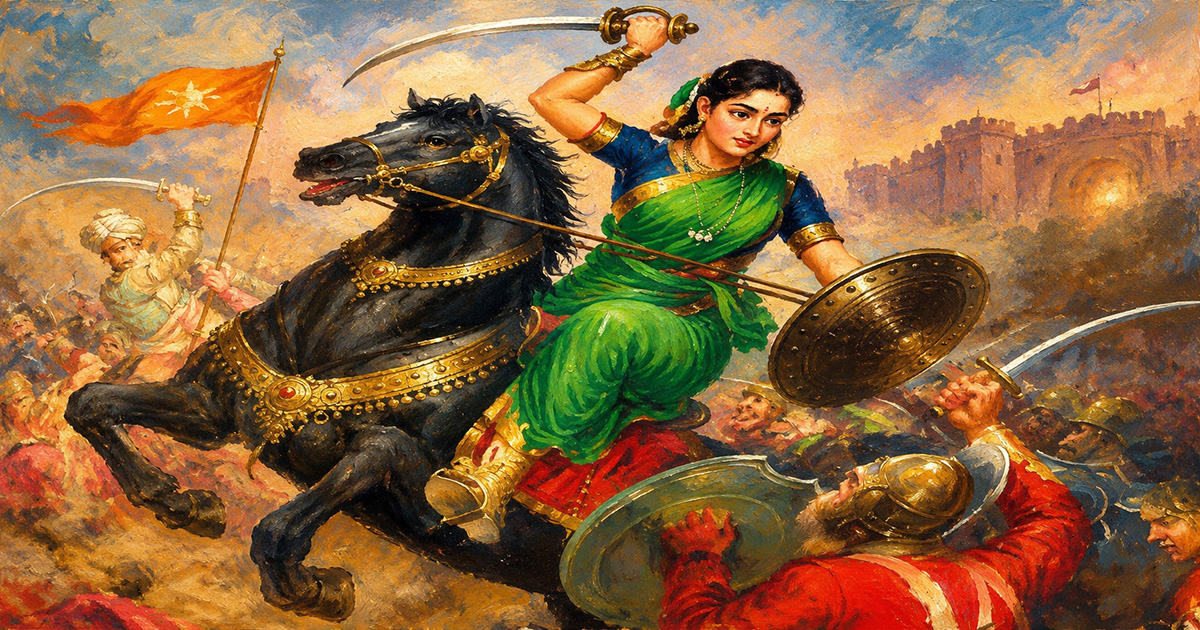
361 years ago, Chhatrapati Shivaji Maharaj didn’t just dream this vision; he brought it to life. 450 kilometers from Mumbai, right in the middle of the Arabian Sea, he built Sindhudurg Fort with the saffron flag waving proudly. For this, alongside Indian architects, he also employed skilled Christian workers from Europe, renowned for constructing sea forts. When the construction of the fort was completed, it also marked the foundation of the indigenous navy right there.
While battling foreign invaders to give the nation the dream of Hindu Swaraj and shape it into reality, why did Chhatrapati Shivaji Maharaj employ foreign Christians? How did hiring foreigners lay the foundation of the indigenous navy? How was the Father of the Indian Navy, Chhatrapati Shivaji Maharaj, able to achieve this?
The Culture of “Vasudhaiva Kutumbakam” & Foresight in Harnessing Skilled Labor
Vasudhaiva Kutumbakam {World is One Family) is the core foundation of Indian culture. Chhatrapati was no exception to this. Under his protective umbrella, he honored every single citizen. This very mindset won him the trust of English and Portuguese Christian workers.
The concept of a skilled labor workforce that America grasped in the 19th century to crown itself the leader of the developed world, Shivaji Maharaj understood it 200 years earlier. He also realized that establishing Hindu Swaraj couldn’t be achieved merely by winning battles against Mughal invaders. Because through sea routes, the English, Portuguese, Dutch, and French were all poised to plunder India. And they possessed the finest maritime technology of the time. Right here, Shivaji’s foresight triumphed.
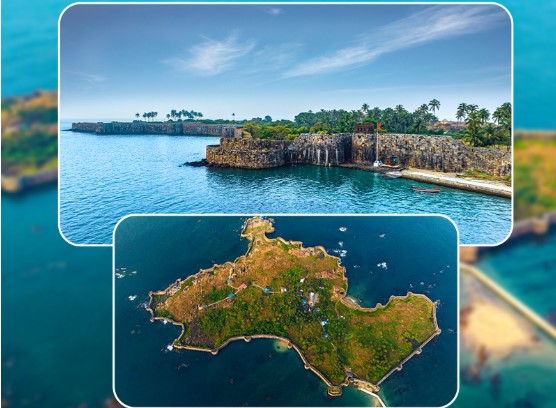
A real aerial photo of Sindhudurg Fort | Courtesy: maharashtratourism.gov.in
Shivaji Maharaj went ahead and offered higher wages to his marine engineers than what the English or Portuguese paid. The strategy worked. Even though they were Christians and foreigners, they worked for India’s progress, realizing the dream of Hindu Swaraj. These skilled artisans built everything from sea forts (see the real photo above) to small but swift-moving warships, all for India. And it wasn’t as if Indians weren’t learning their skills. What we today call lofty terms like “technology and skill transfer” was happening back then, too.
Chhatrapati Shivaji Maharaj was fighting a total of 27 enemy powers, including the English, Portuguese, Dutch, French, Siddis, and Mughals. The Mughals dominated Indian power at the time but stayed away from exploiting the sea’s commercial and military potential. In that era, after the arrival of European invaders in India, the Maratha power was the only force that recognized the capabilities of an indigenous navy and strengthened its naval fleets accordingly.
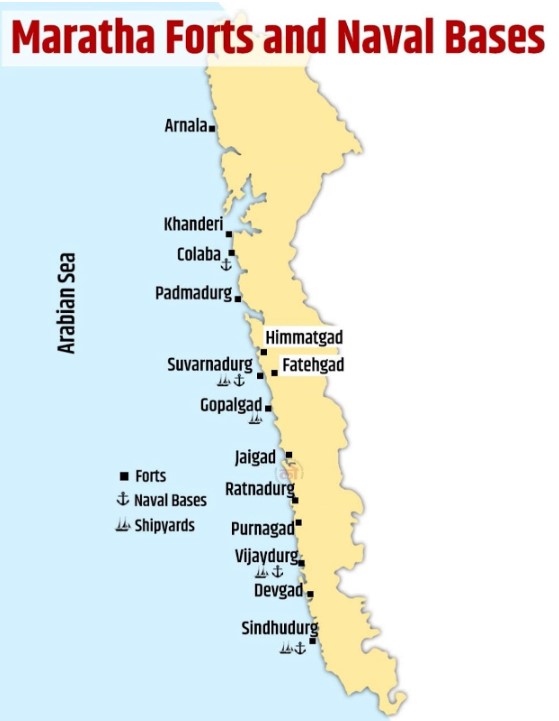
The ‘Sovereignty’ of the Maratha Navy in the Arabian Sea | Image Source: Indian Express
Historian Dr. P.S. Pisurlenkar wrote a book titled Portuguese-Mahratta Relations. Besides the navy, it mentions how Chhatrapati also took the help of skilled Christian workers in other military establishments, like constructing the Belgaum Fort and the Firingi Tower in Bijapur.
“Shivaji Slit the Throats of Christian Priests Because They Wouldn’t Convert to Hinduism”
For a king whose everything was the dream of Hindu Swaraj, who was fighting 27 enemies, who was singularly focused on building India’s only naval fleet of that time, who valued his soldiers and workers based on merit rather than religion, why was he forcing Christian priests to convert to Hinduism? He who issued orders to his army not to take prisoners of war based on religion—why did he slit the priests’ throats?
This was a lie spread by an Englishman, not just verbally, but through a written letter, so it would be recorded in history. But when the entire story is Shivaji versus the Portuguese, why did an Englishman write that letter? The answer to this question exposed the falsehood, not by one, but by several historians.
“Divide and Rule” — this had been the English policy from the start. Barring stray incidents, there was never a situation of direct war between the Portuguese and Shivaji. According to English policy, this wasn’t favorable for them. That’s why they fabricated a story of Hindu versus Christian religion, threats to convert priests to Hinduism, and ultimately their murder. So that the Christian Portuguese king and his soldiers-commanders in Goa would get provoked, jump into direct war against the Hindu king Shivaji, so that the English would benefit.
Portuguese Priests Themselves Gave Shivaji a Clean Chit, English Conspiracy Failed
It’s true that Shivaji Maharaj attacked Bardezi in Goa. But the reason was strategic. Below are illustrated examples from 3 sources confirming this fact.
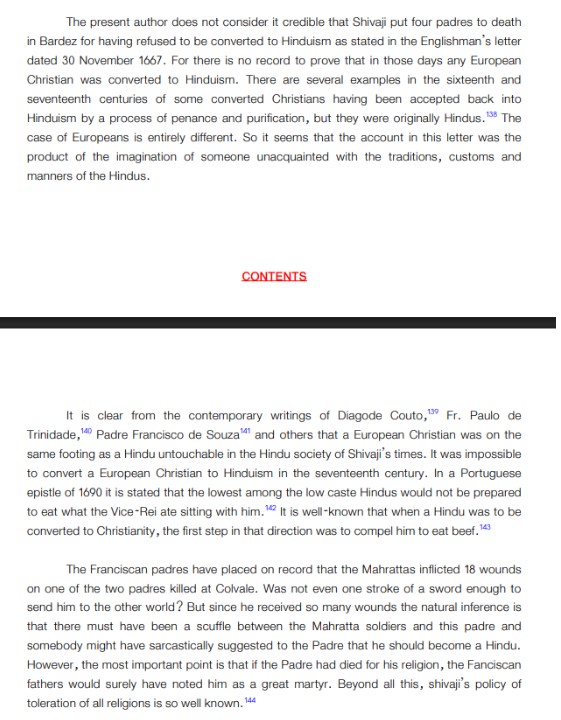
Book from the Maharashtra State Literature and Culture Board, Author: Dr. P.S. Pisurlenkar
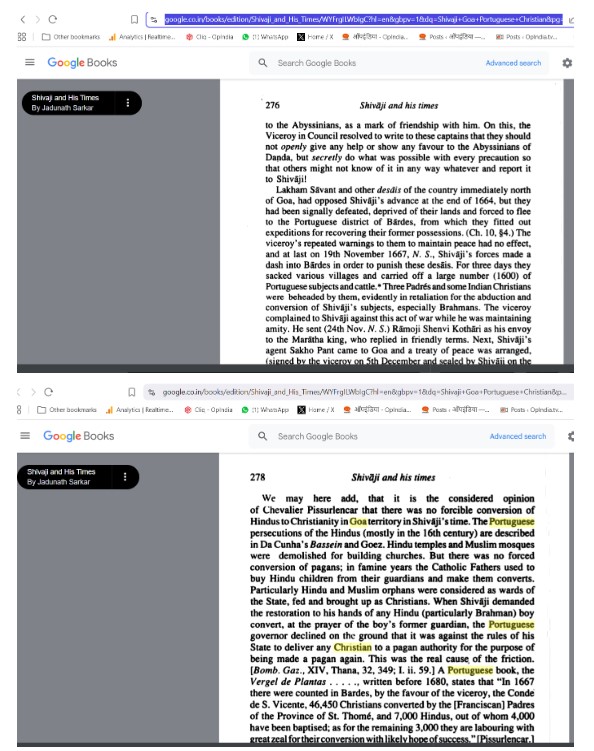
Historian Jadunath Sarkar’s book “Shivaji and His Times”
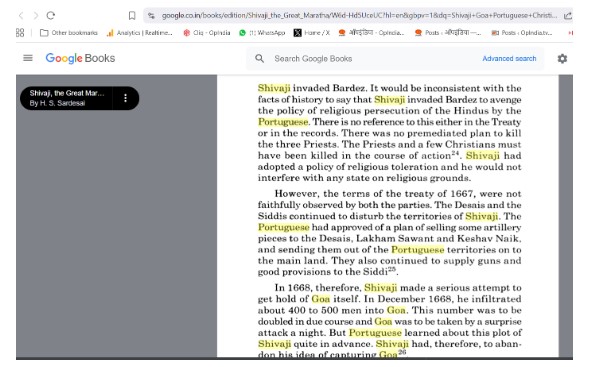
H.S. Sardesai’s book Shivaji the Great Maratha
Historian Pisurlenkar explains that Shivaji Maharaj attacked Bardezi in Goa because the Portuguese had sheltered his enemy there. In this attack, two priests were also killed because back then, priests didn’t just do church work; they were skilled soldiers too, participating in wars. Portuguese historians even wrote that if Shivaji’s intent had been to kill priests, why were only two killed? The number should have been much higher.
Historian Jadunath Sarkar also attributes Shivaji’s attack on Bardezi to the sheltering of his enemy. According to him, three priests were killed. Here, the abduction and forced conversion of Hindus and Brahmins is also cited as a reason. Even if we take this history as true, it was a battle for power and sovereignty, a fight for every citizen to practice their religion without fear. But nowhere is there mention of forcibly converting Christian priests to Hindus and slitting their throats upon refusal.
H.S. Sardesai mentions the death of 3 priests in his book. He states there was no premeditated intent to kill priests in battle; it likely happened during natural combat reactions. While mentioning Shivaji, he also highlights his faith in all religions and his discrimination-free governance.
Chhatrapati Shivaji Maharaj was devoted to the saffron. He should be remembered as the valiant warrior who stood against foreign invaders. At the same time, it’s essential to counter false and fabricated narratives with facts.
.png)


.jpg)