All You Need to Know About How RSS Fought Indira’s Emergency and Continues to Help India in Every Disaster

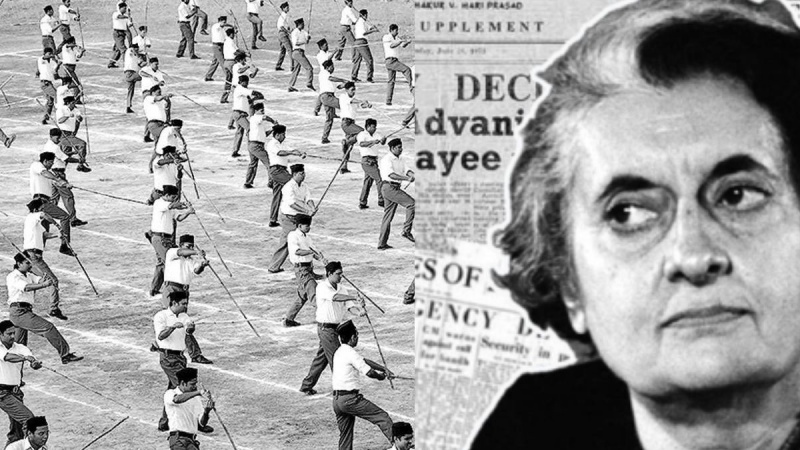
While RSS and Jana Sangh (their political wing) were banned immediately after the Emergency was proclaimed on 25 June 1975, thousands of cadres were jailed, but senior leaders engaged in covert deals to secure parole, cooperation, and even formal alignment with Indira Gandhi’s regime.
Thousands of RSS and Jana Sangh cadres were jailed immediately after the Emergency was declared on 25 June 1975 because the Indira Gandhi-led government saw them as a serious ideological and political threat.
Why were they targeted and imprisoned?
1. RSS’s Wide Network and Influence
- The RSS had a massive grassroots presence with lakhs of swayamsevaks (volunteers) across India.
- It was one of the few organisations that could mobilise people quickly without state support.
- The government feared it could lead to a civil resistance or underground movement against the Emergency.
2. Political Opposition Through the Jana Sangh
- Jana Sangh, the political wing of the RSS, was a vocal critic of Indira Gandhi’s leadership.
- Many of its leaders were aligned with Jayaprakash Narayan’s call for Total Revolution, which called for removing Indira Gandhi democratically.
- The RSS and Jana Sangh were thus painted as instigators of dissent and unrest.
3. Preemptive Crackdown on Organised Opposition
- Indira Gandhi’s government launched preventive arrests under MISA (Maintenance of Internal Security Act) to crush any opposition.
- As part of this crackdown, thousands of RSS volunteers, Jana Sangh leaders, and even those only loosely affiliated were arrested, often without charges or trials.
- Their organisational discipline and history of swift mobilisation made them a prime target for the regime.
4. Suspicion of Underground Anti-Emergency Activities
- Even though the RSS wasn’t directly engaged in violent resistance, the government accused it of circulating underground literature, spreading anti-Emergency sentiment, and supporting civil disobedience.
- Any form of moral or ideological resistance to the Emergency was seen as treasonous by the regime.
Organization and morale in jails
- RSS swayamsevaks introduced yoga, culture sessions, music, wrestling, and bhajans inside prisons, fostering unity and mental resilience.
Top Reasons Behind Declaring an Emergency
- Allahabad High Court Verdict
On 12 June 1975, the Allahabad High Court found Indira Gandhi guilty of electoral malpractice and disqualified her from Parliament for six years, triggering a major political crisis.
- Internal Disturbance Declared
Citing “internal disturbances,” Gandhi invoked Article 352. This was the first time this vague clause was used, instead of war or external aggression, raising serious constitutional concerns. Indian Express
- Power Centralisation & Sanjay Gandhi’s Influence
Sanjay Gandhi, Indira’s son, had begun the controversial five-point programme (forced sterilizations, slum demolitions). This marked a period of increasing authoritarian influence over the government.
- Bypassing Cabinet & Presidency
The proclamation was issued late at night, on Indira Gandhi’s personal advice, without prior cabinet approval; only later did the president and cabinet retroactively endorse it. Hans India
- Fear of Mounting Opposition
Mass protests led by Jayaprakash Narayan and others had gained momentum. The regime feared an unstoppable opposition movement that could topple Congress.
RSS chief Balasaheb Deoras (Sarsanghchalak) wrote multiple letters from prison praising Indira Gandhi’s moves, including praising her Judicial victory and urging support for her 20-point programme, while seeking the lifting of the ban on RSS.
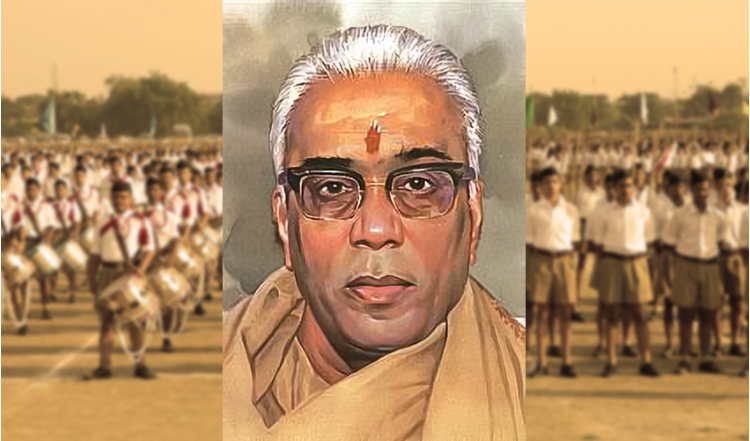
3. Who was RSS Chief Balasaheb Deoras?
Balasaheb Deoras, also known as Madhukar Dattatraya Deoras, was the third Sarsanghchalak (chief) of the Rashtriya Swayamsevak Sangh (RSS). He played a crucial role in shaping the ideological and political direction of the RSS during a critical phase in Indian history.
Role During the Emergency (1975–77)
- Balasaheb Deoras was arrested on June 30, 1975, shortly after the Emergency was declared by Prime Minister Indira Gandhi.
- He was imprisoned but remained an important ideological figure during this period.
- Under his leadership, RSS worked underground and extended support to mass civil resistance efforts, especially through the Lok Sangharsh Samiti.
- He is also known to have written several letters to Indira Gandhi from jail, praising some of her speeches and seeking the removal of the ban on RSS in exchange for cooperation.
- In late 1976, RSS leadership (Madhavrao Mule, Dattopant Thengadi, Moropant Pingle) agreed on a formal “document of surrender”, pledging full support to the Emergency government once their cadres were freed. .
Letters from Deoras to Indira Gandhi:
- 22 Aug 1975: Praised Gandhi’s Aug 15 speech, sought ban’s lift, no mention of opposing Emergency
- 10 Nov 1975: Congratulated her Supreme Court vindication and offered organizational cooperation.
International Observations:
Outlets like The Economist (Jan 1976) reported that Jana Sangh and RSS cadres were key “shock troops” of an underground alliance, estimating 80,000 in jail, yet leadership cooperated quietly.
5. How RSS Saved the Constitution and Democracy During the Emergency
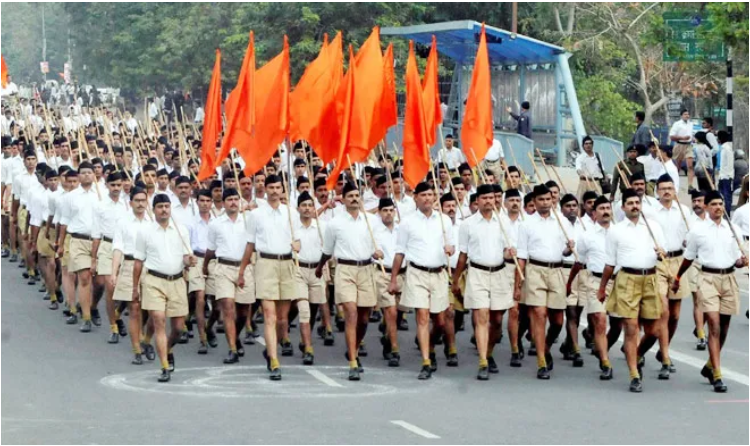
- Among the various resistance movements that emerged during this period, the role of the Rashtriya Swayamsevak Sangh (RSS) stands out as particularly significant.
- The RSS leveraged its extensive network to create clandestine communication channels to networks to disseminate information, counter government propaganda and maintain the morale of the resistance fighters.
- Amidst the suppression of political opposition and mass incarcerations, the 42nd Amendment to the Constitution was passed in 1976, introducing the terms “socialist” and “secular” into the Preamble.
- The role of the RSS during the Emergency did not go unnoticed on the global stage. Various international leaders and newspapers lauded the organization for its relentless fight for democracy and civil liberties.
ALSO READ: “Karyakarta Vikas Varg – II, Closing Ceremony”
- Foreign media recognition
The Economist (Jan 1976) reported that the RSS and Jana Sangh were the shock troops of a four-party underground resisting the Emergency
- Mass Satyaagraha participation
- RSS helped organize the “Lok Sangharsh Samiti”, leading mass civil disobedience with over 100,000 swayamsevaks arrested
- Estimates indicate 25,000–80,000 RSS volunteers jailed under MISA/DIR
- Organised Underground Resistance
RSS quickly adapted its shakha network into a secret resistance apparatus, overseen by leaders like Ravindra Varma and Dattopant Thengadi, who evaded arrest and coordinated nationwide underground efforts through “Lok Sangharsh Samiti” cells.
- Mass Civil Disobedience Participation
Over 100,000 RSS volunteers joined satyagraha, with more than 25,000 detained under MISA, highlighting that RSS formed the largest organised group resisting the Emergency.
- Clandestine Publication and Networking
Under strict censorship, RSS functionaries printed and distributed underground journals like Kurukshetra, Sangharsh, Satyavani, and Satya Samachar using mobile cyclostyle presses and secret locations.
6. How RSS Continues to Serve the Nation: Recent Examples of Selfless Service
Chennai Floods (Dec 2015)
What happened? In late November–early December 2015, Chennai and surrounding districts faced unprecedented rainfall leading to massive floods. About 1.8 million people were affected, ~470 killed, and over 40,000 displaced.
How it happened: A week of nonstop downpours overwhelmed city reservoirs and rivers. Poor drainage and forced dam releases worsened flooding.
What did RSS/Seva Bharati do? Deployed ~5,900 volunteers across 15 operational units
Distributed ~1.2 million food packets; provided water, medicines, and clothing
Assisted rescue missions with NDRF, army, and local authorities, helped evacuate hundreds from hotspots like Mudichur, Mannivakkam, Perambur, and Kolathur.
How they did it: Organized into focused teams: Rescue, Medical, Relief distribution, Food preparation, Coordination, and Counselling. Set up kitchens in 75 locations; e.g., ~12,500 chapatis at one site, 5,000 packets in Anna Nagar, Perambur, and Kolathur over multiple meals
Kerala Floods (Aug 2018)
What happened? In mid-August 2018, Kerala endured massive rainfall, over 400 mm in just 3 days, and unprecedented floods, claiming more than 440 lives and causing economic loss exceeding $3 billion.
How it happened: Extreme rainfall (Aug 15–17) led to dam overflows (35+ gates at Idukki opened), causing rivers to burst.
What did RSS/Seva Bharati do? RSS deployed ~10,000 volunteers; 4,000–5,000 actively took part in rescue missions during critical initial 2 weeks.
Seva Bharati claims rescuing 75,600 people; operated ~350 boats, 75 ambulances, 600 vehicles. Opened 298 relief camps, managed medical teams (650+ health professionals), distributed 2,155 tonnes of grains, and aid to 105,000 families. Lead large-scale cleaning efforts: ~120,000 activists cleaned ~27,600 houses, 400 hospitals, places of worship, wells.
How they did it:
- Rapid identification of worst-affected districts; dispatched teams accordingly.
- Structured into rescue, relief, medical, sanitation, cleaning, and rehab cells. Employed boats and ambulances for evacuation.
- Two volunteers lost their lives; ~40 were injured during high-risk missions.
Other Instances
RSS’s Relief Work During Natural Disasters Odisha Cyclone (Fani – 2019): RSS swayamsevaks were among the first to reach affected areas. They distributed food, cleared roads, and helped rebuild homes. Organiser
RSS’s Role in the Kedarnath Flood Rescue & Relief (June 2013)
- Frontline Rescue & Relief Efforts RMS swayamsevaks, alongside the Indian Army, ventured into extremely hazardous regions, braving blocked and washed-out roads, to rescue and aid thousands of stranded pilgrims across areas like Kedarnath, Rudraprayag, and Rishikesh.
- Extensive Relief Camps They set up numerous relief camps in places such as Joshimath, Badrinath, Chamba, and Haridwar, providing stranded people with food, shelter, medical care, and drinking water.
- Logistical Support in Challenging Terrain In several remote villages where vehicles couldn’t pass, RSS volunteers walked for kilometers with relief supplies, assisting evacuees and transporting essentials on foot.
- Collaboration with Authorities They coordinated closely with the Indian Army, ITBP, and NDRF in rescue missions involving medical aid posts, evacuation arrangements, and helicopter operations.
RSS During the COVID-19 Pandemic
- Volunteers distributed over 2 crore food packets across states.
- Organised plasma donation drives, provided PPE kits, masks, and helped cremate COVID victims where families were absent.
- Ran helplines in various cities to connect patients with hospitals and oxygen suppliers.
Support to Marginalised Communities
RSS works through its affiliated organisations like Seva Bharati to run free coaching for poor students, open healthcare clinics, and vocational training centres for tribal and backward communities.